
Formula feeding your newborn? Learn how to make it work seamlessly with the Babywise eat/wake/sleep routine — from how much to feed and choosing the right formula, to paced bottle feeding and maintaining your supply while supplementing.

Whether you’ve chosen formula from the start, are supplementing breastfeeding, or have transitioned from the breast, formula feeding your newborn can absolutely work beautifully within the Babywise eat/wake/sleep routine. This guide covers everything you need to know — from choosing a formula to paced bottle feeding — so you can feel confident, informed, and fully supported in your feeding journey.
Formula Feeding and the Babywise Philosophy
One of the most reassuring things about Babywise is that the eat/wake/sleep cycle is completely compatible with formula feeding. In fact, formula digests slightly slower than breast milk, which can make it even easier to maintain consistent 2.5–3 hour feeding windows in the early weeks.
The core Babywise principle remains the same whether you’re nursing or bottle feeding:
Feed → Wake Time → Sleep
You begin each cycle with a full feeding, follow with age-appropriate wake time, and then put baby down drowsy but awake for a nap. The predictability of this rhythm benefits both baby and parent — and formula feeding fits naturally into that structure.
How Often to Feed a Formula-Fed Newborn
Following Babywise principles, aim to feed your newborn every 2.5 to 3 hours during the day, measured from the start of one feeding to the start of the next.
Newborn Feeding Schedule at a Glance
| Age | Feeding Frequency | Feedings Per Day |
|---|---|---|
| 0–2 weeks | Every 2–2.5 hours | 8–10 |
| 2–4 weeks | Every 2.5–3 hours | 8 |
| 4–8 weeks | Every 3 hours | 7–8 |
| 2–3 months | Every 3–3.5 hours | 6–7 |
| 3–4 months | Every 3–4 hours | 5–6 |
Note: In the very first days, your newborn may need to eat every 2–2.5 hours to establish weight gain. Once your baby regains birth weight (typically by 2 weeks), you can begin working toward the 2.5–3 hour schedule.
Night feedings: Babywise does not recommend restricting nighttime feedings in the newborn stage. Feed on demand at night until your pediatrician confirms baby is gaining weight well and you can begin gently extending stretches.
How Much Formula to Feed
A common question among new parents is how much formula to offer. Here are reliable starting points:
General Formula: 2.5 oz Per Pound of Body Weight Per Day
Divide that daily total across your scheduled feedings.
Example: A 9-pound baby needs approximately 22–23 oz per day. Divided across 7–8 feedings, that’s roughly 2.5–3.5 oz per feeding.
Feeding Amounts by Age
| Age | Amount Per Feeding | Feedings Per Day |
|---|---|---|
| 1–2 weeks | 1–3 oz | 8–10 |
| 2–4 weeks | 2–4 oz | 8 |
| 1–2 months | 3–5 oz | 7–8 |
| 2–4 months | 4–6 oz | 6 |
| 4–6 months | 5–7 oz | 5–6 |
Signs Baby Is Getting Enough
- 6–8 wet diapers per day after day 4
- Steady weight gain (approximately 5–7 oz per week in the first few months)
- Calm and content between feedings (not rooting or fussing constantly)
- Reaching feeding-time hungry, not frantic
Always follow your pediatrician’s guidance on amounts, especially in the early weeks. These are general guidelines, not prescriptions.
How to Choose a Formula
Walking down the formula aisle can feel overwhelming. Here’s how to make sense of your options.
Types of Formula
Cow’s Milk-Based Formula: This is the most common type and is appropriate for most healthy newborns. Look for formulas that are iron-fortified — the AAP recommends iron-fortified formula for all formula-fed babies. Examples: Similac Advance, Enfamil NeuroPro, Earth’s Best Organic.
Gentle or Partially Hydrolyzed Formula: Proteins are partially broken down, making it easier to digest. A good option if your baby seems gassy, fussy, or uncomfortable on standard formula. Examples: Gerber Good Start Gentle, Enfamil Gentlease, Similac 360 Total Care Sensitive.
Hydrolyzed (Hypoallergenic) Formula: Proteins are extensively broken down for babies with confirmed or suspected cow’s milk protein allergy (CMPA). Typically recommended by a pediatrician. Examples: Nutramigen, Alimentum, Pregestimil.
Soy-Based Formula: Appropriate for families following a vegan lifestyle or for babies with lactose intolerance (rare in newborns). Not recommended as a first-line treatment for cow’s milk protein allergy, as many babies with CMPA are also sensitive to soy. Examples: Enfamil ProSobee, Similac Soy Isomil.
Specialty Formulas: For premature babies, metabolic conditions, or reflux — always used under pediatric guidance.
Formula Form: Ready-to-Feed vs. Powder vs. Concentrate
- Ready-to-Feed (RTF): Most convenient, most expensive, sterile. Great for newborns, travel, or middle-of-the-night feedings.
- Powdered: Most economical and widely available. Always mix with safe water (boiled and cooled, or filtered) in the amounts specified on the can.
- Liquid Concentrate: Mix 1:1 with water. A middle ground in cost and convenience.
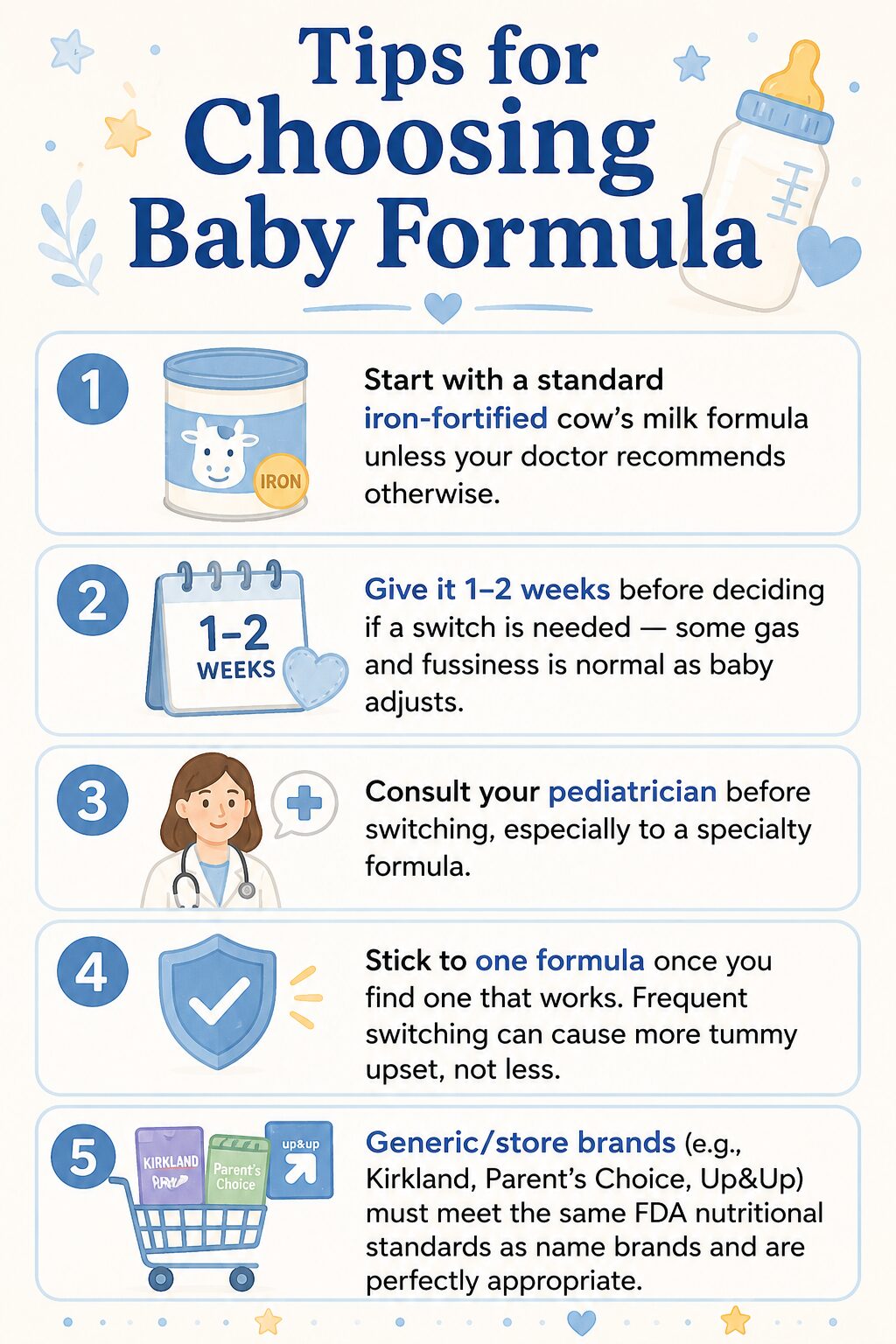
Tips for Choosing
- Start with a standard iron-fortified cow’s milk formula unless your doctor recommends otherwise.
- Give it 1–2 weeks before deciding if a switch is needed — some gas and fussiness is normal as baby adjusts.
- Consult your pediatrician before switching, especially to a specialty formula.
- Stick to one formula once you find one that works. Frequent switching can cause more tummy upset, not less.
- Generic/store brands (e.g., Kirkland, Parent’s Choice, Up&Up) must meet the same FDA nutritional standards as name brands and are perfectly appropriate.
Paced Bottle Feeding: The Babywise-Friendly Way to Bottle Feed
Paced bottle feeding is a technique that mimics the natural flow and pace of breastfeeding. It’s beneficial for all formula-fed babies and essential if you are combination feeding (more on that below).
Why Paced Bottle Feeding Matters
A bottle nipple flows much faster than the breast, which can cause babies to:
- Overeat before their hunger signals catch up
- Develop a preference for the bottle over the breast (bottle preference/nipple confusion)
- Swallow excess air, leading to gas and discomfort
Paced feeding puts baby in control of the feeding and supports healthy hunger/fullness cues — perfectly aligned with Babywise’s goal of a baby who feeds well and is content between feedings.
How to Do Paced Bottle Feeding
- Hold baby in a more upright position (45–60 degrees), not reclined.
- Use a slow-flow nipple — keep using slow flow longer than you think. Most babies do well on slow flow until 4–6 months or even longer.
- Tickle the lips with the nipple and wait for baby to open wide and latch on, rather than inserting the bottle.
- Hold the bottle horizontally (parallel to the floor), so baby has to actively suck to get milk and can pause.
- Pause every 20–30 sucks by tipping the bottle down or removing it briefly — this mimics the natural let-down pauses at the breast.
- Watch for fullness cues, which include slowing suck, turning head away, pushing nipple out with tongue, and relaxed hands. Stop when baby signals done — don’t encourage them to “finish the bottle.”
- A feeding should take 10–20 minutes. If baby is draining the bottle in under 5 minutes, the nipple flow may be too fast.
Combination Feeding: Breastfeeding and Formula Together
Combination feeding (also called supplementing) means offering both breast milk and formula. It’s more common than many parents realize, and with the right approach, it can work well within the Babywise routine.
Reasons Parents Combination Feed
- Low milk supply
- Difficulty latching or breastfeeding challenges
- Maternal health or medication needs
- Returning to work
- Wanting a partner to share in feedings
- Personal preference
How to Combination Feed
There is no single right way. Options include:
Option 1: Breastfeed First, Top Off with Formula: Nurse baby at the breast for a full feeding, then offer a small amount of formula (1–2 oz) if baby still seems hungry. This keeps breast milk as the primary source while ensuring baby is satisfied.
Option 2: Designate Certain Feedings as Formula: Some parents nurse at some feeds and give a full formula bottle at others. For example: nurse in the morning, formula at the evening feeding, nurse at night. This can help with scheduling and allows another caregiver to help.
Option 3: Mix Breast Milk and Formula: You can mix expressed breast milk and formula in the same bottle. Mix formula first according to directions, then add breast milk. Note: you cannot re-refrigerate a bottle of mixed formula/breast milk once started.
Combination Feeding Within the Eat/Wake/Sleep Cycle
The method of feeding doesn’t change the Babywise framework. Whether you nurse, bottle-feed pumped milk, or give formula, you:
- Start each cycle with a full feeding
- Keep baby awake during and after the feeding for age-appropriate wake time
- Put baby down for a nap and repeat
The predictability of the schedule actually supports combination feeding because you can plan which feedings will be at the breast and which will be bottles.
How to Maintain Your Milk Supply While Supplementing
This is one of the most common concerns for breastfeeding moms who begin supplementing. The key principle to understand is: milk supply works on a supply-and-demand basis. The more milk is removed from the breast (by nursing or pumping), the more your body produces.
When formula replaces a feeding at the breast, your body receives less demand — and supply can dip. Here’s how to protect your supply:
Strategies to Maintain Supply While Supplementing
1. Nurse or Pump at Every Feeding: Even if you’re offering formula after a nursing session, put baby to breast first. Alternatively, pump when baby takes a full formula bottle. Replacing a nursing session entirely with formula without pumping will signal your body to reduce production for that time slot.
2. Pump After Nursing: After baby finishes at the breast, pump for 10–15 minutes. This additional stimulation sends a strong demand signal to your body and can help increase supply over time. It also builds a freezer stash.
3. Offer the Breast Before the Bottle: This ensures your body receives stimulation at every feeding, even if baby also takes a formula top-off.
4. Avoid Skipping the Breast Entirely: If you must skip a nursing session (due to work, schedule, etc.), pump at that time to maintain the demand signal.
5. Use a Hospital-Grade or Double Electric Pump: A good pump makes a significant difference in supply maintenance when you’re not nursing at every feeding.
6. Stay Hydrated and Nourished: Dehydration and caloric deficit can directly impact supply. Aim for plenty of water and adequate calories throughout the day.
7. Watch Your Supplement Amount: The more formula you supplement, the greater the impact on supply. If your goal is to increase breastfeeding and decrease formula over time, work with a lactation consultant to create a plan for gradually reducing formula as supply builds.
8. Work with an IBCLC: If supply is a concern, an International Board Certified Lactation Consultant is your best resource. They can help identify the root cause of low supply and create a tailored supplementation plan.
Signs Your Supply Is Decreasing
- Baby seems hungry sooner before scheduled feedings
- Fewer wet diapers from breast milk alone
- Breasts feel less full or don’t experience let-down
- Pumped output decreasing
If you notice these signs, increasing nursing and pumping frequency is the fastest way to build supply back up.
Practical Formula Feeding Tips for Babywise Families
Prep bottles ahead of time. Powdered formula can be mixed and refrigerated for up to 24 hours. Having bottles ready removes stress from the feeding portion of your routine and keeps you on schedule.
Use a bottle warmer. Most babies tolerate room temperature or slightly warmed formula better than cold. A consistent temperature also helps baby associate the bottle with a satisfying, comfortable feeding.
Burp frequently. Formula-fed babies tend to swallow more air than breastfed babies. Burp mid-feeding (after every 1–2 oz) and at the end of the feeding to reduce gas and spit-up.
Keep a feeding log in the early weeks. Tracking ounces offered, ounces taken, and wet/dirty diapers helps you ensure baby is eating enough and gives your pediatrician useful data at well-child visits.
Be consistent with nipple flow. Don’t jump to faster-flow nipples too quickly. A slower flow keeps baby working appropriately for milk and supports healthy feeding duration.
Don’t prop the bottle. Always hold your baby during feedings. Beyond safety (choking risk), this is important bonding time and allows you to watch for fullness cues.
A Sample Formula Feeding Schedule (8-Week-Old)
Here’s an example of how formula feeding fits into a Babywise eat/wake/sleep routine for a 2-month-old on a 3-hour schedule:
| Time | Activity |
|---|---|
| 7:00 AM | Feed – 4–5 oz formula |
| 7:30 AM | Wake time – play mat, interaction |
| 8:00 AM | Sleep – first nap |
| 10:00 AM | Feed – 4–5 oz formula |
| 10:30 AM | Wake time |
| 11:30 AM | Sleep – second nap |
| 1:00 PM | Feed – 4–5 oz formula |
| 1:30 PM | Wake time |
| 2:15 PM | Sleep – third nap |
| 4:00 PM | Feed – 4–5 oz formula |
| 4:30 PM | Wake time |
| 5:15 PM | Sleep – catnap |
| 7:00 PM | Feed – 4–5 oz formula |
| 7:30 PM | Bedtime routine |
| 8:00 PM | Bedtime |
| ~1–4 AM | Night feeding as needed |
This is a guide, not a rigid script. Your baby may need slight adjustments based on their individual hunger cues and growth.
>>>Read: Sample Schedules for a Formula Fed Baby
When to Call Your Pediatrician
Contact your baby’s doctor if you notice:
- Fewer than 6 wet diapers per day after day 5
- Baby is not back to birth weight by 2 weeks
- Baby consistently refuses feedings or takes very little
- Persistent vomiting (not just normal spit-up) after feedings
- Blood in stool, rash, or signs of an allergic reaction
- Extreme fussiness or inconsolable crying that doesn’t resolve
- Baby seems lethargic or difficult to wake for feedings
Conclusion
Formula feeding is a valid, loving, and nourishing choice — and it fits beautifully into the Babywise eat/wake/sleep framework. As they say, fed is best! Whether you’re exclusively formula feeding, combination feeding, or supplementing while working to build supply, the principles are the same: feed your baby well, help them learn healthy sleep patterns, and give yourself grace through the process.
Every family’s feeding journey looks different, and the most important thing is that your baby is growing, thriving, and loved.
Have questions about your formula feeding schedule? Drop them in the comments below! And if you found this post helpful, share it with a fellow Babywise mom who might need it.
Related Posts
- Sample Schedules for a Formula Fed Baby
- How To Wean Baby from Breast, Bottle, and Formula
- The Basics of a Dreamfeed
- How to Successfully Introduce a Bottle to Your Breastfed Baby (Even When Starting Late)
- Parent Directed Feeding (Babywise PDF) Explained
- Hunger Cues: How To Know if Baby Is Hungry
- Reasons for Feeding Baby Sooner than 2.5 Hours