Shoe tying: the milestone that tests every parent’s patience! Learn the best age to start, two foolproof methods kids love, and tips to make it click — without the tears (yours or theirs).
There’s a moment every parent knows well: your child is sitting on the floor, laces flopping everywhere, looking up at you with a mix of determination and defeat. Shoe tying is one of those classic childhood milestones — and while it might seem simple to us, it’s actually a surprisingly complex task for little hands and developing brains.
The good news? With the right timing, a little patience, and a method that works for your child, this skill is very teachable. Here’s everything you need to know.
When Should You Start Teaching?
Most children are ready to learn to tie their shoes somewhere between ages 5 and 7. Before diving in, check that your child can:
- Tie a basic knot (crossing laces over and pulling through)
- Use scissors with some control
- Button and zip their own clothing
If your child is struggling with those basics, it’s worth waiting a few months before introducing shoelaces. Trying too early can lead to frustration on both sides — and that’s the last thing we want associated with a life skill.
You will probably feel a lot of pressure for your child to know how to tie their own shoes as they enter Kindergarten. When you imagine tying 20 kiddos’ shoes each day (adding up to 40 shoes), you can see why a teacher would really appreciate this milestone being met.
If your child is entering school and can’t tie shoes yet, simply send your kiddo to school in shoes that do not require tying. There are plenty of options!
Set the Stage for Success
Before the first lesson, a little preparation goes a long way.
Choose the right shoes. Practice shoes with long, flat laces are much easier than slippery round ones. Some parents buy an inexpensive pair specifically for practice. You can also find lacing practice boards and frames — great for little ones who get frustrated tying on an actual foot.
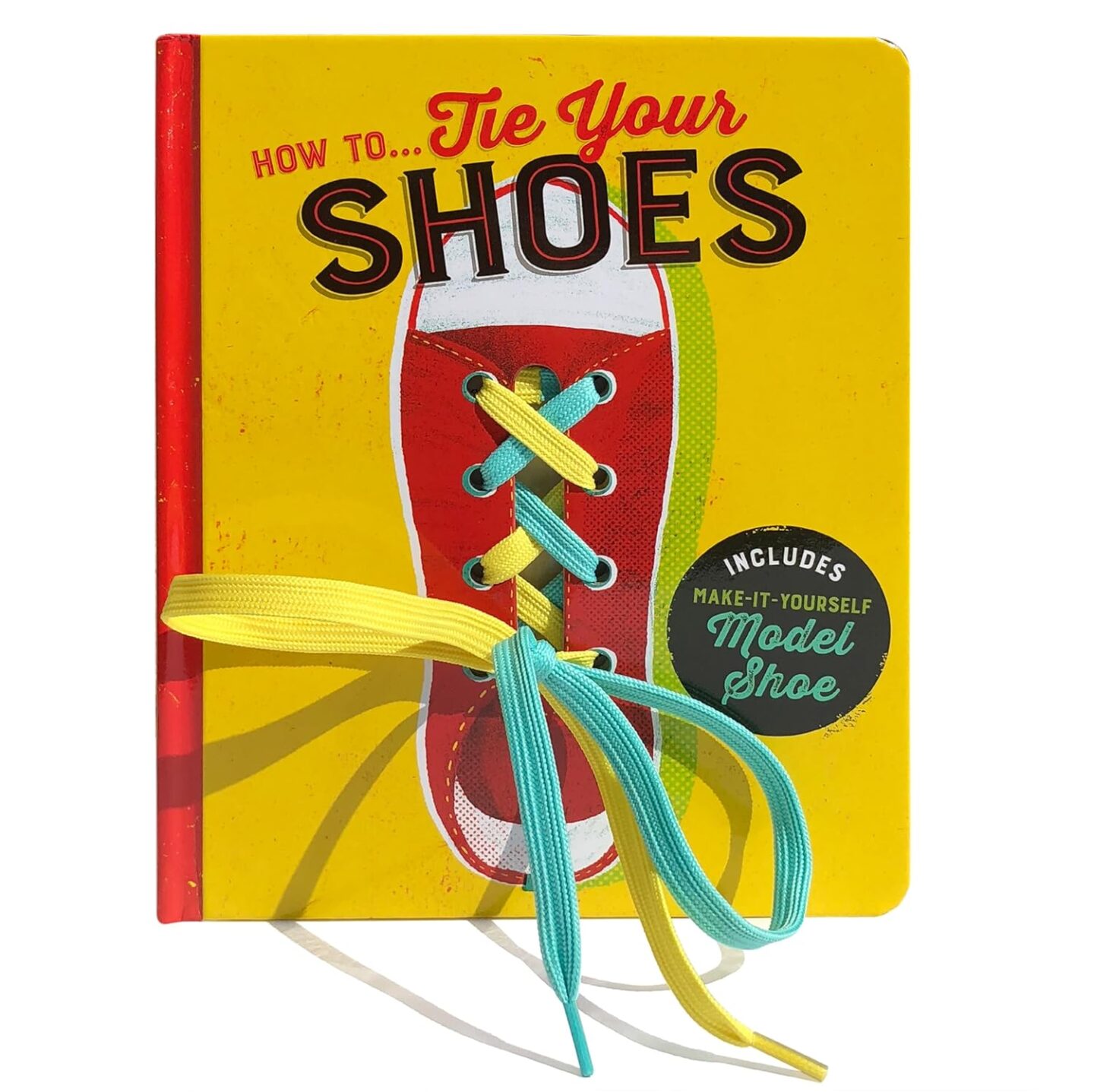
You can try this book or this one for fun practice helps! (affiliate links)
Pick the right moment. Don’t try to teach this on a rushed school morning. Choose a calm, unhurried time when your child is in a good mood and not hungry or tired. Remember to do Training in Times of Non-Conflict
Sit side by side, not across. This is a big one. If you face your child while demonstrating, the directions are reversed — which is deeply confusing! Sit beside them or behind them so they see the laces from the same angle you do.
The Two Most Popular Methods
Here are the two most popular methods for teaching kids to tie their shoes.
Method 1: The Traditional “Bunny Ears” Method
This is the classic approach and works great for younger children or those who struggle with fine motor control.
- Cross the right lace over the left and pull it through to make a basic knot. Pull it snug.
- Make a loop (a “bunny ear”) with each lace.
- Cross the right loop over the left loop.
- Push the right loop under the left loop and pull both loops tight.
The trick here is holding both loops at their bases while pulling them through — that’s where little fingers often get tangled. Let your child practice steps 3 and 4 over and over before putting the whole sequence together.
Method 2: The “Ian Knot” or Loop-Swoop-and-Pull
This single-loop method is often faster once mastered, and many kids find it more intuitive.
- Cross the laces and pull through to make a starting knot.
- Make one loop with the right lace.
- Wrap the left lace around the base of the loop and push it through to create a second loop.
- Hold both loops and pull tight.
Some children take to this method faster because it involves fewer steps to remember. If the bunny ears aren’t clicking after a week or two, give this one a try.
Teaching Tips That Actually Work
Break it into stages. Don’t expect your child to master all the steps in one sitting. Spend one session on just the first knot. Then, once that’s solid, move on to the loops. Trying to teach everything at once overwhelms most kids.
Use a rhyme or a story. The bunny ears method has been passed down for generations partly because the rhyme makes it memorable: “Cross the rabbit over the hole, around the tree and through the hole!” Silly as it sounds, narrative anchors help kids remember the sequence.
Let them practice on your shoes. Tying laces on a shoe that’s sitting still on the floor is much easier than tying on a moving foot. Let your child practice on your shoes — or theirs — while the shoe is off their foot.
Go slow and go backwards. Hand-over-hand guidance works for some kids, while others do better watching and copying. Try both. Also consider working backwards through the steps (a technique called “backward chaining”) — let your child only do the final tug at first, then gradually take on more steps as their confidence builds.
Celebrate effort, not perfection. A lopsided, loose bow is still a bow! Praise the attempt, not just the outcome. Confidence is what moves a child from can’t to can.
What If My Child Is Really Struggling?
Some children have genuinely harder times with shoe tying — especially those with sensory processing differences, fine motor delays, or dyslexia (which can affect sequencing). If your child has been practicing consistently for several months with little progress, it’s worth mentioning to their pediatrician or an occupational therapist.
In the meantime, there are great alternatives: elastic no-tie laces, magnetic closures, or velcro shoes can keep your child independent while fine motor skills continue to develop. There’s no shame in using these tools — independence in getting out the door matters more than the method.
A Realistic Timeline
Most children who are developmentally ready will go from “no idea” to “tying with help” in about 2–4 weeks of regular practice. True independence — tying without reminders or assistance — usually comes a few weeks to a couple of months after that, especially as they get faster and stronger.
Don’t compare your child’s timeline to their classmates’. Every child gets there.
Conclusion
Teaching shoe tying takes time, repetition, and a whole lot of patience — from both of you. Keep sessions short and positive (5–10 minutes is plenty), celebrate small wins, and remember that one day it will just click. And then, like every other milestone before it, you’ll wonder how it ever felt so hard.
You’ve got this, mama — and so does your little one.
Did your child have a breakthrough moment while learning to tie their shoes? Share your tips and funny stories in the comments below!
Related Posts
- Seasoned Mom Hacks: 21 Brilliant Tips
- Parenting Hacks from Real Babywise Moms
- Tips for Staying Sane as a SAHM