
Middle school friendships can be wonderful–and complicated. Learn how to help your child navigate friendship drama, handle conflict, set healthy boundaries, recognize good friendships, and build confidence to walk away when needed.
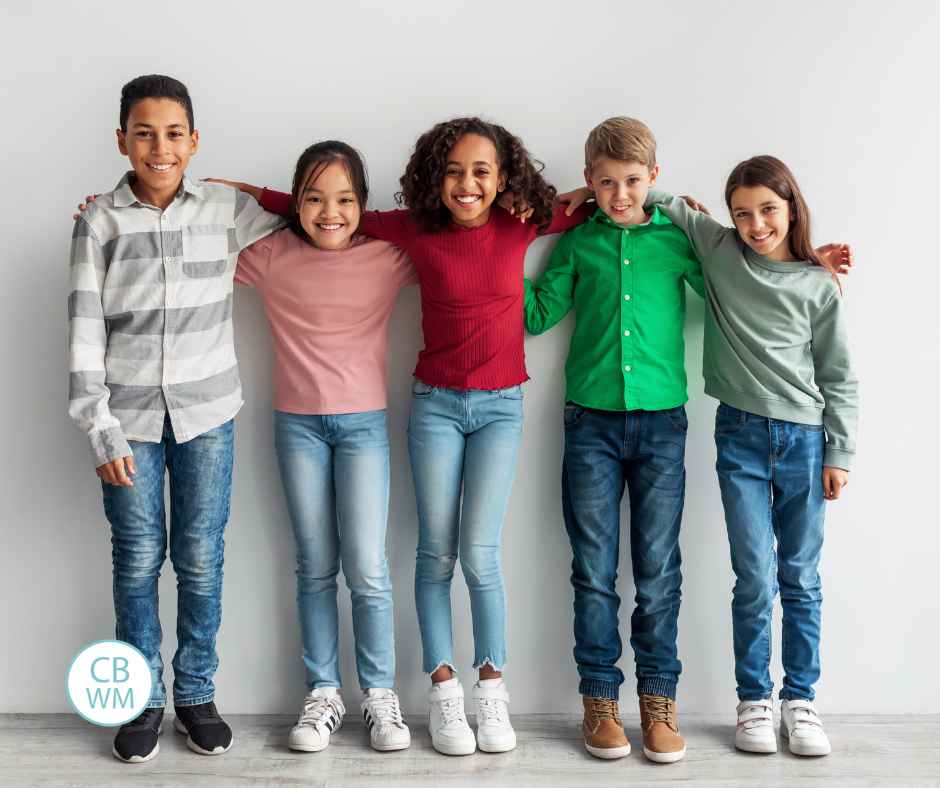
Middle school can be a wonderful season of growth, independence, and new experiences. It can also be a surprisingly complicated time for friendships. A couple of my older kids had such an unpleasant middle school experience that Brinley, my youngest, absolutely dreaded middle school as it approached. In the end, Brinley actually had a wonderful middle school experience with friends, but that is not the case for many middle schoolers.
One day your child may come home excited because she has found her people. The next day she may be in tears because someone left her out of a group chat, said something hurtful, or suddenly decided she wasn’t part of the group anymore. Old friends might ignore her completely, leaving her feeling really confused and sad.
As parents, it can be difficult to know what to do. You want to protect your child, but you also know you can’t, and shouldn’t, solve every friendship problem for them.
The middle school years are an important opportunity to teach children how to navigate relationships, handle conflict, set boundaries, communicate clearly, and recognize what healthy friendship looks like.
Why Friendship Drama Feels So Big in Middle School
Friendship problems aren’t new to childhood, but they can become more intense during the middle school years. Your child likely faced some conflicts during elementary school, but things intensify in middle school.
Children are becoming more socially aware. They care deeply about what their peers think of them, and friendships can feel closely tied to their identity and sense of belonging.
At the same time, middle school friendships can change quickly. Friend groups shift. Tweens develop new interests. Personalities mature at different rates. Some children become more independent while others still want the security of a close-knit group. Some kids care a lot about appearances and being as “popular” as possible, while others care more about connections.
Add texting, social media, group chats, and constant digital communication and there are many more opportunities for misunderstandings and hurt feelings.
Something that might seem small to an adult can feel enormous to a middle schooler.
That doesn’t mean we need to treat every friendship conflict as a crisis (I would actually recommend you do not). It means we need to recognize that these experiences are significant learning opportunities.
Listen Before You Try to Fix It
When your child comes home upset about a friend, your first instinct may be to jump in with advice.
Try to pause.
Listen first.
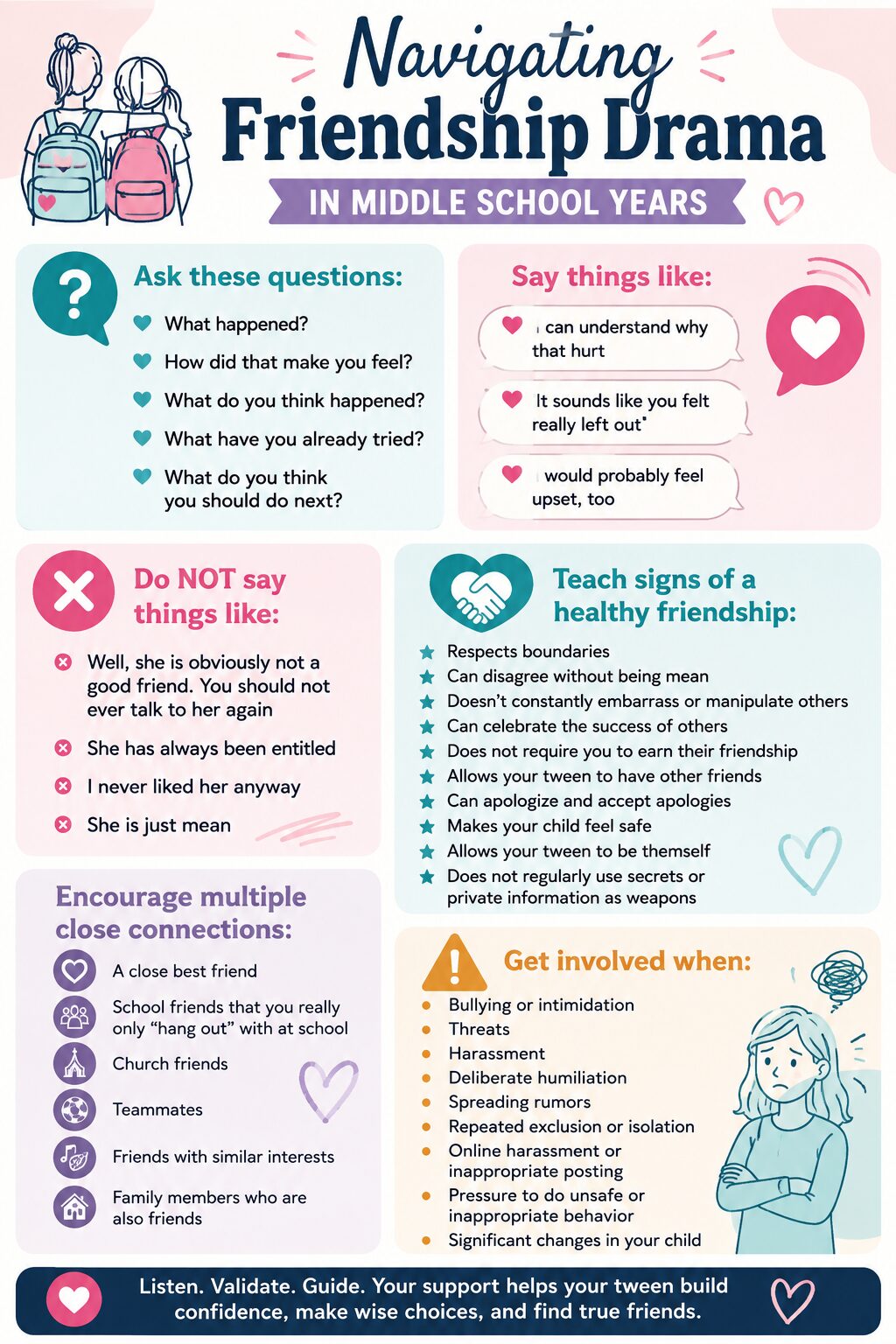
Ask questions such as:
- What happened?
- How did that make you feel?
- What do you think happened?
- What have you already tried?
- What do you think you should do next?
You might discover that your child’s initial interpretation isn’t the whole story. Or you may discover that something genuinely has happened.
Either way, listening gives your child space to process what happened before you start telling them what to do.
Sometimes your child doesn’t need a solution right away. They simply need a safe space to talk and want to be heard.
Validate Feelings Without Automatically Taking Sides
If you are like me, your first instinct will be to go mama bear and tell your child you never liked that friend anyway. Take a breath before you say anything. There is an important difference between validating your child’s feelings and declaring that your child’s friend is a terrible person.
You can say:
- I can understand why that hurt
- It sounds like you felt really left out
- I would probably feel upset, too
But you do not need to say:
- Well, she is obviously not a good friend. You should not ever talk to her again
- She has always been entitled
- I never liked her anyway
- She is just mean
You are on one side of the situation. You do not know the other child’s perspectives nor motives. Middle school friendships can be complicated. Also, there is an excellent chance your child and the friend will make up, which will leave you in an awkward spot.
Your goal isn’t to decide who was right every time. Your goal is to help your child learn how to think through relationships wisely.
Help Your Tween Separate Facts from Feelings
When kids are upset, it is easy for facts and assumptions to become mixed together, with lines blurred.
For example:
Fact: Three girls went to the movies without your daughter
Feeling: They don’t like me anymore
Assumption: They are trying to ditch me
The feeling is real, even if the assumption isn’t necessarily true. Help your tween slow down and ask, “What do you actually know happened?”
This simple habit can prevent a lot of unnecessary drama.
It also teaches an important lifelong skill: Don’t make major decisions based solely on an emotional interpretation of a situation.
Teach Your Child to Communicate Directly
Middle school friendship problems can quickly become bigger when children talk about one another instead of talking to one another.
Encourage your child to address problems directly when appropriate.
Instead of: Everyone knows you’re mad at me
Try: I felt left out when you made plans and didn’t invite me. Did I do something that upset you?
Instead of: You are always so mean to me
Try: Yesterday when you said that in front of everyone, it embarrassed me
Learning to communicate specific concerns is much more productive than making accusations.
Your child doesn’t have to confront every situation. Sometimes walking away is the better choice. But when a relationship matters and a misunderstanding may be involved, direct communication is a valuable skill.
In sports, coaches will often ask that you wait 24 hours before addressing a situation you are upset about. That could be wise advice for your child, also. Encourage them to really think things through and give themselves a chance to calm down before talking to a friend about something they are upset about.
Teach Them They Don’t Have to Win Every Conflict
One of the most valuable lessons you can teach your child that not every disagreement needs to be won. Sometimes the best response is an apology. Sometimes it is forgiveness. Sometimes it is a conversation. Sometimes it is letting something go. And sometimes it is creating distance from someone who consistently treats them poorly.
Healthy relationships require humility. Your child needs to be able to ask, “Was I part of the problem?”
Encourage them to take responsibility when they have done something wrong without teaching them to accept blame for things that are not their fault.
Help Your Child Recognize Healthy Friendship
Kids need more than instructions about how to handle bad friendships. They also need to understand what a healthy friendship looks like. A healthy friend usually:
- Respects boundaries
- Can disagree without being mean
- Doesn’t constantly embarrass or manipulate others
- Can celebrate the success of others
- Does not require you to earn their friendship
- Allows your tween to have other friends
- Can apologize and accept apologies
- Makes your child feel safe
- Allows your tween to be themself
- Does not regularly use secrets or private information as weapons
Friendship does NOT have to be perfect to be healthy. Your tween needs to understand that. Their friends WILL make mistakes. They will cross lines. There will be disagreements. Friends will be moody at times. Humans are not perfect, so human relationships are not perfect. That’s okay.
But there can be signs of an unhealthy relationship. Even two great people might not be great for each other as friends. The question is: when the bad days or moments happen, can the friendship recover, grow, and remain respectful.
Teach Your Child That Being Left Out Isn’t the Same as Being Unlovable
This can be a really hard lesson for a middle schooler. Sometimes your chidl will be excluded. Sometimes it will be intentional and sometimes it won’t.
Sometimes friendships end. That is a very normal thing. A friend they had in elementary school won’t necessarily remain on the same trajectory through middle school. That is okay. People change, friendships change, groups change.
Those experiences definitely hurt, but they do not determine your child’s worth. Remind your child that choosing not to include them doesn’t mean there is something wrong with them. Your child can’t make everyone like them. It just won’t happen.
Instead, have them focus on what they have control over. They can be a good friend. They can look for and foster healthy friendships. They can initiate things to do and invite people along.
Encourage More Than One Friendship
It is really fun to have that one bestie you do absolutely everything with. Your ride-or-die.
The trouble is, sometimes that bestie drifts away as you get older. That is why it is really wise to encourage your child to have more than one friend. Real difficulties arise when your child is completely dependent on one friend.
You don’t even want your child to have lots of friends but feel a responsibility to one friend. To feel like they can’t do anything without that one friend. To feel like they can’t make new friends without the approval of the one friend.
When that friendship is going well, everything is great! When there is conflict, it can feel like the entire social world has collapsed.
Of my four kids, two had a super tight bestie and two had lots of great friends. The two with lots of great friends had a much happier time in middle school. As friendships fluctuated, they still had a friend group. That change didn’t stress them out because they weren’t super connected to just one person.
Encourage your kids to develop several friendships and connections:
- A close best friend
- School friends that you really only “hang out” with at school
- Church friends
- Teammates
- Friends with similar interests
- Family members who are also friends
The broad support system gives children more resilience when one friendship becomes difficult.
When your kids’ friends do things with other friends, do not get all ruffled up and upset that they did things without your child. That is okay! If your child sees you mad that people did things without them, they will get mad. When they see you feeling like it is normal and no big deal, it won’t be a big deal to them.
The reality is you cannot do things with every friend you have every time you ever do something. That is normal life.
If you encourage your tween to participate in activities, clubs, and events that line up with their interests, they will find people who are compatible with them and form new friendships.
Don’t Make Your Child’s Friend Drama Your Drama
Remember how happy you were to leave school drama behind you when you graduated? Maintain that happiness. Do not dive into the drama with your kids.
It can be hard! Mama bear is real! When your child tells you about a mean kid, you want to go all 13-year-old and talk about how terrible of a person that kid is.
Take a deep breath. Remember to be an adult. Remember your child is likely going to forgive them. You will probably live in that drama long after your child has moved on.
Support your child while leaving room for friendships to change and repair. Do not vent to other parents. You wouldn’t want adults talking poorly of your child, so don’t do that to another child. Don’t post online. Always be the example of maturity.
Know When To Get Involved
With that said, sometimes you do need to step in. If you see your child is in an unhealthy friendship, you might need to do something. If you see:
- Bullying or intimidation
- Threats
- Harassment
- Deliberate humiliation
- Spreading rumors
- Repeated exclusion or isolation
- Online harassment or inappropriate posting
- Pressure to do unsafe or inappropriate behavior
- Significant changes in your child
It is time to step in. Some things will require you to step in and navigate things with your child rather than just advise at home. You might need to contact the school, the other parent, or even authorities in extreme cases. Most of the time it will just be you advising your child, “You probably need to seek out some different friends. These friends are really not treating you well and you do not deserve that.”
Do not call the other parents every time there is a conflict. I know you have a little vision of you calling the other mom and letting her know the terrible things her child did to your child. Now, if it really is terrible (like real harassment or bullying), getting adults involved is wise. If it is just that she was left out, this is not a time to call the other mom.
For simple conflicts, your child needs to learn to navigate these. Interpersonal conflict happens with coworkers, roommates, neighbors, teammates, coaches, spouses, and even friends in adulthood. They need to learn how to handle interpersonal conflict. Middle school is a great place to practice. Coach them in healthy ways to handle conflict and how to set up boundaries when needed.
Teach Your Child to Walk Away
Not every friendship needs to be saved. Sometimes it is best to walk away. If things just cannot be worked out and the relationship is repeatedly a source of issues for your child, it is time for some boundaries.
Walking away doesn’t need to be a blow-up. It doesn’t need to be dramatic. It can just be investing less time and energy into the friendship. It can be making new friends. It can be sitting with different friends at lunch. It can be leaving when the conversation turns gossipy. It can be nice school friends and not close at-home besties.
Sometimes the healthiest friendship decision is simply to stop chasing someone who doesn’t want to be a friend.
Model Healthy Relationships at Home
Your child learns a whole lot from you. How do you handle disagreement with your friends? What about with your spouse and other family members, including children? Do you apologize? Do you gossip about others in front of your kids? Do you hold grudges? Do you forgive? Can you disagree respectfully? Can you set healthy boundaries when needed? Do you speak kindly of others? Are you happy for the success of others?
Your kids learn the most from your example. Set a strong example at home.
Give Them a Safe Space To Come Home To
Home should be a safe space where they feel wanted and loved no matter how popular they are, how many friends they have, or how many visible talents they display.
Be available to talk to your kids each day so they can open up to you. Most teens don’t really want to talk until bedtime. If you are able, be mentally prepared for the bedtime talk and unload. Other great times kids will open up is on a walk or when driving somewhere. Family mealtime can also be a time kids will open up.
Make home a haven. This sometimes means you temper your reaction to a frustration you have with them leaving their stuff out again. Be aware of how they are doing emotionally so you do not pile on after a hard day.
You can also make it a safe space by limiting screen time at home and having tech-free time and zones. You can delay social media until they are at least 16 (I HIGHLY recommend this). They need to be able to take a social break and let home be a haven.
The Goal Isn’t to Prevent Friendship Drama
You really can’t. Friendship drama will. come. We want to protect our children from all hard things, but we cannot if we let them experience life. This is a great time to learn those conflict resolution skills.
Sometimes they will mess up and hurt others. Sometimes others will mess up and hurt them. Friends will say mean things. Your child can learn to talk to them about it in a healthy way.
Friendships will change. Some friendships will drift apart. Others will grow stronger.
I honestly think Brinley had the best time in middle school because she was such an emotional child. As a young child, we had to coach her and teach her how to manage her emotions and talk about her feelings in a productive, healthy way.
When her friends did hurtful things in middle school, she talked it out with them. She shared her perspective and got their perspective. Her friends apologized and she apologized. They worked things out and stayed close. It wasn’t big drama. It was all very mature.
She didn’t face fewer issues. She was just already better equipped ot handle the issues.
But most kids don’t develop those skills as elementary kids. They develop them as middle schoolers. So let them develop the skills. Listen. Ask questions. Don’t overreact. Help your child think things through. Coach them. Don’t be dramatic yourself. Let them practice. Because learning how to navigate friendship drama in middle school isn’t just about surviving middle school years. It is preparation for a lifetime of relationships.
Related Posts
- How to Correct Your Preteen
- How to Respond to “Everyone Else is Doing It”
- Should You Correct for Attitude?
- Teach Tweens to Have Respect
- 45 Questions to Get Your Child Talking
- Cell Phone Rules for Teens and Tweens
- Getting Kids to Talk and Open Up to You
- What Age Should Kids Have Social Media Accounts?