
You can set the stage for sleep. You can do everything right. And sometimes your baby still won’t sleep. Here’s how to think about that — and what to actually do about it.
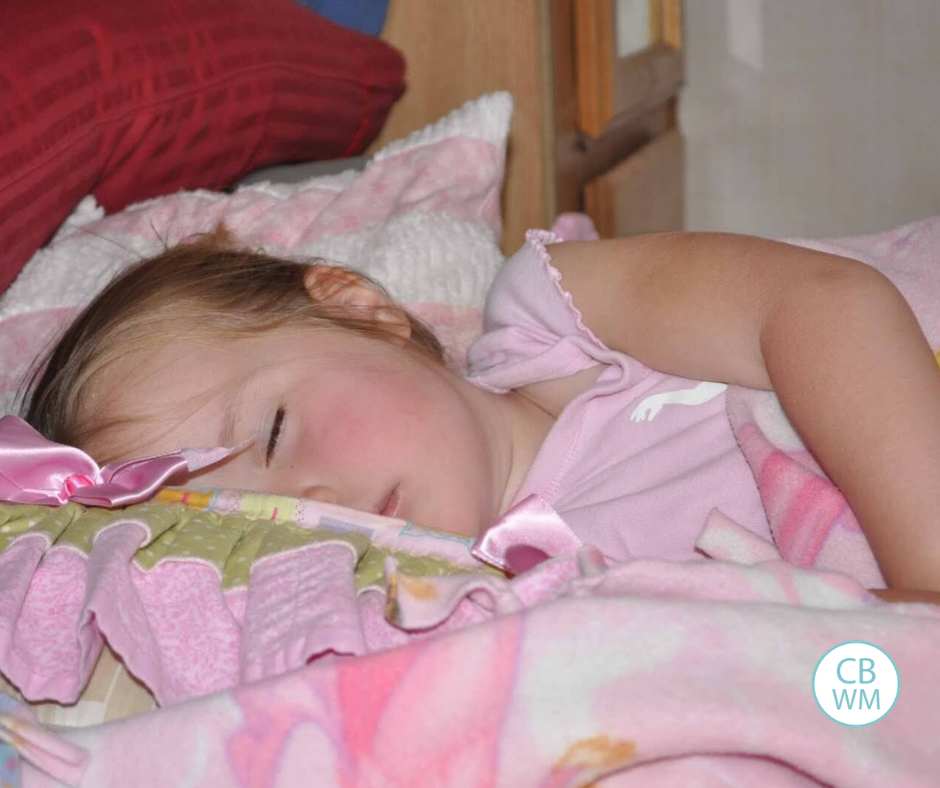
As much as we would all love to have the power to flip a switch and make our child sleep when it’s time, it just isn’t possible.
Dr. Marc Weissbluth puts it plainly in Healthy Sleep Habits, Happy Child (affiliate link):
“You, and your child, can force wakefulness upon sleep, but you cannot force sleep upon wakefulness” (page 30).
He follows that up with something equally important:
“Parents have the opportunity to permit the maximum amount of sleep to occur.”
I think those two ideas together are so worth sitting with.
You can force wakefulness. You can keep a baby up past when she needs sleep. But you cannot run it in the other direction. You cannot make sleep happen on command — not for your baby, and not for yourself either.
What you can do is create the best possible conditions for sleep to occur. That’s your job. That’s the part you’re actually in control of.
What You DO Have Control Over
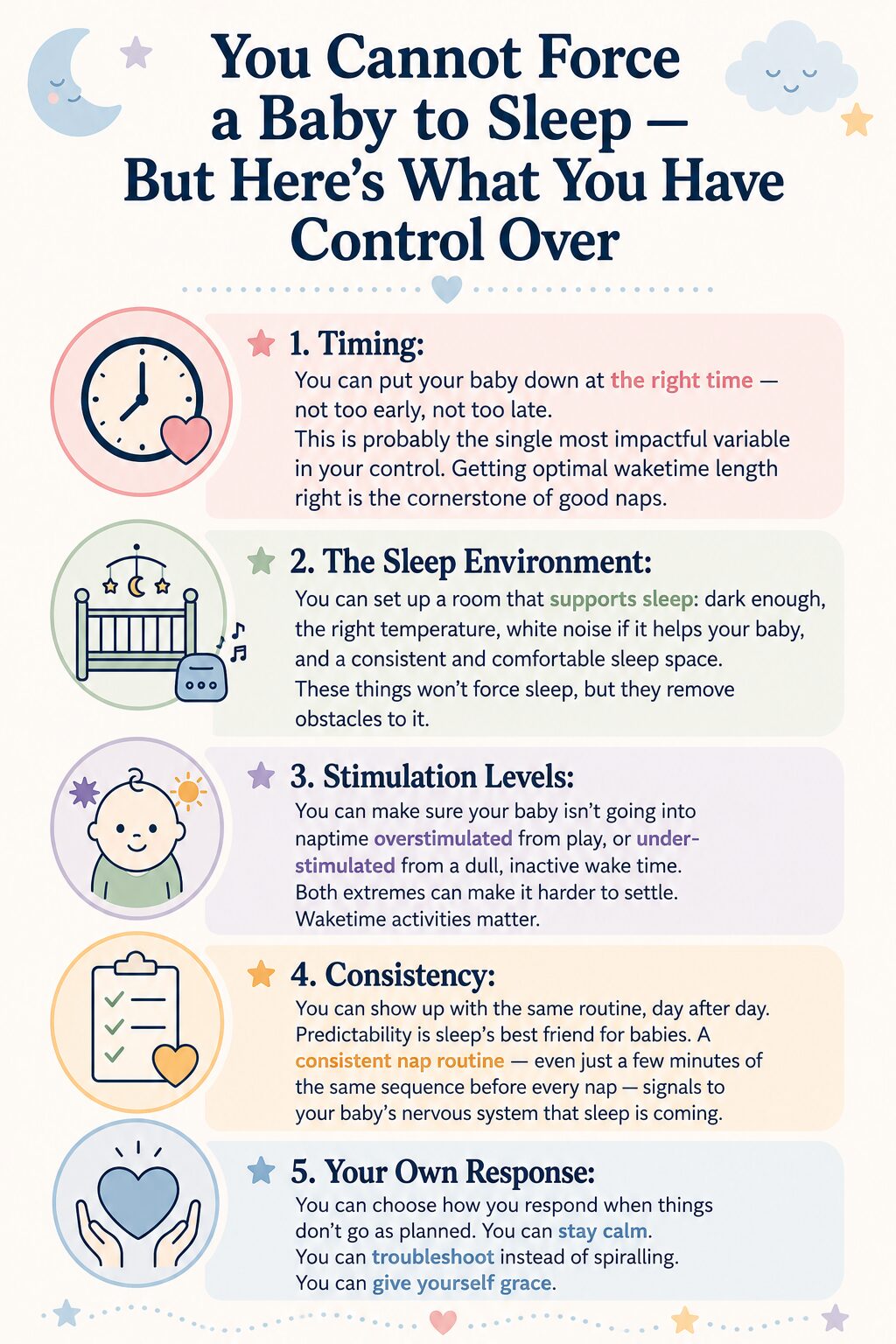
When your baby won’t sleep, it’s easy to feel completely powerless. But there’s actually quite a lot within your reach. You can do the best you can. Focus here:
Timing. You can put your baby down at the right time — not too early, not too late. This is probably the single most impactful variable in your control. Getting optimal waketime length right is the cornerstone of good naps. A baby who goes down at just the right level of tiredness — ready to sleep but not overtired — has the best shot at falling asleep smoothly and staying asleep.
The sleep environment. You can set up a room that supports sleep: dark enough, the right temperature, white noise if it helps your baby, and a consistent and comfortable sleep space. These things won’t force sleep, but they remove obstacles to it. Check out Essential Elements to Any Babywise Bedroom for the full breakdown.
Stimulation levels. You can make sure your baby isn’t going into naptime overstimulated from play, or under-stimulated from a dull, inactive wake time. Both extremes can make it harder to settle. Waketime activities matter — the goal is engaged, appropriate stimulation that naturally leads to a tired, ready-to-sleep baby.
Consistency. You can show up with the same routine, day after day. Predictability is sleep’s best friend for babies. A consistent nap routine — even just a few minutes of the same sequence before every nap — signals to your baby’s nervous system that sleep is coming. Over time, that signal becomes powerful.
Your own response. You can choose how you respond when things don’t go as planned. You can stay calm. You can troubleshoot instead of spiralling. You can give yourself grace.
All of these things are genuinely within your control. That’s not nothing — that’s actually quite a lot.
Even When You Do Everything Right, It Might Not Go Well
Here’s the part that’s harder to hear: you can do everything right, and your baby still might not sleep well.
That is so frustrating. And I want to be honest about it rather than pretend it away.
When you’ve done what you can, the best thing you can do for your own sanity and ability to enjoy your days is to take a breath and tell yourself: I have done what I can do.
That’s easier to accept when it’s a rough patch — a couple of bad naps in a row, a week of disrupted sleep during a developmental leap or illness. You know it’s temporary. You can ride it out.
It becomes genuinely hard when bad sleep drags on for weeks or months.
I know. I really do.
Brayden (my oldest) didn’t nap well consistently until he was 6.5 months old. Where most babies sleep well most of the time and have an occasional bad nap, he had it flipped: bad naps most of the time, with a good one here and there. I tried everything. I researched, I adjusted, I troubleshot. And I kept coming up against the fact that he was just a baby who needed more time.
I’m not a naturally anxious person, which honestly helped me get through that season. I accepted it and we went about our lives. But I want to acknowledge: it was still hard. And I think it would have been much harder if he hadn’t been my first. If he had followed a great napper, I would have known exactly what I was missing and exactly what he was missing. There’s a particular kind of grief in that.
Some Babies Are Just Short Nappers
If you have a baby who consistently takes short naps despite your best efforts, it may help to know this: Weissbluth estimates that 5–18% of babies are naturally short nappers, and that for these babies, it’s not a fixable problem so much as a biological reality.
He notes this tendency typically persists until 18–24 months old.
I can’t tell you with certainty how accurate that range is, but I can tell you from years of working with Babywise parents: I have absolutely worked with moms who did everything right, tried every adjustment, and still had a baby who just took short naps. It happens. Some babies are simply wired that way.
That doesn’t mean you stop trying to optimize conditions. It means that at some point, if you’ve genuinely done the work and the short naps remain, you can give yourself permission to stop blaming yourself.
You’re not failing. You’re just parenting a short napper.
The Mindset Shift That Helps Most
Think about yourself for a moment. Have you ever had a night where you just could not fall asleep — even though you were exhausted, even though you desperately wanted to sleep? You lay there in the dark, willing sleep to come, and it just… didn’t.
It happens to all of us. And no one was doing anything wrong in that scenario.
Your baby is not so different.
There’s an old saying: “You can lead a horse to water, but you can’t make him drink.” I grew up with horses — I showed them as a teenager — and I can tell you that statement is absolutely true. A horse will drink when it’s ready. You can make sure clean water is available. You can bring the horse to it. You can even try to push their muzzle into the water. You cannot make it drink.
Sleep is the same way. Your job is to lead your baby to the conditions for sleep — the right timing, the right environment, the right routine. What happens from there is, to some meaningful degree, out of your hands.
Accepting that isn’t giving up. It’s wisdom. And it’s the thing that will allow you to stop white-knuckling every nap and start actually enjoying your days.
What to Do When You’re in a Hard Season
If you’re in a rough stretch of bad naps right now, here’s what I’d suggest:
First, troubleshoot systematically. Don’t just accept bad naps without checking the most likely culprits first. Waketime length is almost always the first thing to look at. Is your baby going down too late — overtired? Too early — not ready? Even a small adjustment of 10–15 minutes can make a real difference. Check out The Complete Guide to Troubleshooting Short Baby Naps for a full walkthrough.
If it’s chronic 45-minute naps, that has its own set of considerations — see Chronic 45 Minute Naps for more specific help.
Once you’ve genuinely troubleshot, and you’re still in a hard stretch, give yourself permission to let go of what you can’t control. You’ve done what you can. Now you just keep showing up consistently, stay as rested as you can yourself, and trust that this stage won’t last forever.
It won’t.
Conclusion
You can set the stage. You can give your baby every possible advantage for good sleep. And sometimes, despite all of that, it won’t happen the way you hoped.
That’s not a reflection of your effort, your love, or your competence as a parent.
Do your best. Then learn to roll with what comes next. That combination — consistent effort plus genuine acceptance of what you can’t control — is what gets most parents through the hard seasons with their sanity (mostly) intact.
Hang in there.
Related Posts
- The Complete Guide to Troubleshooting Short Baby Naps
- Chronic 45 Minute Naps
- The Cornerstone for Good Naps
- Optimal Waketime Lengths
- Essential Elements to Any Babywise Bedroom
- Why You Shouldn’t Over-Stimulate Baby During Playtime
- How To Solve Your Baby’s Nighttime Sleep Issues
This post first appeared on this website in April 2011