Your great sleeper just turned one — and suddenly nothing is working. You didn’t do anything wrong. The 12-month sleep regression is real, it’s temporary, and here’s exactly how to get through it without losing your hard-won sleep habits.

Your baby just turned one. You’ve made it through a whole year. You’re feeling good — maybe even a little smug about how well your little one sleeps. And then, almost like clockwork, everything falls apart.
Suddenly your great sleeper is waking up at night again. Naps that used to be reliable are now a battle. Your baby fusses at bedtime when she never did before. You’re exhausted and confused and wondering: Did I do something wrong? Did she forget how to sleep?
You didn’t do anything wrong. What you’re dealing with is the 12-month sleep regression — and it is real, it is temporary, and you can get through it.
What Is a Sleep Regression?
A sleep regression is a period of time when a baby or toddler who was sleeping well suddenly starts sleeping poorly. It can look like:
- Night wakings that weren’t happening before
- Difficulty falling asleep at nap time or bedtime
- Shorter naps than usual
- Early morning waking
- Increased fussiness around sleep
Regressions happen because your child’s brain and body are going through significant developmental changes. Sleep is closely tied to brain development, and when big things are happening neurologically, sleep gets disrupted.
The 12-month regression is one of the most common ones parents encounter — and one of the most disorienting, because it hits right as you may be feeling like you’ve finally figured this sleep thing out.
Why Does the 12-Month Sleep Regression Happen?
At 12 months old, your child is going through an enormous amount of development all at once. Understanding what’s driving the sleep disruption can help you feel less helpless and more patient while you’re in the thick of it.
Motor development. Many babies are pulling to stand, cruising along furniture, or learning to walk right around their first birthday. Motor milestones are notorious sleep disruptors. Your baby’s brain is so busy practicing and processing new physical skills that it can interfere with the ability to settle into sleep — and once she’s in the crib, she may pop up to stand and then not know how to get back down.
>>>Read: How to Stop New Skills from Disrupting Naps and Sleep
Cognitive leaps. The brain development happening at 12 months is significant. Your baby is starting to understand object permanence more deeply (the concept that things — and people — still exist when she can’t see them). This can fuel separation anxiety, which shows up most intensely at sleep time when you’re walking out the door.
Separation anxiety. This is often at its peak around 12 months. What looks like a sleep problem is sometimes really a separation problem. Your baby has become deeply attached to you (which is wonderful and normal), and the moment you leave the room, she is suddenly, desperately aware that you are gone.
The nap transition. Right around 12 months, many babies begin showing signs of transitioning from two naps to one. This transition period is notoriously messy and can create a cycle of overtiredness and disrupted sleep. (More on this below.) Despite the signs, DO NOT DROP THE NAP. You do not want to move to one nap until at least 14 months old.
Language development. Your baby is working hard to understand and produce language right now. That kind of cognitive work doesn’t stop just because it’s bedtime.
Pain/Sickness. Your new little toddler can be having teething pain or not feel well. The vaccinations that happen around 12 months old can leave baby not feeling well, also.
All of these things can happen simultaneously, which is why this regression can feel so intense.
How Long Does the 12-Month Sleep Regression Last?
This is the question every exhausted parent wants answered. The honest answer is: it varies. Most sleep regressions last anywhere from two to six weeks. Some children sail through in less than two weeks; others have a tougher stretch that lasts closer to six.
The good news is that regressions are temporary by nature. Your child has not lost the ability to sleep. She is going through a phase, and phases pass.
The most important thing you can do during a regression is not to introduce new sleep habits that you’ll have to undo later. Do not start anything that you do not want to continue. I cannot tell you how many messages I get from moms of pretoddlers this age telling me, “I just brought her into my bed on night! I didn’t think it would cause an issue!” More on that in the tips section below.
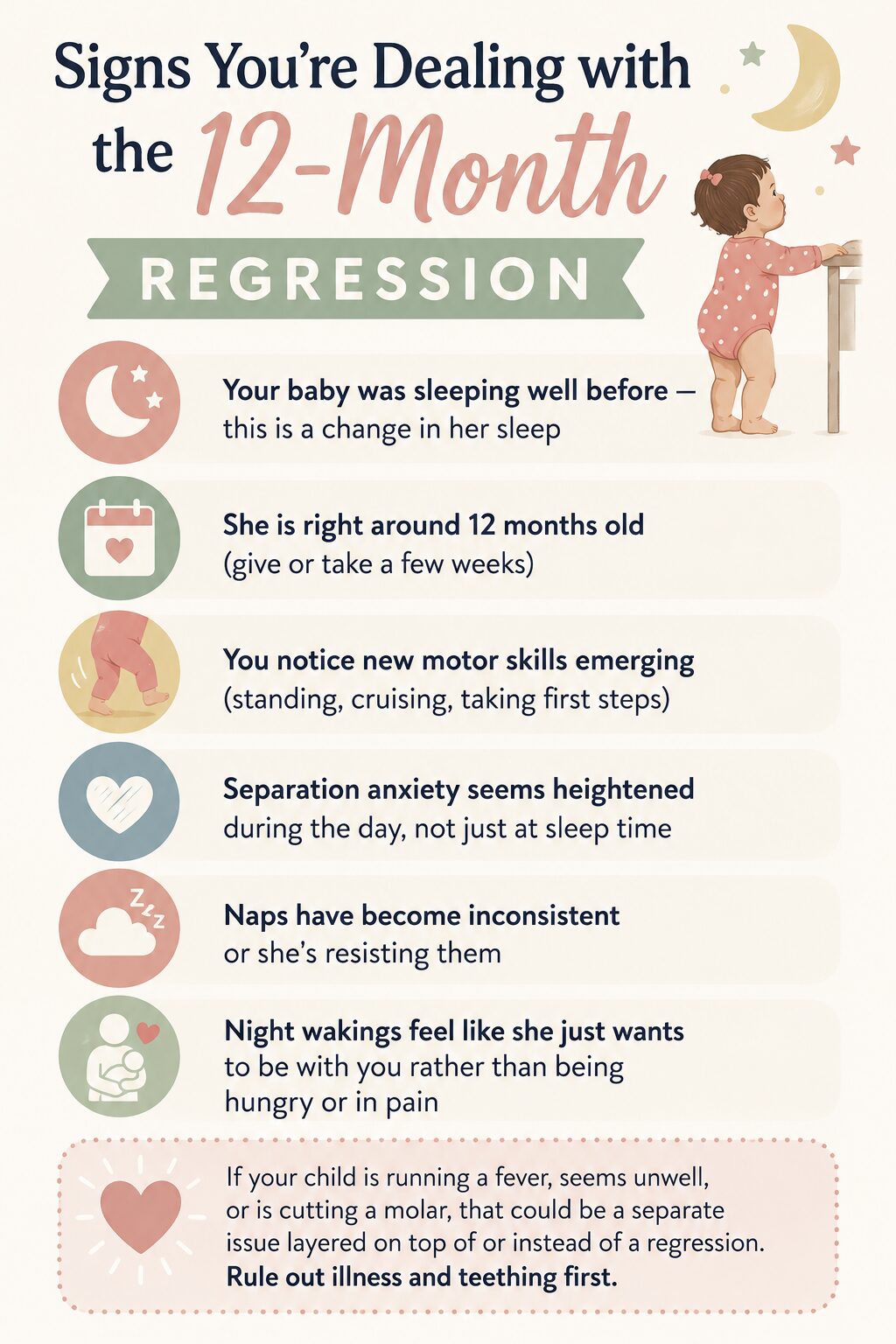
Signs You’re Dealing with the 12-Month Regression
It can be hard to know if what you’re experiencing is a regression or something else entirely (illness, teething, a schedule problem). Here are the signs that point specifically to the 12-month regression:
- Your baby was sleeping well before — this is a change in her sleep
- She is right around 12 months old (give or take a few weeks)
- You notice new motor skills emerging (standing, cruising, taking first steps)
- Separation anxiety seems heightened during the day, not just at sleep time
- Naps have become inconsistent or she’s resisting them
- Night wakings feel like she just wants to be with you rather than being hungry or in pain
If your child is running a fever, seems unwell, or is cutting a molar, that could be a separate issue layered on top of or instead of a regression. Rule out illness and teething first.
The Nap Transition Complication
The 12-month period overlaps with one of the trickiest sleep transitions of early childhood: moving from two naps to one. This makes the regression harder to navigate because you’re dealing with two things at once.
Most children are ready to drop the morning nap somewhere between 14 and 18 months. But some show signs of readiness earlier, around 12 months. Others aren’t ready until closer to 18 months. The wide range is completely normal.
During the regression, your baby may start fighting the morning nap — but that doesn’t necessarily mean she’s ready to drop it. She may just be going through a phase of resistance. The key question to ask: Is she handling the day well on two naps, or is she consistently refusing one of them and then sleeping better at night?
If she is still getting overtired on one nap, she probably still needs two. The regression will pass and the nap resistance usually goes with it.
If she is consistently refusing one nap, sleeping well at night, and managing her wake windows without falling apart, she may be genuinely ready to transition. See my post on Dropping the Morning Nap Transition for more detail on navigating that.
If you think you are in a transition, make a concerted effort to give your kiddo more physical and mental stimulation each day. This will help her be tired physicall and mentally and will lead to her literally needing more sleep to process and recover from that activity.
>>>Read: Importance of Exercise and Stimulation for Sleep
Tips for Getting Through the 12-Month Sleep Regression
Here is the most important thing I want you to hear: Your goal during a regression is to maintain your existing sleep habits, not to add new ones.
When your baby starts waking at night, it is very tempting to nurse her back to sleep, rock her, or bring her into your bed — things you might not have been doing before. These feel like kindnesses in the moment, but they can extend the regression significantly by teaching your child new sleep associations that she’ll now need every time she wakes. You’ll be left with a new sleep problem on the other side that has nothing to do with the developmental leap.
With that principle in mind, here are my best tips:
1. Respond, but don’t create new habits. You don’t have to do cry-it-out during a regression. But you also don’t want to establish habits you don’t intend to keep. Go in and check on her, reassure her, pat her back — but then leave. Give her the chance to fall back to sleep on her own.
2. Keep your routine consistent. Routines are your best friend during regressions. The predictability of the same bedtime routine every night is genuinely calming for a child who is going through neurological upheaval. Don’t abandon your routine just because the regression is making things harder. Hold the line.
3. Keep wake windows appropriate. Overtiredness makes everything worse. An overtired baby is harder to put to sleep AND harder to keep asleep. Make sure she is going down for naps and bedtime within her appropriate wake window for her age. At 12 months, your baby will be up for 2-3 hours before the first nap, then 2-3 hours before the second nap. Then awake until bedtime.
4. Make sure bedtime isn’t too late. When naps go poorly, the temptation is to push bedtime later to “make up” the lost wake time. This usually backfires. An earlier bedtime often helps a baby fall asleep faster and stay asleep longer.
5. Help her practice motor skills during the day. If your baby is learning to stand or walk, give her plenty of floor time during wake hours to practice. The more she can work out those motor skills while awake, the less her brain needs to process them during sleep.
6. Address separation anxiety during the day. Practice brief separations throughout the day so she builds confidence that you always come back. Play peekaboo, step out of the room and return, do short independent play sessions. These small moments help her feel more secure when it’s time for sleep.
7. Increase physical and mental stimulation. Make an effort to have your child do more physically in the day. Make sure toys are age appropriate so they are challenged mentally. Go for walks and outings to expose your child to new things.
8. Be patient with yourself. Regressions are genuinely hard. They’re especially hard because they tend to come just when you thought you were past the hard part. Give yourself grace. It won’t last forever.
What NOT to Do During the 12-Month Regression
A few things to avoid that tend to make regressions last longer:
Don’t rush to change her schedule. If she’s been on a schedule that was working, give it a few weeks before you decide to make significant changes. What looks like a schedule problem during a regression often resolves on its own once the regression passes.
Don’t assume it’s hunger. It’s common to wonder if your newly-one-year-old needs more food, especially if she’s wakng at night. But if she was sleeping through before the regression, hunger probably isn’t the issue. She’s likely waking for connection and reassurance, not calories.
Don’t compare to other babies. Some children have very easy regressions. Others have harder ones. This has nothing to do with your parenting or whether you’re doing Babywise. It’s just temperament.
Don’t abandon sleep training gains if you’ve made them. If you’ve done sleep training and your baby knows how to fall asleep independently, hold onto that. The regression may test it, but the skills are still there. If you add new sleep associations now, you’ll be sleep training again on the other side.
When to Be Concerned
In most cases, the 12-month sleep regression resolves on its own within a few weeks. But there are situations worth talking to your pediatrician about:
- Sleep disruption that lasts longer than 6–8 weeks with no improvement
- Your child seems to be waking in pain or significant distress
- Snoring, labored breathing, or gasping during sleep
- Significant changes in daytime behavior beyond normal fussiness
Your pediatrician is always a good resource if something doesn’t feel right to you.
You’ll Get Through This
The 12-month sleep regression is a badge of honor of sorts — it means your baby is doing exactly what she’s supposed to be doing developmentally. She is growing, learning, and changing at a breathtaking pace. Her sleep is disrupted because her brain is working overtime on remarkable things.
Hold the line. Keep your routine. Don’t introduce habits you don’t want to keep. And remember that this, like every hard season of parenting, is temporary.
You did the work to get here. You can get through a few hard weeks.
Related Posts
- Dropping the Morning Nap Transition Time
- One Nap Schedules Perfect for Your Toddler
- What To Do When Your Pre-Toddler is Taking a Short Morning Nap
- Timing Naps for Toddlers
- Babywise Sample Schedules: 12-15 Months Old
- 15-Month Sleep Regression: What It Is and How to Get Through It