Wondering how to help your tween with bullying? Learn what bullying really is, the warning signs, what to do if your tween is bullied, and how to raise a kid who stands up for others.
If you’ve been in the mom trenches long enough to get through the sleep schedules, the toddler tantrums, and the “why is my kid suddenly obsessed with their friends?” phase, I have news: the tween years bring a whole new set of challenges. And one of the heaviest is bullying.
Friendships get complicated around ages 9 to 12. Social groups shift overnight, phones and group chats enter the picture, and your sweet kid who used to tell you everything may suddenly answer “fine” to every question. That’s normal tween behavior, but it also makes it harder to tell when something is really wrong.
I want to walk you through what bullying actually is (and isn’t), how to tell if your tween is being bullied, what to do when they are, how to make sure your own child isn’t the one causing harm, and how to raise a kid who steps up when they see someone else being hurt.
I still remember hearing from another mom about McKenna standing up on the bus and standing up for a friend who was being bullied. She emphatically told the other kids to stop what they were doing and did her best to protect her friend. I was so proud of her for doing what was right even if it might mean people liked her less.
What Bullying Is and What It Isn’t
Let’s start with the definition, because I think many of us use the word “bullying” for everything from a rude comment to a full-blown campaign against a kid. The U.S. government’s StopBullying.gov describes bullying as unwanted, aggressive behavior among school-aged children that involves a real or perceived power imbalance, and that is repeated or has the potential to be repeated over time.
Two pieces of that definition do a lot of work. The first is the power imbalance. The child doing the bullying uses something, like popularity, physical strength, or access to embarrassing information, to control or hurt someone else. The second is repetition. It’s not just one bad day; it’s a pattern, or something that very likely will happen again.
Bullying comes in a few different forms. Verbal bullying is name-calling, insults, teasing, and threats. Social bullying is the sneaky one, and it’s especially common in the tween years: leaving someone out on purpose, spreading rumors, or telling other kids not to be friends with someone. Physical bullying includes hitting, pushing, tripping, or damaging someone’s things. And cyberbullying is any of the above happening through texts, social media, group chats, or gaming platforms.
What Bullying Is Not
This is the part that surprises a lot of parents. A one-time argument between two friends, a mean comment in the heat of the moment, or two kids with equal standing who simply don’t get along is typically not bullying. That doesn’t mean it’s okay, and it doesn’t mean you shouldn’t help your tween handle it. Harmful behavior still deserves attention. But the label matters, because the response is different.
Normal conflict between peers calls for coaching: how to communicate, set boundaries, and repair a friendship or walk away from one. Bullying calls for adult involvement, usually including the school. Knowing the difference helps you respond in proportion, and it helps your tween trust that you’ll take them seriously when it really is bullying.
>>>Read: Navigating Friendship Drama in the Middle School Years
How To Tell If Your Tween is Being Bullied
Here’s the tricky part: most tweens won’t tell you. They may feel embarrassed, worry that you’ll overreact and make things worse, or fear getting labeled a tattletale. So you often have to watch for changes instead of waiting for a confession.
Some common warning signs include:
- Unexplained injuries, or lost, damaged, or “missing” belongings like clothing, electronics, or books
- Frequent headaches or stomachaches, or sudden requests to stay home from school
- Changes in eating habits or trouble sleeping, including nightmares
- Declining grades or a sudden loss of interest in school
- Avoiding social situations, activities, or friends they used to love
- Low self-esteem, mood swings, or seeming withdrawn, anxious, or sad
- Seeming jumpy or upset after looking at their phone, or suddenly wanting off their devices (or glued to them)
Any one of these can have other explanations, and tweens go through plenty of ups and downs on their own. What I look for is a change from their normal and a pattern that sticks around. If something feels off, trust that mom gut and start a gentle conversation.
One more thing: some kids who are bullied also have thoughts of hurting themselves. If your tween ever talks about self-harm or not wanting to be here, please get help right away. In the U.S., you can call or text 988 (the Suicide & Crisis Lifeline) any time, day or night, and your child’s pediatrician can point you to local support too.
Tweens often look to self-harm in relation to cyber-bullying issues. This is another reason to monitor and protect your child’s online presence.
What To Do If Your Tween is Being Bullied
If you’ve confirmed (or strongly suspect) that your tween is being bullied, take a breath. Your calm is going to set the tone for everything that follows.
Listen first, fix second
It’s so tempting to jump straight into problem-solving mode, or to march up to the school with fire in your eyes. Resist that for a moment. Start by listening, and let your tween tell the story at their own pace. Stay calm even if you’re boiling inside, and thank them for trusting you with something hard. You might say something like, “I’m so glad you told me. I’m on your team, and we’re going to figure this out together.”
Please don’t blame your child, even if they did something that seemed to set it off. No one deserves to be bullied, period. And avoid advice like “just ignore it” or “toughen up.” Those messages tell your tween that their pain isn’t a big deal, which can make them stop coming to you.
Gather the details
Ask questions that help you understand what’s happening: what happened, where and when it happens, who was involved, and whether anyone saw it. Write it all down. Dates, times, names, and descriptions will be incredibly helpful if you need to involve the school.
Involve the school
Most schools have a bullying policy, and many states have anti-bullying laws that spell out what schools are required to do. Contact your tween’s teacher, counselor, or principal, share your documentation, and ask what steps they’ll take and what the follow-up plan is. Stay calm and factual; you’ll get further as a partner than as an adversary.
One note here: resist the urge to contact the other child’s parents directly. It can feel like the logical move, but those conversations tend to go sideways when emotions are high. Let the school act as the mediator.
It is also wise to constantly remind yourself that there are always two sides to the story. This is why it is good to just stick to facts. Do not embellish and do not add your own interpretation to things.
If it is happening online
Cyberbullying has its own playbook. Coach your tween to not respond and not retaliate, block the person, and save the evidence with screenshots that show dates, usernames, and messages. Don’t delete anything. Then report it to the platform, since all reputable apps and sites prohibit harassment and have reporting tools, and to the school if the other child attends it. If there are threats or anything that could be criminal, contact the police.
This is also a good moment to talk about phone boundaries. Setting limits on devices is reasonable, but be careful not to take the phone away as a “punishment” for being targeted. Kids who fear losing their devices often stop telling their parents what’s happening online.
And once again, YES you report these things to the school and even the police.
Rebuild their confidence and their circle
Bullying chips away at a child’s sense of worth, so help them rebuild. Encourage activities where they feel capable and valued, whether that’s a sport, art, music, or a club. Help them nurture friendships with kids who are kind to them. Help facilitate healthy friendships and relationships. Host friends at your house. Tweens often don’t know where to hang out. Remind them often, and out loud, that what was said about them says nothing about who they are. If you notice lingering anxiety, sadness, or changes in behavior, a school counselor or therapist can be a real gift.
How To Make Sure Your Tween Is Not the One Bullying
This is the section nobody wants to read, and it might be the most important one. Our kids are not perfect, and most of us would be stunned to find out our child was hurting someone. But tweens are still learning empathy, impulse control, and how to handle big feelings, and the pressure to fit in can push even good kids into bad choices.
Here’s something helpful to know: some kids who bully have also been bullied themselves, and sometimes the behavior comes from anger, insecurity, or feeling powerless somewhere else in their life. Understanding the “why” doesn’t excuse it, but it helps you address it.
Be honest about the possible signs. A child who is bullying others might get into physical or verbal fights, be quick to blame others, get frequent trips to the principal’s office, have unexplained extra money or belongings, become competitive about popularity, or hang around with kids who bully. Again, these aren’t proof, just reasons to start a conversation.
Set a clear, consistent message. Tell your tween directly, and more than once, that bullying is never okay, in person or online. Explain what it looks like, including the sneaky social and online versions, so they can’t claim they “didn’t realize.” You as the parent need to care more about what is right than about your child’s popularity.
Talk about the group chat. A lot of tween meanness happens behind a screen where it feels less real. Remind them that the person on the other end is a real kid with real feelings, and that “it was just a joke” doesn’t cancel out the hurt. Check in on their online activity, and make sure you have access to their accounts and passwords at this age.
Model it. Our kids learn how to treat people by watching how we treat people, including how we talk about the other moms at pickup, the waiter, or the driver who cut us off. Kindness and respect have to look like something at home.
Teach conflict skills. Practice (even through role-play) how to handle frustration without insults, threats, or aggression. Give them words for big feelings so they don’t take them out on someone else. Practice healthy conflict resolution at home. You will have a lot of conflict that comes up with your tween, from cleaning up, to clothing choices, to rules they don’t like. Use healthy conflict resolution so they learn the skils.
If your child is bullying, respond with accountability and support. If the school or another parent tells you your tween has been involved in bullying, take a breath and don’t get defensive. Listen to the details, talk to your child without excusing the behavior, and make a plan together: an apology, repairing the harm, and consequences that fit. Then dig into what’s underneath. Is something going on at school? With friends? At home? Getting to the root is how you actually change the behavior.
What To Do When Your Tween Sees Someone Else Being Bullied
Most kids aren’t the one being bullied or the one doing the bullying. Most are in the middle: the bystanders. And bystanders have more power than they realize. Bystanders can feel guilt, anxiety, and helplessness, but they can also be a big part of the solution.
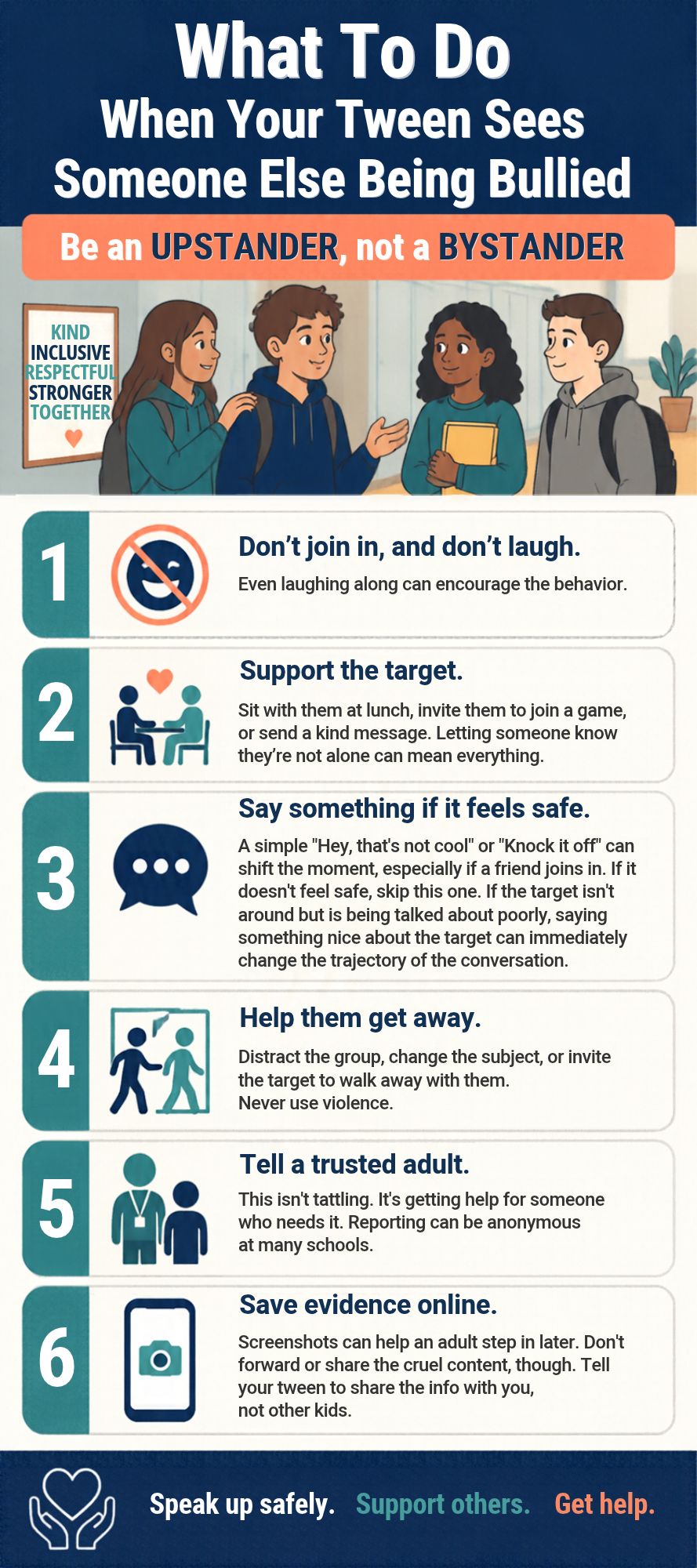
I love the idea of raising an upstander instead of a bystander. An upstander is a kid who doesn’t just watch, laugh along, or scroll past, but does something. And it doesn’t have to be dramatic. Here are some ways your tween can safely help:
- Don’t join in, and don’t laugh. Even laughing along can encourage the behavior.
- Support the target. Sit with them at lunch, invite them to join a game, or send a kind message. Letting someone know they’re not alone can mean everything.
- Say something if it feels safe. A simple “Hey, that’s not cool” or “Knock it off” can shift the moment, especially if a friend joins in. If it doesn’t feel safe, skip this one. If the target isn’t around but is being talked about poorly, saying something nice about the target can immediately change the trajectory of the conversation.
- Help them get away. Distract the group, change the subject, or invite the target to walk away with them. Never use violence.
- Tell a trusted adult. This isn’t tattling. It’s getting help for someone who needs it. Reporting can be anonymous at many schools.
- Save evidence online. Screenshots can help an adult step in later. Don’t forward or share the cruel content, though. Tell your tween to share the info with you, not other kids.
Talk through these scenarios ahead of time. Ask your tween, “What would you do if you saw someone getting left out or picked on?” Practicing the words in advance makes it so much easier to find them in the moment.
How To Keep the Lines of Communication Open
Everything above works better when your tween knows they can talk to you. A few habits that have helped moms I know:
- Talk in the car, at bedtime, or while doing something side by side. Tweens often open up when they don’t have to make eye contact.
- Ask specific, open-ended questions. Instead of “How was school?”, try “Who did you sit with at lunch?” or “What was the hardest part of your day?”
- Stay curious about their friendships and their online world without interrogating them.
- Keep your reactions steady. If every confession gets a big reaction, they’ll stop confessing.
- Remind them often that nothing is too big or too embarrassing to tell you.
Trusted Resources for Parents
If you want to go deeper, these are good places to start: StopBullying.gov (tools for parents, educators, and kids, including how to report cyberbullying), PACER’s National Bullying Prevention Center, and Stomp Out Bullying, a national nonprofit that offers help for kids in crisis. For the online side of things, ConnectSafely and Common Sense Media can help you stay current on the apps your tween is using.
Conclusion
Helping your tween navigate bullying, whether they’re on the receiving end, tempted to take part, or standing on the sidelines, isn’t about getting everything perfect. It’s about staying close, staying calm, and making sure your child knows, deep down, that you are their safe place.
You don’t need to have all the answers today. Start with one conversation this week. Ask a good question, and then really listen. That small step can make a bigger difference than you think.
I’d love to hear from you. Have you had to help your tween through a bullying situation? What worked for your family? Share in the comments below, because your story might be exactly what another mom needs to read today.
Disclaimer: I’m a mom, not a doctor or licensed counselor. This post is meant to share information and encouragement, not replace professional advice. If your child is in danger or talking about hurting themselves, please call 988 or your local emergency services right away.
Related Posts
- How to Teach Your Child Executive Function Skills
- 45 Questions to Get Your Child Talking
- Parenting Preteens: Tips Parents Need