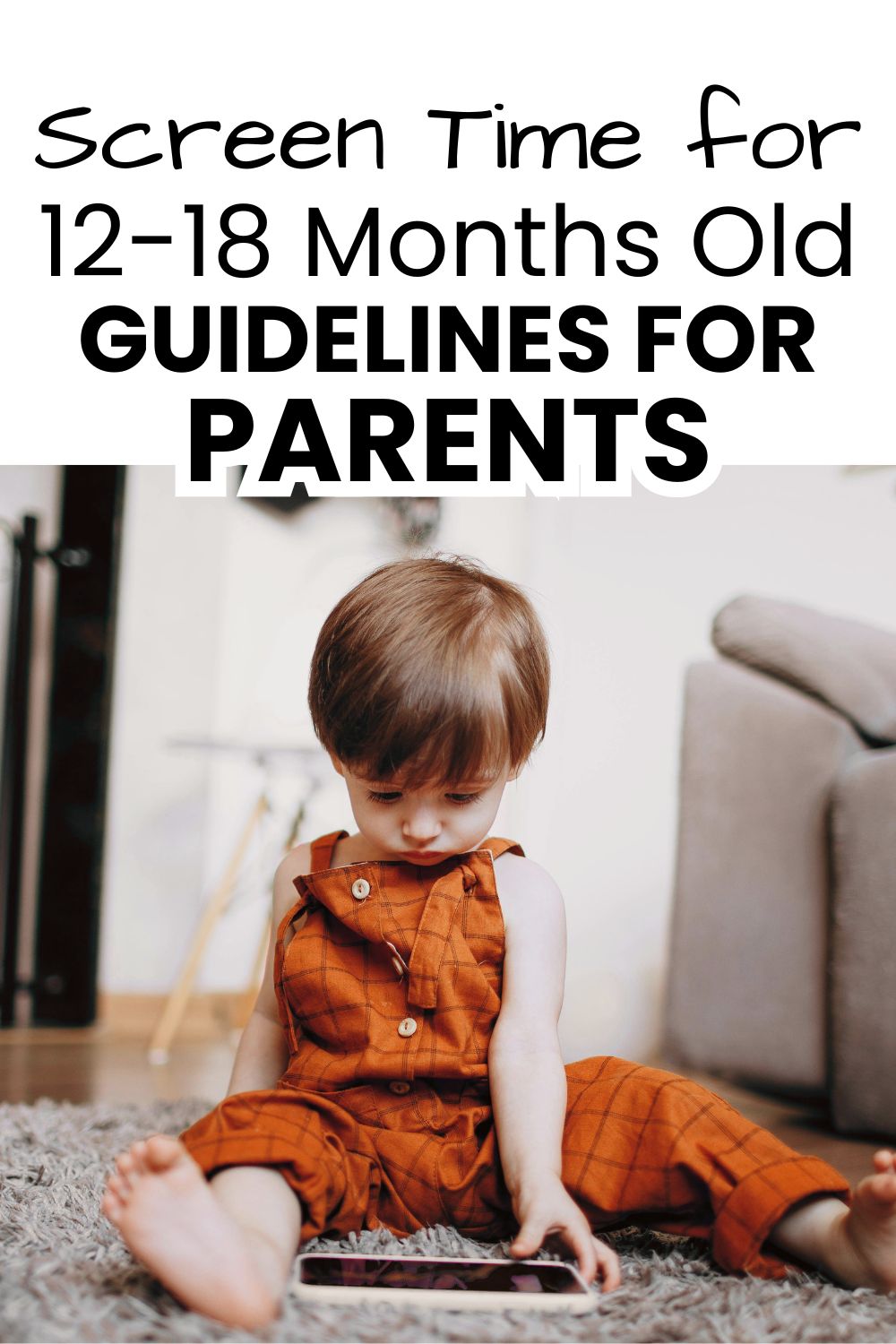
Screen time guidance for 12-18 month olds, including AAP guidelines, practical limits, what to do when older siblings watch TV, and honest talk about using screens as a babysitting tool.
If you have a pretoddler somewhere between 12 and 18 months old, you’ve probably already run into the screen time question, whether you meant to or not. Maybe it’s the TV playing in the background while you make dinner. Maybe it’s an older sibling’s show. Maybe it’s five minutes of a phone video that bought you enough peace to get a diaper changed without a fight. Screen time at this age is rarely an all-or-nothing decision — it’s a series of small, everyday moments, and it helps to know what’s actually recommended before you decide what works for your family.
Post Contents
- What the AAP Actually Recommends
- Why the Guidelines Are So Strict at This Age
- Practical Limits That Work in Real Life
- What About Older Siblings Watching TV?
- Using Screen Time as a Babysitting Tool
- Better Alternatives When You Need a Few Minutes
- Signs Screen Time May Be Too Much
- FAQ: Screen Time for 12-18 Month Olds
What the AAP Actually Recommends
The American Academy of Pediatrics’ current guidance is straightforward for this age group: babies under 18 months should have no screen time at all, with one exception — video chatting with a family member, like a grandparent or a parent traveling for work. Video chatting counts as real, interactive connection rather than passive viewing, so it gets a pass.
Once your baby crosses the 18-month mark, the AAP says you can start introducing some high-quality educational programming, but only with a parent or caregiver watching alongside them, not as something they view alone. By ages 2 to 3, that expands to up to an hour a day of high-quality content.
It’s worth knowing that the AAP’s newest framework has moved away from rigid hour-by-hour rules in favor of a more values-based approach sometimes called the “5 Cs” — Child, Content, Calm, Crowding Out, and Communication. In plain language, that means asking: Is this right for my child specifically? Is the content actually good quality? Is my child calm and regulated, or using the screen to avoid a meltdown? Is the screen crowding out something more valuable, like sleep or play? And am I communicating with my child during and after, rather than just parking them in front of it? For a baby under 18 months, though, the bottom line hasn’t changed — the recommendation is still no screens, aside from video chatting.
Why the Guidelines Are So Strict at This Age
I know “no screens at all” can feel like an unrealistic standard, especially once you’re living real life with a kiddo. But there’s a reason the guidance is this firm for the youngest kids. At 12 to 18 months, your baby’s brain is doing enormous work — building language, learning to read faces and voices, and figuring out cause and effect through real, hands-on interaction. A screen, even a well-made one, can’t replicate the back-and-forth of a real conversation or the sensory experience of stacking blocks or exploring a texture with their hands. Passive viewing at this age simply doesn’t offer the same developmental payoff that real-world play and interaction do.
That doesn’t mean an occasional few minutes of a video is going to derail your child’s development. It means the daily default for this age is real-world play, and screens are the occasional exception rather than the rule.
When my kiddos were babies, the recommendation was no screens until 2 years old, and so we worked to follow that. It is doable! When kids don’t rely on screens, they learn to rely on other things.
Practical Limits That Work in Real Life
Here’s how I’d think about it practically, especially with a baby in the 12-18 month range:
- Treat video chats as the exception, not the rule. A call with grandma counts as connection, not screen time to worry about.
- If you do let your 15 or 16 month old watch a few minutes of something, sit with them. Narrate what’s happening, point at things, ask questions, even if they can’t answer yet. That turns a passive moment into an interactive one.
- Skip background TV when you can. Even when no one’s actively watching it, background television has been shown to interrupt a young child’s focus during play and reduce parent-child talk in the room. If the TV needs to be on, try pointing it away from your baby’s usual play space.
- Choose slow-paced, simple content over anything fast-cut or loud. Fast edits and flashing visuals are harder for a young brain to process and are more overstimulating than something like a slow nature clip or a simple song.
- Keep screens out of mealtimes and out of the bedroom, for your baby and honestly for the whole family. Both habits are easy to build now, before they become harder to break later.
What About Older Siblings Watching TV?
This is one of the most common real-world snags, and I get it completely — I’ve lived it with my own kids spanning a wide range of ages. You can’t put a household on lockdown just because the youngest hasn’t hit the recommended age yet, and you shouldn’t feel like you need to.
A few things help here. First, know that occasional exposure to an older sibling’s show isn’t the same as your baby being a deliberate, daily viewer — incidental background exposure and intentional, parent-selected screen time aren’t equal in terms of impact. Second, if you have some flexibility, scheduling the older child’s screen time during your baby’s nap or independent playtime cuts down on overlap without anyone feeling deprived. Third, when the two are watching together, try to keep your baby facing away from the screen or engaged in a toy nearby rather than staring straight at it — proximity and orientation both matter more than most parents realize.
If your house runs on a fairly consistent eat, wake, sleep rhythm, you may already have more built-in separation between kids’ screen time and baby’s awake time than you’d expect, since naps and independent play blocks naturally create some of that space.
>>>Read: Play Time for Children
Using Screen Time as a Babysitting Tool
Let’s be honest about this one, because most parents have done it and there’s no use pretending otherwise. Nearly half of parents report using screens at some point to manage a meltdown or buy a few minutes of peace, and the guidelines exist in the real world, not a fantasy one where nobody ever needs five uninterrupted minutes to shower or answer the door.
The AAP does specifically caution against using screens as a regular pacifier, babysitter, or way to stop tantrums, and that’s worth taking seriously — not because an occasional exception is going to hurt your child, but because it’s easy for “occasional” to quietly become “daily” without you noticing. The real risk isn’t the five minutes here or there. It’s when a screen becomes the go-to answer every single time your baby is fussy, bored, or in the way of something you need to get done, since that’s the pattern that starts crowding out other coping skills and interaction.
If you notice you’re reaching for a screen out of habit rather than genuine need, it’s worth building a small stash of alternatives (below) that you can grab just as fast.
Better Alternatives When You Need a Few Minutes
A little bit of independent playtime can solve a lot of the same problems screens solve, without any of the guilt. A baby who’s practiced spending time playing alone in a safe space — even five or ten minutes at a stretch — gives you a legitimate, screen-free way to get a few things done.
A few other go-tos that work well at this age:
- A basket of a few rotating toys kept just for “busy moments,” swapped out every week or two so they still feel new
- Board books left within reach, since babies this age will often “read” independently for a few minutes
- A safe kitchen drawer with plastic containers and wooden spoons if you need five minutes to finish cooking
- A short stretch in a high chair with a snack and a toy while you handle something nearby
None of these need to replace screens entirely — they just give you more tools in the rotation so screens aren’t the only option you reach for.
>>>Read: Is Watching Television Bad for Kids?
Signs Screen Time May Be Too Much
For a baby this age, a few signs can suggest it’s worth pulling back:
- Screen time is displacing sleep, meals, or physical play on a regular basis
- Your baby seems more resistant to being redirected away from a screen than usual for their age
- You notice yourself reaching for a screen automatically, before trying anything else
- Screen time has become a daily habit rather than an occasional exception
- Your kiddo cries when they do not get to have screen time
None of these are cause for alarm on their own — they’re just useful signals that it might be time to reset the routine a bit.
FAQ: Screen Time for 12-18 Month Olds
Is any screen time okay for a 12-month-old? The AAP recommends no screen time under 18 months, aside from video chatting with family, which is considered interactive rather than passive. If screens do come up occasionally in daily life, keeping exposure brief and watching together rather than letting your baby view alone is the better approach.
Does watching TV with an older sibling count the same as intentional screen time? Not exactly. Incidental exposure to a sibling’s show is different from sitting a baby down in front of a screen on purpose, though it’s still worth minimizing when you can, especially by keeping your baby’s play space and line of sight away from the TV.
Is it bad to use a screen occasionally to get through a hard moment? An occasional exception isn’t going to undo your child’s development. The concern is more about pattern than any single instance — if a screen becomes the automatic response every time your baby is upset or bored, it can start crowding out other coping tools and interaction that matter more at this age.
What can I do instead of screen time when I need a few minutes? Independent playtime, a rotating basket of “busy” toys, board books, or a snack in the high chair nearby can all buy you a few minutes without a screen. Building up your baby’s independent playtime skills over time makes this easier as they grow.
See Also
- Play Time for Children
- Independent Playtime
- Is Watching Television Bad for Kids?
- Balancing Technology for Kids
- Why You Shouldn’t Allow TV Time Under Two
- Everything You Need to Know for Your Toddler
How does your family handle screen time with a baby in the house? I’d love to hear what’s worked for you.