Get 9 research-backed tips for how to help your child stop being aggressive — whether your child is consistently aggressive or just going through a rough patch. This works for consistently aggressive kids and also occasional aggression.

No one wants their child to be bullied. That thought alone is enough to break a parent’s heart.
But honestly? I think most of us fear something even more: discovering that our child is the one doing the bullying. At least, that’s how I feel.
The good news is that it doesn’t have to be an either/or situation. Aggressive behavior in children — even persistent, consistent aggression — can be addressed, redirected, and stopped with the right strategies.
Before we dive in, let’s make an important distinction.
Is This Normal Aggression or a Consistent Pattern?
Sometimes a child acts aggressively because of an unusual circumstance. Maybe another child hit her first, and she reacted. Maybe you took your toddler to the park right at nap time and she simply can’t regulate her emotions when she’s overtired. Maybe something genuinely pushed her over the edge.
Those moments are frustrating, but they’re not the same as having a child who is consistently aggressive — a child you’d describe to other parents as aggressive.
This post is about the latter. We’re talking about the child who regularly hits, bites, pushes, or lashes out. If that’s what you’re dealing with, keep reading.
Why Do Children Become Aggressive?
Understanding the “why” behind aggression helps you address the root cause, not just the behavior on the surface.
Developmental stage. Toddlers and preschoolers are still learning to manage big emotions with very limited verbal skills. When a child can’t say “I’m so frustrated that Tommy has the dump truck I wanted,” hitting can feel like the only available option. This is especially true around 18 months to 3 years old — a prime window for aggressive behavior as kids navigate wanting autonomy without yet having the emotional tools to handle disappointment.
A lack of language. One reader shared that her 9-month-old had started hitting whenever he was frustrated or heard the word “no.” This is so common at that age! Babies and young toddlers can think far more than they can verbalize. When words fail them, physical expression takes over. Teaching some basic sign language — “more,” “all done,” “help” — can reduce frustration-driven hitting significantly.
Overstimulation or fatigue. Children who are overtired, overstimulated, or hungry are far more likely to act out aggressively. Consistent sleep schedules and predictable routines make a bigger difference than many parents expect.
Learned behavior. Children are sponges. If they spend significant time around aggressive peers, older siblings who aren’t corrected, or media with aggressive content, they absorb those behaviors as normal.
Temperament. Some children are naturally more strong-willed, high-intensity, or impulsive. That doesn’t mean aggression is inevitable — but it does mean you may need to be more intentional and consistent in your approach.
>>>Read: How to Teach a Toddler Not to Hit or Throw Things at People (Including You)
How to Stop Consistent Aggression in Children: 9 Tips
The strategies below come from Parenting the Strong-Willed Child (affiliate link-this does not change your cost) — a book I highly recommend for any parent dealing with a child on the more intense end of the spectrum. That said, I apply many of these even with my typically non-aggressive children when occasional aggressive behavior pops up.
1. Praise Good Behavior
This might feel counterintuitive when you’re in crisis mode over hitting and biting, but actively praising the good behavior you want to see is one of the most powerful tools you have.
When your child shares a toy without being prompted, point it out enthusiastically: “I love how you shared your truck with your friend! That was so kind.” When she uses her words instead of pushing, celebrate it. Children repeat behaviors that earn positive attention. If the only time they get a reaction from you is when they misbehave, guess what behavior they’ll keep performing?
Make a point to notice and name the good — especially with an aggressive child who may be used to mostly negative feedback. Aim for a ratio of several positive comments for every correction.
2. Find Alternatives to Aggression
Rather than simply saying “don’t hit,” help your child figure out what to do instead when big feelings hit.
Work with them proactively — not in the moment of meltdown, but during a calm, connected time. Practice phrases like “I’m so mad!” or “I need a turn!” Role play what to do when a friend takes a toy: “Instead of hitting, you can come get Mommy and say ‘Can you help me?'”
>>>Read: Training in Times of Non-Conflict
For younger children who don’t have those words yet, give them physical alternatives: stomp your feet, squeeze a pillow, take three big breaths. The goal is to give them a release valve that isn’t another person’s body.
3. Limit Screen Time
I’ll be direct here: this one matters more than most parents want to admit.
Anyone who has watched a child’s behavior shift after extended TV or video game time has witnessed this firsthand. The more aggressive or stimulating the content — even seemingly innocent cartoons can be surprisingly physical — the more that behavior tends to show up in play.
If your child is struggling with aggression, I’d start here. Cut screen time to 0–30 minutes per day and be thoughtful about what you allow during that window.
I did this with Brayden, who was very far from an aggressive kid. He’s the child who gets hit and doesn’t hit back. But one day, his overall demeanor shifted — he was just edgier, more combative in his tone and attitude. I immediately cut all TV, video games, and computer time cold turkey for a full week. No negotiation, no exceptions. It was the first thing I did, and it helped. Noticeably.
If your child is already aggressive, this isn’t optional. It’s step one.
4. Limit Time with Aggressive Children
Children learn from the children around them. This is especially true before age three, when a child’s moral reasoning is still very much in development. She doesn’t yet have the internal resources to watch a friend hit and think, “That’s wrong, I won’t do that.” She’s far more likely to think: “Oh, that’s what you do when you’re mad.”
If your child is spending a lot of time with kids who push, grab, bite, or hit — whether at daycare, playgroups, or family gatherings — that exposure is affecting her behavior, even if she doesn’t seem to notice.
Limit playtime with consistently aggressive children. Keep interactions shorter and less frequent. When you do allow time together, stay close and supervise actively rather than from across the room.
As your child grows — especially past age three — she’ll gradually develop the moral framework to make good choices even when peers don’t. But that’s a slow, developmental process. Don’t rush it by over-exposing a young child to poor behavior and expecting her to resist it alone.
5. Do Not Reward Aggressive Behavior
This one seems obvious, but it’s easy to get wrong in the heat of the moment.
Did your child hit another child to get the dump truck? Make absolutely sure he does not end up with the dump truck. Even if it causes a meltdown. Even if it feels easier to just let it go. The moment aggression “works” — even once — you’ve taught him that it’s an effective strategy.
Did she hit you because you said no to a cookie? Do not give her the cookie.
Every time an aggressive act earns a reward (the toy, the cookie, the attention, the capitulation), you reinforce the exact behavior you’re trying to stop. Consistency here is everything. It’s hard in the moment, but the short-term peace isn’t worth the long-term lesson you’re accidentally teaching.
6. Remain Calm
Your calm is your superpower.
When you respond to your child’s aggression with your own raised voice, big energy, or visible frustration, a few things happen: the situation escalates, your child gets flooded emotionally, and attention (even negative attention) becomes the reward. Some kids will ramp up the behavior just to keep getting that big reaction.
You can be firm without being reactive. A steady, low voice often does more to de-escalate a situation than any amount of yelling. It also models the emotional regulation you’re trying to teach.
There’s another benefit to staying calm: when the child owns the consequences of their own behavior without having your emotional storm to redirect blame onto, accountability is clearer. He hit, he got a time-out. That’s the story. No drama, no confusion.
7. Give an Immediate Time-Out — Every Time
With aggression specifically, there are no warnings and no second chances. The time-out happens immediately, every single time.
I think of the time-out not as a punishment in the traditional sense, but as a forced pause — a chance for your child to step away from the situation, calm his nervous system, and regain composure before rejoining play.
For young toddlers, 1–2 minutes is appropriate. For preschoolers, you can extend slightly. The key isn’t duration — it’s the consistency. Every act of aggression results in a time-out, without exception. Your child needs to know this is the rule, not a threat that sometimes gets followed through on.
For a 22-month-old who is repeatedly pushing younger cousins at family gatherings (a scenario several readers have brought to me!), I recommend staying right at her elbow during play. The moment a push happens, remove her immediately and don’t allow her to return to play for a meaningful stretch of time. Repeat, every time, without fail. Over time, she will connect the action to the consequence.
>>>Read: How To Use Time-Out Effectively
8. Acknowledge Your Child’s Feelings
This step often gets skipped when parents are frustrated, but it’s important — especially for building the emotional vocabulary that eventually replaces aggression.
Before you launch into correction, take a brief moment to name what you see: “I can see you’re really angry right now. It’s hard when someone has the toy you want.”
That validation matters. It communicates that you understand him, that his feelings are real and recognized. Children who feel understood are more open to correction. Children who feel dismissed often double down.
You’re not excusing the behavior by acknowledging the feeling. You’re building the bridge to the next step.
9. Stress That the Behavior Was Inappropriate — Clearly and Every Time
After acknowledging the feeling, bring it home: “I know you’re angry because Tommy has the dump truck you want… but it is not okay to hit him. We do not hit people.”
Simple. Direct. Consistent.
Children need to hear this message over and over as they’re developing their moral framework. Don’t assume they know. Don’t assume the message has sunk in because you’ve said it before. Repeat it calmly and clearly, every single time.
The acknowledgment + boundary formula is powerful precisely because it does both jobs: it meets the child emotionally and holds the line behaviorally. Neither step works as well without the other.
A Note on Age-Specific Aggression
Babies (6–12 months): Hitting at this age is usually not intentional aggression — it’s sensory exploration and frustration expression. Say “gentle” and guide their hand in a gentle motion. Begin simple sign language to give them a way to communicate their needs.
Toddlers (1–3 years): This is the peak window for aggressive behavior. Emotions are huge, verbal skills are tiny, and impulse control is essentially nonexistent. Be consistent, stay close, and keep consequences immediate and predictable.
Preschoolers (3–5 years): Children this age are developing empathy and moral reasoning, which means they can start to understand why hitting is wrong — not just that it has consequences. Role play, social stories, and talking through scenarios during calm moments become more effective.
School age (5+): Persistent aggression at this age may warrant a conversation with your child’s pediatrician or a child therapist, especially if it’s happening across multiple settings.
When to Seek Additional Help
Most childhood aggression responds well to consistent, patient parenting. But there are times when outside support is appropriate:
- The aggression is severe or causing injury
- It’s happening across multiple environments (home, school, activities)
- You’ve been consistent for months with no improvement
- Your child seems unable to control their impulses even when they want to
- There are other concerning behaviors alongside the aggression
Talk to your pediatrician. There’s no shame in asking for support — in fact, getting help early is one of the most proactive things you can do for your child.
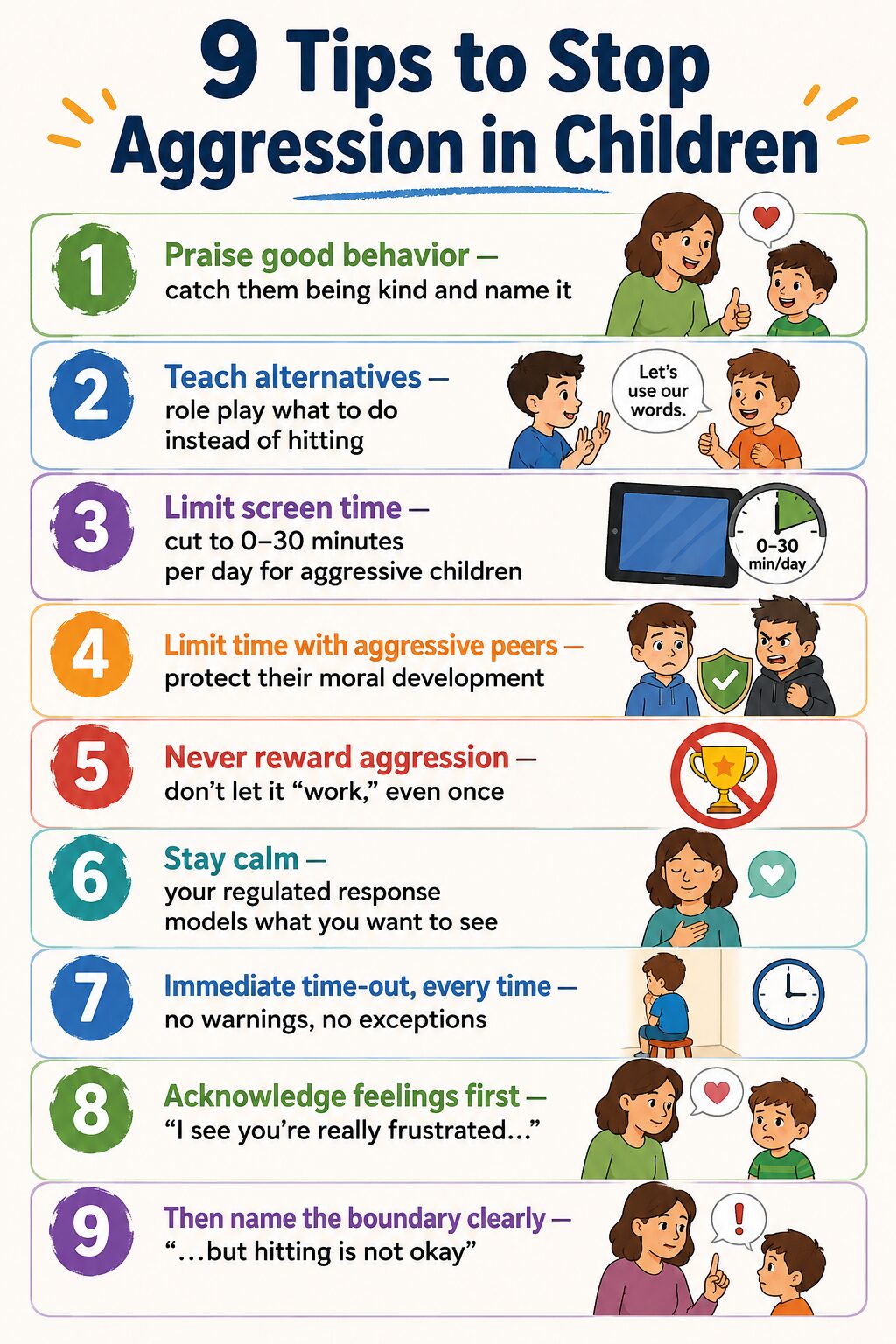
Summary: 9 Tips to Stop Aggression in Children
- Praise good behavior — catch them being kind and name it
- Teach alternatives — role play what to do instead of hitting
- Limit screen time — cut to 0–30 minutes per day for aggressive children
- Limit time with aggressive peers — protect their moral development
- Never reward aggression — don’t let it “work,” even once
- Stay calm — your regulated response models what you want to see
- Immediate time-out, every time — no warnings, no exceptions
- Acknowledge feelings first — “I see you’re really frustrated…”
- Then name the boundary clearly — “…but hitting is not okay”
These nine tips work together. You may not see overnight results, but with consistency and patience, you will see progress.
Related Posts:
- Logical Consequences to Stop Kids Hitting and Biting
- Why You Should Teach Your Toddler to Have Self-Control NOW
- How to Handle an Aggressive Toddler
- How to Respond to Siblings Fighting
- How to Discipline Your Strong-Willed Child
This post first appeared on this blog in May of 2011