
…and how to prepare
Worried about how the fall time change will affect your baby’s sleep schedule? Learn how to prepare ahead of time, minimize early wake-ups, and smoothly adjust your Babywise routine so everyone can transition through daylight saving time with less disruption.

Every autumn, the clocks “fall back” one hour — and if you have a baby on a Babywise schedule, you might be a little anxious about what that means. The good news? With a little preparation, you can transition through the time change with minimal disruption. Here’s everything you need to know.
Does the Time Change Really Affect Baby’s Sleep?
Short answer: yes, it can — but it doesn’t have to derail everything.
Your baby’s body runs on an internal clock called a circadian rhythm. It’s synced to light, temperature, feeding times, and wake times — all the cues we use intentionally in the Babywise method. When the clocks shift, the external clock and your baby’s internal clock suddenly don’t match, and that mismatch is what causes sleep disruption.
In the fall, we gain an hour. That sounds nice for adults who love sleep, but for babies it often means:
- Early morning wakings. Your baby’s body still thinks it’s 7:00 AM when the clock says 6:00 AM — or worse, they wake at 5:00 AM because their internal clock reads 6:00 AM.
- Shifted nap times. Naps may come earlier than your schedule calls for because your baby is genuinely tired at a time that now looks “too early” on the clock.
- Bedtime resistance. If bedtime is 7:30 PM, your baby’s body thinks it’s only 6:30 PM — they may not be tired yet.
The good news for Babywise families is that you’re already ahead of the game. Because you’ve been following a consistent eat/wake/sleep routine, your baby’s internal clock is well-established and predictable. That makes adjustment faster and more manageable.
When Does the Fall Time Change Happen?
In the United States, Daylight Saving Time ends on the first Sunday of November. At 2:00 AM, clocks “fall back” to 1:00 AM, giving everyone an extra hour.
Mark it on your calendar so you can start preparing about a week in advance.
Two Approaches: Gradual vs. Cold Turkey
There are two main strategies for adjusting your baby’s schedule through the fall time change. Which one you choose depends on your baby’s age, temperament, and your personal preference.
Option 1: The Gradual Shift (Best for Younger Babies and Sensitive Sleepers)
Start about 5–7 days before the time change and shift your baby’s entire routine forward by 10–15 minutes every day or two. By the time the clocks change, the transition is complete and your baby barely notices.
Here’s what that looks like in practice:
Example: Baby currently on a 7:00 AM / 10:00 AM / 1:00 PM / 4:00 PM / 7:30 PM schedule
| Day | Wake / First Feed | Nap 1 | Nap 2 | Nap 3 (if applicable) | Bedtime |
|---|---|---|---|---|---|
| 6 days before | 7:00 AM | 10:00 AM | 1:00 PM | 4:00 PM | 7:30 PM |
| 4 days before | 7:15 AM | 10:15 AM | 1:15 PM | 4:15 PM | 7:45 PM |
| 2 days before | 7:30 AM | 10:30 AM | 1:30 PM | 4:30 PM | 8:00 PM |
| Time change day | 7:00 AM (new time) | 10:00 AM | 1:00 PM | 4:00 PM | 7:30 PM |
By gently nudging the whole routine forward in small increments, you’re essentially resetting your baby’s internal clock before the official clock change happens.
Shift feedings with everything else. In Babywise, eat/wake/sleep is a cycle — not just a nap schedule. Shift the first morning feed first, and the rest of the day will follow naturally.
If you want it even more gradual, you can shift starting a month before. This really only works if you have that kind of flexibility in your schedule, but it really removes any sleep issues from the time change. Read how I did that here: Tips for Shifting Your Schedule (Time Change, Time Zones)
Also, remember that you can shift before the time change or after the time change (or some of both). It is okay to take a week or two to adjust to the new time.
Option 2: The Cold Turkey Method (Best for Older Babies and Toddlers)
Some families prefer to just let the time change happen and adjust all at once on the morning of. This works especially well for babies over 6 months who are more adaptable, and for toddlers who you can explain things to (however simply). This is also often the necessary method if both parents are working and your baby does not have a caregiver who can slowly adjust the schedule.
What to do:
- On the morning of the time change, start your day at your normal wake time on the new clock (e.g., 7:00 AM).
- Feed, play, and put down for naps according to the clock — not what the body “thinks.”
- Expect your baby to seem tired a little early the first day or two, especially for naps.
- Stick to your schedule consistently, and most babies regulate within 3–7 days.
This is a totally valid approach, especially if your baby is flexible or you don’t have a week of runway before the change.
>>>Read: How To Manage The Time Change Your Way
What to Expect in the Days After
Even with preparation, you may notice some residual effects for a few days after the time change. That’s completely normal. Here’s what commonly happens and what to do:
Early morning wakings (before your target wake time): Your baby may wake 30–60 minutes before you want them up because their body clock still hasn’t fully shifted. If they’re in a safe sleep space and not distressed, give them 10–15 minutes to resettle before going in. Over several days, this will naturally correct.
Shortened or shifted naps: Nap timing may feel off for the first week. Your baby might hit their sleepy cues earlier than the clock says, especially in the first few days. Honor those cues — trying to push an overtired baby to the “correct” nap time usually backfires.
Fussiness around bedtime: If bedtime feels too early for your baby’s body clock, they may resist going down. A slightly later bedtime (15–20 minutes) for a few nights can help bridge the gap while their body adjusts.
The most important thing: stay consistent. The eat/wake/sleep cycle is your anchor. Hold to your routine as closely as possible and your baby’s internal clock will sync back up within a week or so.
>>>Read: Time Change: Troubleshooting Sleep Issues
Age-Specific Tips
Newborns (0–3 Months)
Newborns aren’t yet on a strong circadian rhythm, so the time change may actually be a non-event. Their cycles are driven primarily by hunger, not the clock. Just continue following feed-on-schedule principles and watch for hunger cues. If they’re already sleeping stretches at night, a brief disruption is possible but usually short-lived.
Young Babies (3–6 Months)
By this age, your baby likely has a fairly established routine, and their internal clock is more developed. The gradual shift method works especially well here. Start shifting 5–7 days out and move the entire eat/wake/sleep cycle in 10–15 minute increments.
Older Babies (6–12 Months)
Babies in this range typically adapt well. You can choose either the gradual or cold turkey approach. One thing to watch: the fall time change often coincides with developmental milestones and sleep regressions (hello, 8-10 month regression). If your baby is already going through a rough patch, a little extra grace and consistency is the name of the game.
Toddlers and Pre-Toddlers (12–24 Months)
Toddlers often have strong opinions about sleep — and a time change can stir those opinions up. The extra hour of evening light can make it harder to wind down at bedtime. Using blackout curtains in the bedroom makes a significant difference. You can also help toddlers understand by talking about it simply: “When the big hand is here, it’s bedtime — even if it still feels light outside.”
>>>Read: Time Change with Older Children
Adjusting the Eat/Wake/Sleep Cycle
This is the Babywise-specific piece that makes all the difference. Because the Babywise method is built on a cycle rather than a rigid clock-based schedule, the time change affects the whole cycle — not just sleep times.
Here’s the key principle: shift the first morning feed, and the rest of the day follows.
Your morning feed anchors the entire day. If your baby normally eats at 7:00 AM, and you shift that to 7:15 AM for a few days, the next feed, the nap, the afternoon feed, and bedtime all shift naturally.
During the adjustment period, prioritize these three things:
- Consistent wake time — Even if your baby wakes early, don’t start the day until your target wake time (within reason). A consistent morning anchor helps reset the internal clock faster.
- Watch awake windows, not just the clock — If your baby shows sleepy cues before the scheduled nap time during the transition, it’s okay to put them down a few minutes early. An overtired baby makes everything harder.
- Don’t skip feedings to force the schedule — If your baby is hungry, feed them. The schedule is a guide, not a rule to enforce at the expense of your baby’s needs.
Quick-Reference Tips for the Fall Time Change
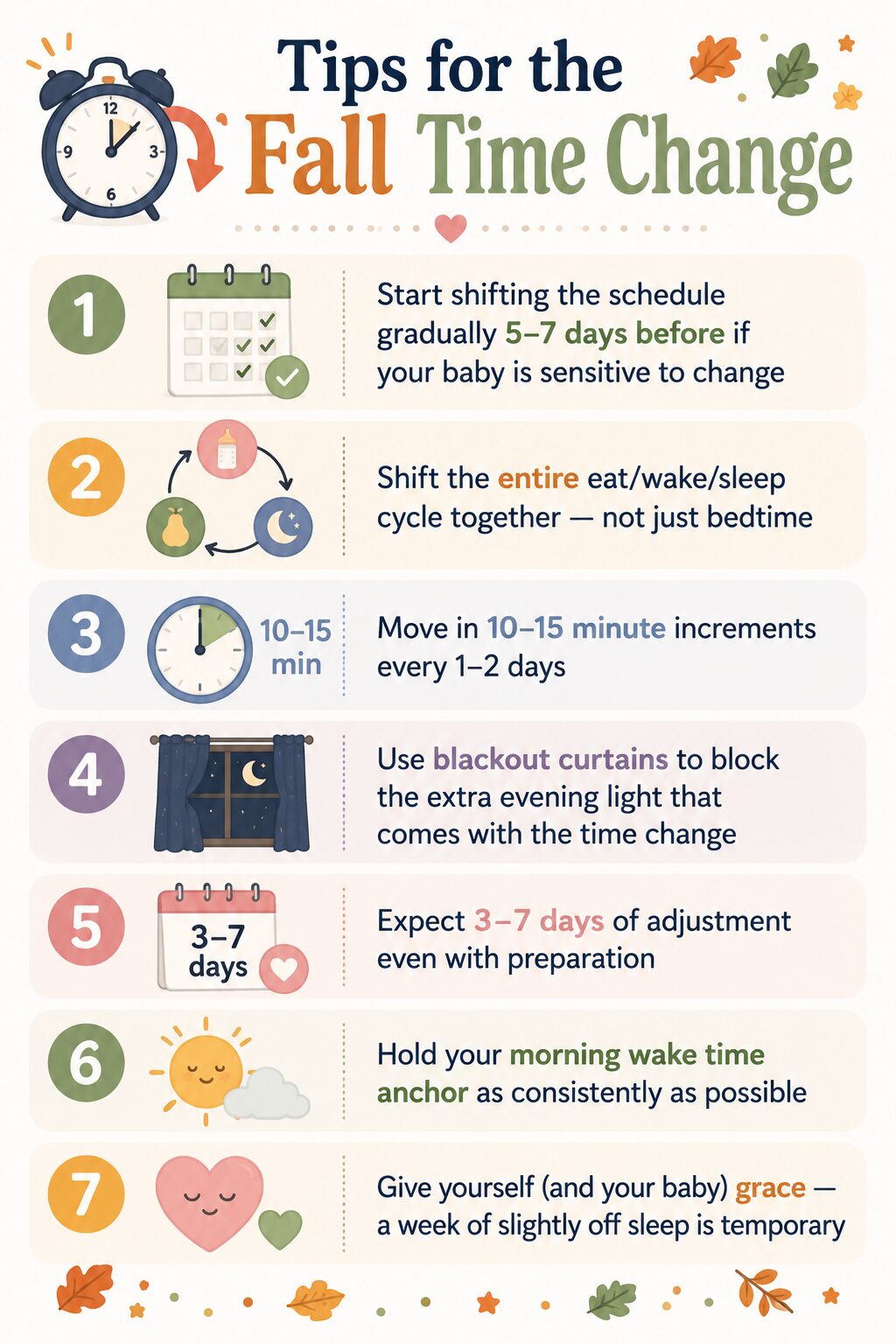
- Start shifting the schedule gradually 5–7 days before if your baby is sensitive to change
- Shift the entire eat/wake/sleep cycle together — not just bedtime
- Move in 10–15 minute increments every 1–2 days
- Use blackout curtains to block the extra evening light that comes with the time change
- Expect 3–7 days of adjustment even with preparation
- Hold your morning wake time anchor as consistently as possible
- Give yourself (and your baby) grace — a week of slightly off sleep is temporary
Conclusion
The fall time change is one of those parenting moments that sounds scarier than it actually is — especially when you’re using the Babywise method. Because you’ve already put in the work to establish a predictable eat/wake/sleep routine, your baby’s internal clock is well-calibrated and resilient.
Whether you choose to shift gradually or just wake up Sunday morning and roll with the new time, your baby will adjust. It might take a few days. You might have one or two rough mornings. But consistency is your best tool, and you already have it.
You’ve got this, mama.
Related Posts
- Tips for Shifting Your Schedule (Time Change, Time Zones)
- How To Manage The Time Change Your Way
- Time Change: Troubleshooting Sleep Issues
- Time Change with Older Children
- McKenna Baby Summary: Week 32
- Brinley Pre-Toddler Summary: 15.5 Months Old