Is it really a growth spurt — or something else? Learn the key signs to look for so you can stop guessing and start helping your baby (and your schedule) get back on track.
Every Babywise parent has been there. Your baby has been doing beautifully on a predictable schedule, napping well, and sleeping through the night — and then suddenly everything falls apart. Baby is waking early from naps, fussing between feedings, and acting like she hasn’t eaten in days.
Your first thought is probably: growth spurt.
But is it really?
Growth spurts get blamed for a lot of sleep and feeding disruptions. And honestly, sometimes the culprit is something else entirely — a nap transition, an illness coming on, a sleep association issue, or simply a bad couple of days. The problem is that misidentifying the cause means you could be “treating” the wrong thing, which just drags out the disruption longer than necessary.
So how do you actually know if your baby is having a growth spurt? Here are the clues to look for.
Start With the Timing
One of the quickest checks you can do is look at your baby’s age and when her last growth spurt was.
Growth spurts tend to happen roughly every 3–4 weeks. Based on my experience with four Babywise babies, the typical timeline looks something like this:
- Around 2–4 weeks old
- Around 4–6 weeks old
- Around 3 months
- Around 6 months
- Around 9 months
- Around 12 months
Now, these ages are a guideline, not a guarantee. No two babies follow the exact same schedule. But if your baby is close to one of these ages and is suddenly acting hungrier and sleeping poorly, that is a meaningful clue. Timing alone doesn’t confirm a growth spurt, but combined with other signs, it adds up.
If your baby just had a growth spurt two weeks ago and is showing these symptoms again, look a little harder for another explanation first.
Look at the Sleep Disruptions
The way sleep falls apart during a growth spurt is actually somewhat specific. Here is what typically happens:
Baby wakes early from naps. A baby going through a growth spurt is hungry, and that hunger wakes her up before the nap is done. If baby was reliably taking full naps and suddenly starts waking at the 30–45 minute mark, hunger is a likely reason.
Night wakings are at different times each night. This is a really helpful clue from Tracy Hogg (the Baby Whisperer). If your baby is waking at the exact same time every night — say, 3:17 AM like clockwork — that is more likely a habitual waking than a hunger waking. But if the night wakings are scattered (one night at 1 AM, the next at 3 AM, the next at midnight), that pattern is more consistent with genuine hunger from a growth spurt.
Baby was previously sleeping well. This one matters a lot. A sleep disruption that comes out of nowhere after a long stretch of good sleep is more likely to be a growth spurt than a deep-rooted sleep issue. If your baby has never been a great sleeper, a growth spurt won’t be as easy to spot because there isn’t a clear “before” to compare to.
Pay Attention to How Baby Eats
This is often the most telling clue of all.
If you feed baby early and she takes a full feeding, it is probably a growth spurt.
If you are breastfeeding, watch whether baby seems satisfied or whether she is pulling off, fussing, and clearly still hungry. If you are bottle feeding, notice whether baby is draining the bottle faster than usual or wanting more than her typical amount.
A baby who is waking early from naps AND eating well when you offer food early is almost certainly going through a growth spurt. That combination — early waking plus genuine hunger — is the clearest signal you can get.
On the other hand, if baby wakes early from a nap but then barely eats when you feed her ahead of schedule, hunger may not be the cause. You might be dealing with a sleep association issue or a developmental disruption instead.
One caveat: if you have a sleepy eater (very common in the newborn weeks), baby might still be slow to eat during a growth spurt just because that is her style. In that case, look at her overall behavior and whether it is different from her normal.
Watch for the Other Signs
Beyond sleep and eating, there are a few other signals that tend to show up during a growth spurt:
Crankiness and fussiness. A baby who is hungrier than usual and not sleeping as well is going to be a little out of sorts. If your typically happy baby is fussier than usual, and you can’t chalk it up to teething, illness, or overstimulation, a growth spurt is worth considering.
Baby seems “off” in a general way. Sometimes it is hard to put your finger on exactly what is different. Baby just seems less content, harder to settle, and not quite herself. That general “off” quality is a soft signal, but it counts.
Less frequent dirty diapers. This one surprises people, but babies often have fewer dirty diapers during a growth spurt. The reason makes sense when you think about it — baby’s body is using more of the food for actual growth, so there is less waste. Fewer dirty diapers alongside the other signs is a supporting clue.

Babywise Mom Book of Logs
Babywise Mom book of tracking sheets to keep track of everything you need to know to get your baby on a fabulous schedule and sleeping well.
This is my Book of Logs PDF. This is invaluable to troubleshooting naps, night, and other problems you encounter with a baby.
What Is NOT a Growth Spurt
Just as important as knowing what a growth spurt looks like is knowing what it doesn’t look like.
If the same-time night waking has been happening for more than a week or two, it is likely habitual. A true growth spurt only lasts about 3–7 days (though some babies run longer). If you are still in disrupted-sleep land two weeks later, something else is going on.
If baby wakes early from naps but is not hungry when you feed her, hunger is probably not the cause. Look at wake time length, sleep associations, or developmental changes instead.
If baby just seems cranky but is sleeping fine and eating normally, it probably isn’t a growth spurt. Teething, illness, overstimulation, or a schedule tweak may be worth looking at first.
If the disruptions started right after a nap transition or a schedule change, give that change time to settle before assuming growth spurt.
When You Are Not Sure, Treat It Like a Growth Spurt First
Here is the practical takeaway: if you genuinely cannot tell, treat it like a growth spurt for a few days. Feed baby more often, offer more food at each feeding if possible, and watch what happens.
If it is a growth spurt, baby will eat well and you will start to see things settle back to normal after a few days. If it isn’t a growth spurt, feeding baby more certainly isn’t going to hurt anything. You can always revisit other possibilities after a week if the disruptions continue.
Babywise is clear that you should always feed a hungry baby. So even if you are not 100% certain whether it’s a growth spurt, responding to hunger is always the right call.
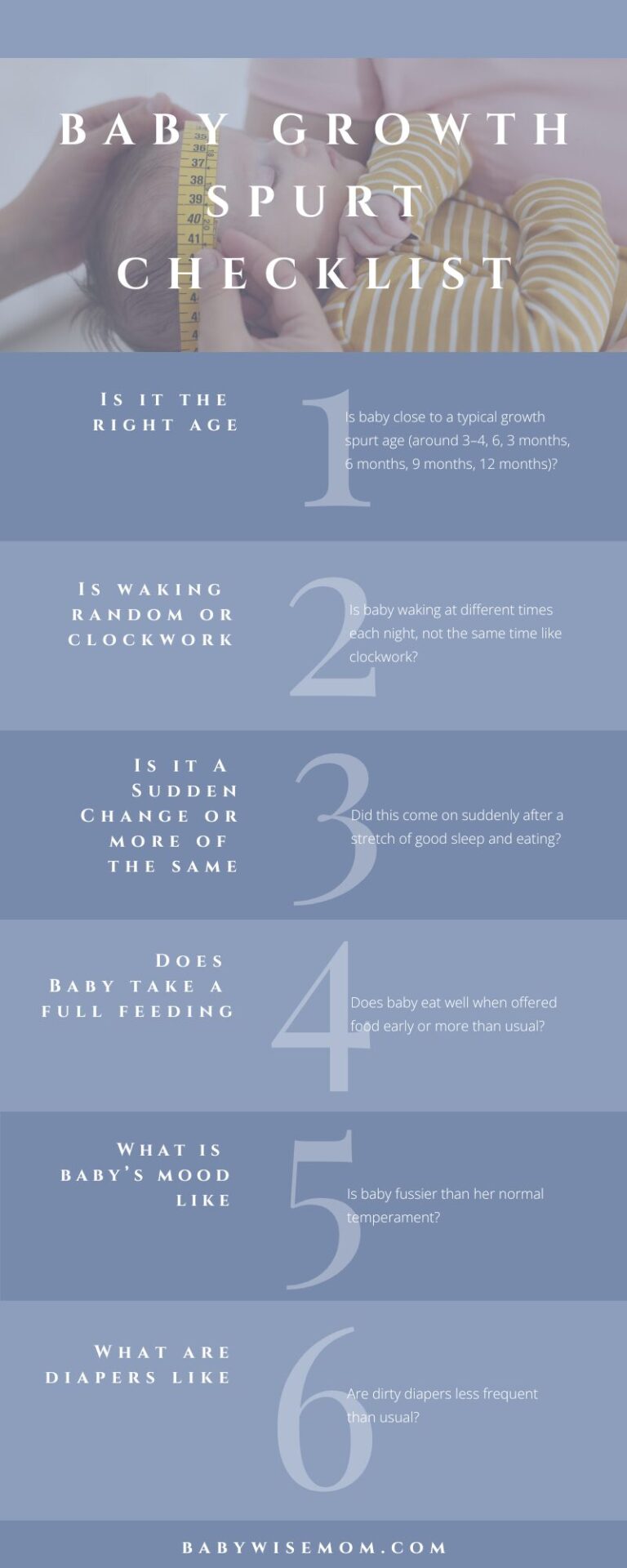
A Quick Summary: Growth Spurt Checklist
Ask yourself these questions:
- Is baby close to a typical growth spurt age (around 3–4, 6, 3 months, 6 months, 9 months, 12 months)?
- Is baby waking at different times each night, not the same time like clockwork?
- Did this come on suddenly after a stretch of good sleep and eating?
- Does baby eat well when offered food early or more than usual?
- Is baby fussier than her normal temperament?
- Are dirty diapers less frequent than usual?
The more of these boxes you are checking, the more likely it is a growth spurt. Feed baby, be patient, and know it will pass — usually within a week.
It Will End
Growth spurts are exhausting. I will not sugarcoat that. When McKenna was going through her growth spurts, some of them lasted nearly a week with her eating every two hours. That is a lot. But they always ended. Baby always went back to her normal schedule once her body had what it needed to grow.
If you are in the middle of one right now, hang in there. Keep feeding your baby, try not to panic about the schedule, and know that things will settle back down. This is such a normal, healthy part of your baby’s first year — even when it doesn’t feel that way at 2 AM.
Related Posts
- Baby Growth Spurts: Everything You Need To Know
- Baby Whisperer: Growth Spurts
- Babywise Instructs Parents to Feed Baby When Hungry
- The Basics of a Dreamfeed
- Cluster Feeding