
…and a Simple Routine That Works)… The best time for homework isn’t a magic hour — it’s consistency. Here’s why doing it soon after school beats waiting, plus a simple 3-step routine (talk, snack, homework) that keeps evenings calmer. What is the best time of day to have your kids do homework each day? Where should it fit in the routine? Read for tips!

Parents with children just starting school often wonder: what time should my child do homework? Do you do it right when they get home? Do you let them play for a while first, since they’ve already been at school all day? Do you try to knock it out in the morning before school? What actually works?
I was no different when my oldest son Brayden was starting school. I worried about making him sit down and do homework right after being at school all day. I also worried that if we waited, we’d forget to get it done at all. But I’m a big “work before play” person, so ultimately we landed on doing homework as soon as he got home from school, before any playing happened.
So, What Is the Best Time of Day for Homework?
My take: get homework done as soon after school as possible. If you let playing or TV happen first, you’ll find yourself battling “fun” every time you try to transition into homework mode. And late at night, right before bed, a child is usually too tired to focus well — and you’ll likely be too worn out yourself to handle it with any patience.
There’s also a practical reason to do homework the same day rather than saving it for the next morning: the brain processes what it learned that day while sleeping, so reviewing material soon after learning it tends to help it stick. On top of that, being rushed to finish homework before running out the door in the morning creates unnecessary stress for everyone. You never really know how long homework is going to take, so pushing it to the morning risks it not getting done at all.
You might wonder — aren’t kids tired when they get home from school? Children vary in this, just like adults do, but in most cases, a small break followed by getting the work done and out of the way works well. Then you and your child get to enjoy the rest of the evening without homework hanging over your heads. You can do a snack. You can take a walk. You can so something simple and short to give a slight break before doing homework.
Really, the best time to do homework is whatever time consistently works for your family. Picking one time of day and sticking with it so it becomes part of your routine is the real key. If soon-after-school doesn’t work for your family, experiment until you find what does. With that said, here’s the routine that has worked well for us.
Post Contents
- Talk About the Day
- Eat a Snack
- Do Homework
- What to Do If Homework Time Isn’t Working
- Adjusting the Routine as Kids Get Older
- FAQ: Homework Timing and Routines
Talk About the Day
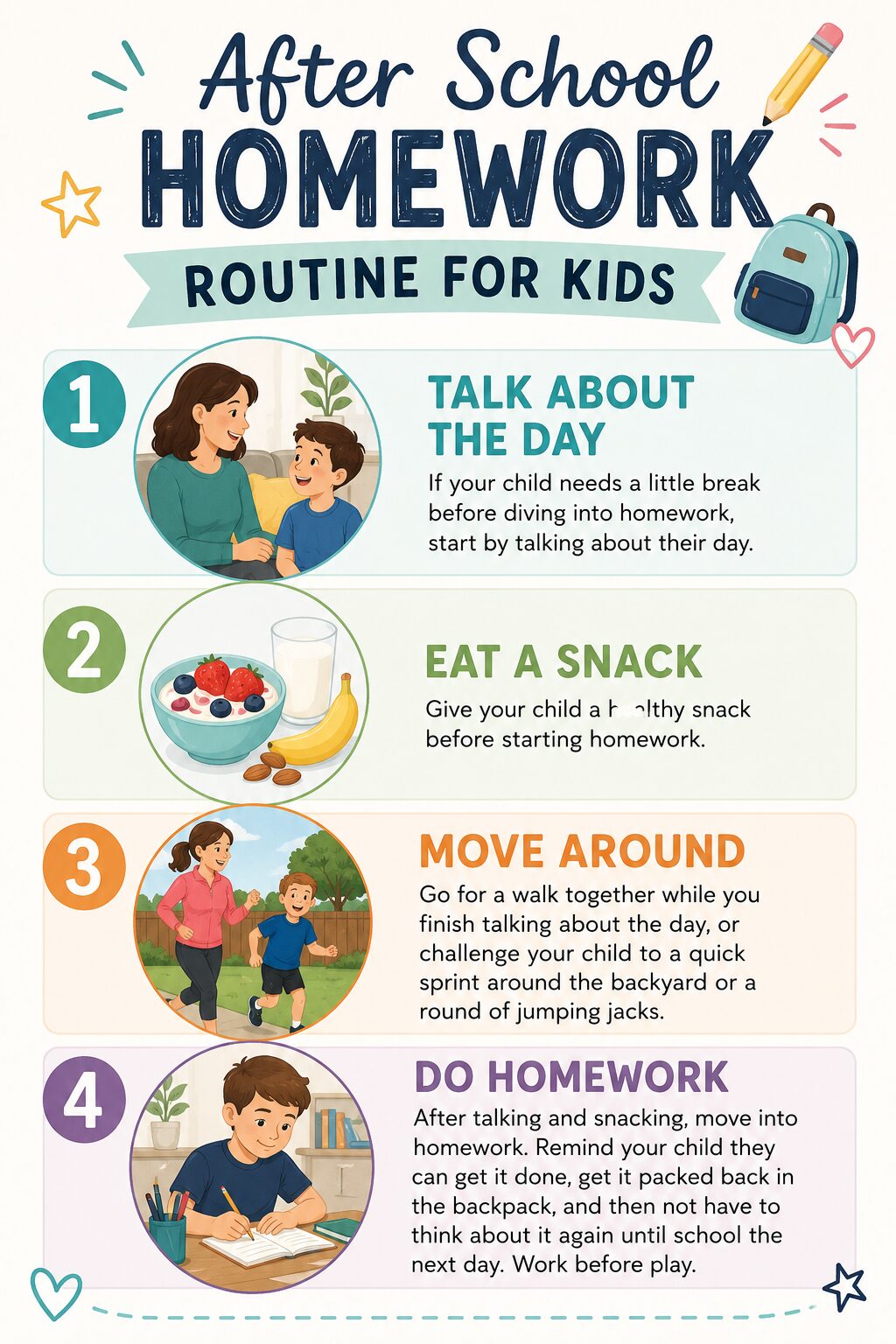
If your child needs a little break before diving into homework, start by talking about their day. It gives them a few minutes to decompress from the school day before shifting into work mode, and it doubles as good connection time for you two.
>>>Read: 45 Questions to Get Your Child Talking
Eat a Snack
Give your child a healthy snack before starting homework. This buys a few more minutes of transition time and helps with focus, since it’s hard for anyone — kid or adult — to concentrate well on an empty stomach after a long day.
>>>Read: 18 Healthy Snacks for After School for Your Kids
Do Homework
After talking and snacking, move into homework. Remind your child they can get it done, get it packed back in the backpack, and then not have to think about it again until school the next day. Work before play.
If your child is still struggling to settle in after the talking and snack, try adding in some movement. Go for a walk together while you finish talking about the day, or challenge your child to a quick sprint around the backyard or a round of jumping jacks. A little exercise can help a child sit still and focus for that next stretch of homework time.
When my kids were in elementary school, they often walked home from school. This gave them some time to decompress and get some physical movement in after school.
What to Do If Homework Time Isn’t Working
If you’ve tried the after-school routine above and it’s still a daily battle, a few small tweaks can make a big difference before you scrap the approach entirely:
- Shrink the transition. Some kids need only five minutes of talking and snacking before they’re ready; others need twenty. Pay attention to what your child actually needs rather than following a fixed number of minutes.
- Break homework into chunks. For a child who struggles to sit for a full block of time, try one subject, a short movement break, then the next subject.
- Keep the space consistent. Doing homework at the same table or desk every day, with the same supplies on hand, removes a layer of friction before the work even starts.
- Watch for a pattern, not just a bad day. One rough afternoon doesn’t mean the routine has failed — but if the same time of day is a struggle every single day, that’s useful information that it may be worth adjusting.
Adjusting the Routine as Kids Get Older
The after-school routine above works well for early elementary kids, but homework routines don’t have to stay static as your child grows. As kids move into upper elementary and middle school, homework volume increases, and after-school activities like sports or music practice start competing for that same time slot. Some families shift to a “homework after dinner” routine at that stage, or build in a set homework time that flexes around practice schedules. The underlying principle stays the same regardless of age: consistency matters more than the specific hour on the clock.
If your family is juggling homework alongside music lessons, sports, or other commitments, it can help to treat those the same way — same time, same expectations — so kids know what’s coming each day.
As your kids move into teen years, the idea is that the routines you have built in the young years will carry over into the teen years. What you want to do as the parent is back off and let them set their own homework time. It is perfectly okay for you to have policies of things that cannot happen until homework is done (like screen time). It would just be up to them when to do the homework. It is good for teens to start to take over their routine so they learn to manage their time themselves.
I have found that teachers in middle school usually give kids enough classroom time to work on homework. When kids know there are things they can’t do at home before homework is done, they are move motivated to just do it at school.
>>>Read: Scheduling Homework Time/Piano Practice Time/etc.
FAQ: Homework Timing and Routines
Is it better to do homework right after school or after a break? For most kids, a short break — long enough for a snack and a few minutes of conversation — works better than either diving in immediately or waiting a long time. A short break helps kids decompress without giving “fun” enough time to take over and make the transition into homework harder.
Should kids do homework in the morning before school instead? Doing homework the same day it’s assigned is generally better than saving it for the next morning. Sleep helps the brain process what was learned that day, and a rushed morning adds stress and risks the homework not getting finished before it’s time to leave.
What if my child is too tired to do homework after school? Try a short break with a snack and conversation first, and if that’s not enough, add in a few minutes of physical movement, like a walk or a lap around the backyard. Movement can help a tired child refocus enough to sit and finish the work.
Related Posts
- Scheduling Homework Time/Piano Practice Time/etc.
- 45 Questions to Get Your Child Talking
- 18 Healthy Snacks for After School for Your Kids
When do you do homework in your house? Do you have any special routines that help it go smoothly?


This post first appeared on this blog in August 2014