
The morning nap is one of the most important, if not THE most important, naps your baby will take all day. Learn why and how to get it down well. Why the first nap of the day is the one worth protecting above all others — and how to time it, troubleshoot it, and never accidentally skip it again.

Of all the parenting commitments I made when my babies were young, the one I held to most fiercely was this: protect the morning nap at almost any cost. Appointments got rescheduled. Outings got reorganized. We drove a longer route home if it meant arriving before nap time.
That might sound extreme. But once you understand what the morning nap actually is — biologically, not just logistically — you’ll understand why it earned that level of protection in our house. And why disrupting it tends to unravel the rest of the day in ways that no amount of afternoon catching-up can fully repair.
This post covers everything you need to know: the science behind why the morning nap matters most, exactly how to time it at every age, what goes wrong when it’s skipped or poorly timed, and how to troubleshoot common morning nap problems.
What’s Covered
- Why the Morning Nap Is the Most Important Nap
- The REM Sleep Connection
- How the First Nap Sets Up the Entire Day
- How to Time the Morning Nap by Age
- Signs You’ve Timed It Right (and Wrong)
- Common Morning Nap Problems and Solutions
- What Happens When You Skip the Morning Nap
- When to Drop the Morning Nap
- Frequently Asked Questions
Why the Morning Nap Is the Most Important Nap
When parents hear “the morning nap is the most important nap,” the first reaction is often confusion. Surely the longest nap — often the midday or afternoon one — matters more? Or the last nap, which gets baby to bedtime without being overtired?
The morning nap’s importance isn’t about length. It’s about timing and sleep architecture. The morning nap is biologically the closest nap to nighttime sleep, and it shares a key characteristic with it: high proportions of REM (rapid eye movement) sleep.
Most parents think of REM sleep primarily in the context of dreaming. But in babies and young children, REM sleep is far more significant than that. It’s the sleep stage most closely associated with brain development, memory consolidation, emotional processing, and nervous system regulation. When babies are learning at the explosive rate they do in their first year — new motor skills, language input, social development, cause-and-effect understanding — REM sleep is when much of that learning gets locked in.
“…the morning nap has more REM sleep than the afternoon nap; this suggests that in some infants, the morning nap may be viewed as a sort of continuation of night sleep.”— Dr. Marc Weissbluth, Healthy Sleep Habits, Happy Child, p. 29
This is the key insight. The morning nap isn’t a separate, isolated sleep event — it is functionally a continuation of the night’s sleep. The brain hasn’t finished its overnight work, and the morning nap is where that work gets completed. Interrupting it consistently means interrupting a biological process that your baby’s developing brain genuinely needs.
📖 What This Means Practically Because the morning nap is high in REM sleep, it’s especially restorative for cognitive and emotional development. A baby who consistently misses or shortchanges this nap isn’t just “a little tired” — she’s missing a developmental window that the afternoon nap, which is higher in non-REM deep sleep, cannot fully replace.
The REM Sleep Connection: What It Means for Your Baby
To understand why the morning nap is so special, it helps to understand how sleep cycles work in babies versus adults.
In adults, sleep cycles run roughly 90 minutes and follow a predictable architecture: light sleep → deep (non-REM) sleep → REM sleep → repeat. REM sleep is concentrated in the latter part of the night. This is why people who wake early consistently feel groggy and emotionally off — they’re cutting short their REM-rich sleep.
In babies, sleep cycles are shorter (around 45–60 minutes in young infants) and the ratio of REM to non-REM sleep is much higher — newborns spend approximately 50% of their sleep in REM, compared to about 20–25% for adults. This elevated REM proportion reflects how much brain development is happening.
The morning nap, as an extension of overnight sleep, continues the REM-rich pattern of the night. The afternoon nap, in contrast, tends to be higher in slow-wave (deep, non-REM) sleep — which is more physically restorative and supports growth hormone release, but is a different kind of rest than the morning nap provides.
This is why you can’t simply substitute one for the other. A baby who naps beautifully in the afternoon but consistently skips or shortchanges the morning nap is getting plenty of physically restorative sleep but potentially missing the cognitively and emotionally restorative sleep she needs.
💡 A Useful Analogy
Think of the morning nap as the closing chapter of overnight sleep — a gentle, REM-rich wind-down from the night. The afternoon nap is a separate event: a mid-day recharge. Both matter, but they are not interchangeable. Missing the morning nap is more like cutting overnight sleep short than it is like skipping an optional mid-afternoon rest.

How the Morning Nap Sets Up the Entire Day
Beyond its sleep architecture advantages, the morning nap plays a structural role in the rest of the day that parents often underestimate until they see what happens without it.
This nap sets the precedent for the rest of the day. That is why I preserve it.
A well-timed, well-executed morning nap accomplishes several things at once:
It anchors the schedule. When the morning nap is consistent — starting around the same time each day and lasting a predictable length — it creates a fixed point from which the rest of the day can be planned. Feeding times, the afternoon nap, and bedtime all fall into place when the morning nap is solid. When the morning nap is chaotic or skipped, everything downstream becomes harder to predict.
It prevents early-morning overtiredness from compounding. Babies have very short wake windows in the early months. A newborn may only be able to handle 30–60 minutes of wake time before she’s overtired. A 3-month-old might manage 60–90 minutes. If the morning nap is delayed — even by 20–30 minutes — a young baby can tip into overtiredness before she’s ever had a chance to start the day well. An overtired baby is harder to settle, sleeps lighter, and wakes sooner. The damage from a poorly timed morning nap ripples through every subsequent nap and into the night.
It makes the afternoon nap easier. A baby who has had a good morning nap is better regulated emotionally and physically by midday, which makes the afternoon nap easier to initiate and more likely to be a full, restorative sleep rather than a short, fragmented one. Many parents who struggle with short afternoon naps don’t realize the problem started that morning.
It protects nighttime sleep. A well-rested baby during the day — especially in the morning — is more likely to sleep well at night. The sleep-begets-sleep principle is real: overtiredness, paradoxically, disrupts rather than improves sleep quality. Protecting the morning nap is one of the most reliable ways to protect overnight sleep.
🔁 The Domino Effect
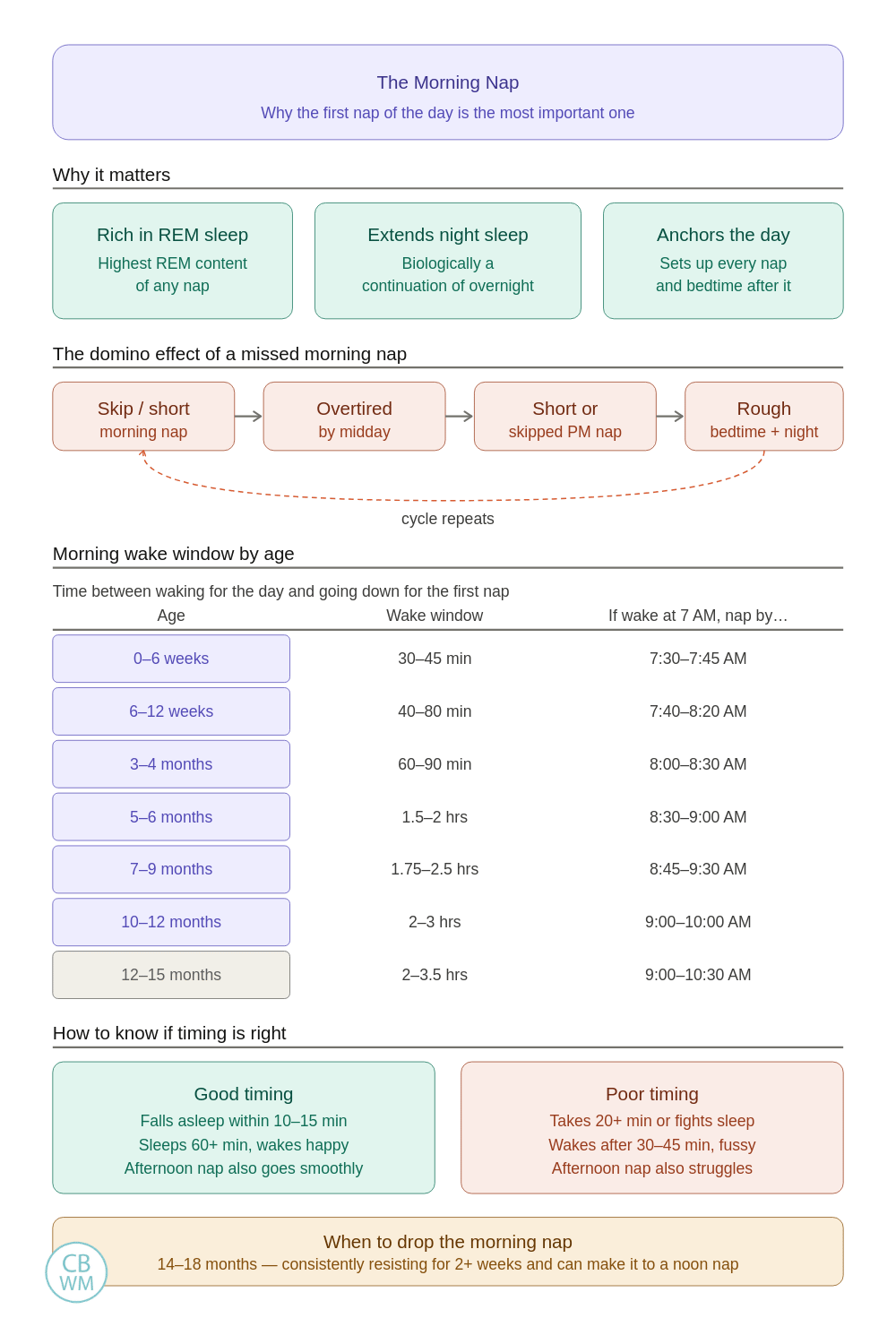
Morning nap goes wrong → baby is overtired at lunch → afternoon nap is short or skipped → baby is overtired by dinner → bedtime is a battle → overnight sleep is fragmented → baby wakes early → first wake window is extra short → morning nap is hard to time → repeat. Protecting the morning nap is how you interrupt this cycle before it starts.
How to Time the Morning Nap by Age
One of the most surprising things about the morning nap for new parents is how early it comes. Putting a baby down for a nap at 8:30 or 9:00 AM when she only woke at 7:00 or 7:30 AM feels wrong — like you’re rushing her back to sleep before the day has even started.
But this is exactly right. The first wake window of the day is typically the shortest wake window of the day. Remember: morning waking is not a fresh start from a fully rested state. It is the end of a night’s sleep that has gradually lightened toward waking. Your baby’s sleep pressure — the biological drive that makes sleep feel necessary — is lower in the morning than it will be later in the day. That means she genuinely needs to sleep again soon.
I remember talking to a friend on the phone one day as I put Brayden down for his morning nap. It was around 9 AM. She was shocked he was going down for a nap and asked what time he got up in the morning. She didn’t have kids yet and was surprised he would be napping at 9 AM.
The first waketime of the day is often the shortest waketime of the day. Remember, this nap is a continuation of night sleep, so wake time length should not be long.
>>>Read: Optimal Waketime Length: Finding Baby Wake Windows
Here is how to time the morning nap at different ages. These are wake window lengths — the time between waking for the day and going down for the first nap:
| Age | Morning Wake Window | Example: Wake at 7 AM | Expected Nap Length | Notes |
|---|---|---|---|---|
| 0–6 weeks | 30–45 min | Down by 7:30–7:45 AM | 1–3 hrs (variable) | May barely have a wake time — eat and back to sleep is normal |
| 6–12 weeks | 40–80 min | Down by 7:40–8:20 AM | 1.5–2.5 hrs | Still short; increase gradually as baby shows readiness |
| 3–4 months | 60–90 min | Down by 8:00–8:30 AM | 1.5–2 hrs | Begin to establish more consistent nap timing |
| 5–6 months | 1.5–2 hrs | Down by 8:30–9:00 AM | 1.5–2 hrs | Wake windows lengthening; watch sleepy cues closely |
| 7–9 months | 1.75–2.5 hrs | Down by 8:45–9:30 AM | 1.5–2 hrs | Two solid naps; protect this one |
| 10–12 months | 2–3 hrs | Down by 9:00–10:00 AM | 1.5–2 hrs | Approaching transition; don’t drop yet |
| 13–15 months | 2–3.5 hrs | Down by 10:00–10:30 AM | 1-2 hrs | Transition window — some days 1 nap, some days 2 |
Note: These are general ranges. Individual babies vary. Always combine these guidelines with your baby’s own sleepy cues (eye rubbing, yawning, decreased activity, staring) — the cues should confirm what the clock is telling you, not override it entirely.
📌 On Four-Hour Schedules
Once your baby moves to a four-hour feeding schedule, the morning wake window will still not always equal two hours. A younger baby on a four-hour schedule might have a 90-minute wake window followed by a 2.5-hour nap. The total time between feeds is four hours, but the sleep portion may be longer than the wake portion. This is normal and appropriate — don’t force baby to stay awake longer just to make the math feel even.
Signs You’ve Timed the Morning Nap Right (and Wrong)
Timing is everything with the morning nap. Too early and baby isn’t ready to sleep yet; too late and she’s overtired and harder to settle. Here’s how to read both situations:
- Good timing: Baby goes down with little or no fussing, falls asleep within 10–15 minutes, sleeps a full nap, and wakes up in a good mood. This is the gold standard. When the morning nap is well-timed, many babies won’t even stir at this nap — they simply go down, sleep, and wake happy.
- Too late (overtired): Baby is cranky and harder to settle than usual, takes a long time to fall asleep despite obvious tiredness, may fall asleep quickly but then wake after just one short sleep cycle (30–45 min), and wakes up fussier than when she went down. Overtired babies release cortisol to compensate for exhaustion, which interferes with sleep onset and quality.
- Too early (under-tired): Baby doesn’t seem sleepy when you put her down, talks or plays in the crib for 20+ minutes without falling asleep, or takes an unusually short nap. If this is consistent, try extending the wake window by 10–15 minutes each day until you find the right window.
- Good overall sign: The afternoon nap also goes smoothly. A well-timed morning nap makes afternoon nap success significantly more likely. If both naps are going well consistently, your timing is likely solid.
>>>Read: How to Tell if Baby is Overtired vs. Undertired
⏱️ The 10–15 Minute Rule
A baby who is put down at the right time should fall asleep within about 10–15 minutes. If she consistently takes longer than 20 minutes to fall asleep, the wake window is probably too short (not tired enough). If she falls asleep in under 5 minutes and wakes early, she may have been overtired. Use this as calibration data to adjust timing by 10–15 minutes in either direction.

The Babywise Mom Nap Guide
The Babywise Mom Nap Guide eBook helps you establish successful naps from birth through the preschool years. It is a great resource!
Gary Ezzo, co-author of Preparation For Parenting and On Becoming Babywise, states: “Whether it is talking about establishing good nap behavior or offering solutions to sleep disruptions, this is a practical resource that I trust and recommend. The book is well laid out and answers just about every question a new or seasoned mom might have about babies, toddlers and sleep. We view this as more than a nap guided; it is a resource of encouragement that comes with compassion.”
Common Morning Nap Problems and Solutions
Problem: Morning nap is consistently short (30–45 min)
This is one of the most common nap complaints and usually means baby is waking at the end of one sleep cycle rather than transitioning into the next. Possible causes: wake window is slightly off (either too short or too long), baby lacks the independent sleep skills to re-settle herself between cycles, the sleep environment has a disruption at the 30–45 minute mark (light, noise, temperature), or baby is genuinely only needing one cycle at this nap.
>>>Read: How to Finally Stop the 45 Minute Intruder
Solution: For the short morning nap
First, audit the sleep environment: check that the room is dark, white noise is running, and the temperature is appropriate. Then review wake window timing — try adjusting by 15 minutes in either direction for several days and observe. If baby wakes after one cycle and calls out, wait 5–10 minutes before going in; some babies will re-settle. If the short nap persists, focus on independent sleep skills during the nap. Read the Complete Troubleshooting Guide for Short Naps for a full workthrough.
Problem: Baby fights the morning nap / won’t fall asleep
If baby seems awake and alert when you put her down and doesn’t fall asleep for 20+ minutes, the wake window is likely too short — she simply isn’t tired enough yet. This is especially common when parents try to keep the morning nap very early because it “worked before,” without accounting for the fact that wake windows lengthen as babies develop. It can also happen around developmental leaps, when baby is simply too mentally activated to wind down.
Solution: For nap resistance
Extend the morning wake window by 10–15 minutes increments until you find the timing that produces a willing, quick-to-sleep baby. Pair nap time with a consistent pre-nap routine (2–3 minutes: diaper change, sleep sack, a brief cuddle or song, into the crib awake). Consistency in the routine signals to baby’s brain that sleep is coming. During developmental leaps, be patient — nap resistance during these windows usually resolves within 1–2 weeks.
Problem: Morning nap time keeps shifting later
As babies grow, their wake windows naturally lengthen, which pushes the morning nap progressively later. This is normal and expected — don’t try to hold the nap at the same time if baby is clearly showing she needs more wake time first. The shift from a 7:30 AM nap at 8 weeks to a 9:30 AM nap at 9 months is appropriate development, not a schedule problem.
Solution: For a shifting nap time
Follow the wake window, not the clock. As your baby’s wake window lengthens (which happens gradually — usually in 10–15 minute increments over weeks), let the nap start time adjust accordingly. Update your schedule every few weeks to reflect where baby actually is, rather than holding to a start time that made sense three months ago. At some point, you will move to a 4 hour feeding schedule.
Problem: Morning nap is great but afternoon nap is short
Counterintuitively, this can sometimes mean the morning nap is going too long, leaving insufficient sleep pressure for the afternoon nap window. If baby consistently sleeps 2+ hours in the morning and then can’t sleep in the afternoon, consider capping the morning nap at 90 minutes to preserve afternoon sleep drive.
Solution: Capping the morning nap
If you suspect the morning nap is crowding out the afternoon one, try waking baby after 90 minutes for a few days and see if the afternoon nap improves. This is especially worth trying with older babies (7+ months) who are on a two-nap schedule. Note: don’t cap the morning nap in the newborn period — young babies need all the sleep they’ll take.
What Happens When You Skip the Morning Nap
Life happens. Appointments run long. Car rides go at the wrong time. The occasional skipped morning nap is not a crisis. But habitually skipping or disrupting the morning nap — for weeks at a time — tends to have predictable, compounding consequences.
Here’s what typically unfolds when the morning nap is consistently disrupted:
Day 1 of a skipped morning nap: Baby is cranky and harder to settle by midday. The afternoon nap may come early and be shorter than usual, or baby may fight it entirely. Bedtime is often moved earlier to compensate. Baby may sleep well that night — the extra tiredness sometimes produces a solid overnight sleep. Don’t let this fool you into thinking skipping the morning nap is fine.
Over several days: Sleep debt accumulates. A baby who is consistently getting less total daytime sleep than she needs will show it in her mood, her feeding, and eventually her nighttime sleep. Cortisol levels stay elevated, which makes all sleep — day and night — shallower and more fragmented. What started as one short afternoon nap becomes chronic early waking, frequent night wakings, and a fussier baby overall.
The trap: When overtiredness causes early morning waking, many parents respond by keeping baby up longer in the morning, reasoning that a later first nap will help her make it through to the afternoon. This strategy sometimes seems to work short-term, but it often backfires — a later morning nap means later afternoon nap means later bedtime, and early morning waking continues because the root cause (sleep debt) hasn’t been addressed.
>>>Read: How to Fix Your Child’s Sleep Deficit
🚗 On Car Rides and Outings
One of the most common ways the morning nap gets accidentally disrupted is a short car nap — 15–20 minutes in the car that “counts” as a nap but doesn’t provide the full rest of a proper crib nap. This is sometimes called a “junk nap.” A car nap short enough to take the edge off baby’s sleep drive without actually completing a full restorative cycle can make the rest of the day harder than if baby had simply stayed awake. When possible, time outings to avoid the morning nap window entirely.
>>>Read: 10 Proven Strategies to Keep Baby Awake in the Car
When to Drop the Morning Nap
Despite being the most important nap of the day during the first year, the morning nap is the nap to go when baby transitions to one nap a day. This transition typically happens between 14 and 18 months, though some babies make the shift as early as 12 months and some as late as 20 months. DO NOT MOVE TOO EARLY. It leasds to sleep deficit.
This feels like a paradox: if the morning nap is so important, why does it get dropped first? The answer is that as babies develop, sleep pressure builds more slowly — they can comfortably stay awake longer. By around 15 months, many babies can manage a 5–6 hour wake window, which means one midday nap is sufficient. The afternoon nap becomes the single nap because it anchors the second half of the day most effectively and bridges to bedtime without the early-morning-waking problem that a single morning nap would cause.
Signs baby may be ready to drop the morning nap:
- Consistently resisting or refusing the morning nap for 2+ weeks
- Morning nap has shortened to 30–45 minutes or less and doesn’t improve with timing adjustments
- If given a morning nap, baby won’t take an afternoon nap at all
- Baby is 14+ months old and showing the above signs
- Baby can make it to an 11:00–12:00 PM nap comfortably without being overtired
⚠️ Don’t Drop Too Early
The 8–10 month sleep regression is one of the most common triggers for parents to consider dropping the morning nap prematurely. Baby starts resisting the morning nap, parents assume she’s transitioning, they drop it — and everything gets worse. Resistance to the morning nap during the 8–10 month window is almost always temporary. Don’t drop the morning nap at this age. The Dropping the Morning Nap Full Guide has everything you need for navigating this transition correctly.
Frequently Asked Questions
Why does my baby need a nap so soon after waking up for the day?
Because morning waking isn’t a fresh start from a fully rested state — it’s the natural end point of a night’s sleep that has been gradually lightening. Your baby’s brain hasn’t finished all its overnight work, and the morning nap completes it. The first wake window of the day is genuinely shorter than later ones because sleep pressure (the biological drive to sleep) is lower in the morning. As your baby grows, this first wake window will lengthen — but it will always be shorter than the windows later in the day.
My baby slept well last night — does she really still need the morning nap?
Yes, in almost all cases. A full night of sleep doesn’t eliminate the need for the morning nap — it actually sets it up. The morning nap’s importance isn’t about compensating for a bad night; it’s about completing the sleep architecture that nighttime sleep begins. The REM-rich quality of the morning nap is distinct from what afternoon naps provide, regardless of how well baby slept overnight.
My baby’s morning nap used to be perfect and now it’s suddenly short. What happened?
The most common culprit is a wake window that has quietly outgrown its timing. As babies develop week by week, their ability to stay comfortably awake lengthens — often in 5–15 minute increments that are easy to miss. If the morning nap was working at a 75-minute wake window a month ago and is now consistently short, try extending to 80 or 90 minutes and see if that restores nap quality. Other possibilities: a developmental leap, a new physical skill baby is practicing, or an environmental disruption in the sleep space.
What if our schedule requires us to be out during the morning nap sometimes?
Occasional disruptions are fine — life happens, and babies are adaptable. The goal is to protect the morning nap as a default, not to never leave the house. When you know a disruption is coming, try to ensure it’s genuinely occasional rather than recurring. If baby naps in the car or stroller on a disrupted day, a shorter or lower-quality nap is better than no nap. Get back to your normal routine the following day and give it 1–2 naps to recalibrate.
Is the morning nap or afternoon nap more important?
For babies in the first year on two naps, the morning nap is more important from a sleep quality standpoint — it has higher REM content and serves as a continuation of night sleep. However, the afternoon nap is more important from a schedule standpoint in the toddler years — when baby transitions to one nap, it will be an afternoon nap, not a morning one. Both matter; they serve different purposes. In the first year, prioritize the morning nap. After the transition to one nap, that single afternoon nap becomes the priority.
My baby is 9 months old and started fighting the morning nap. Should I drop it?
Not yet. Morning nap resistance at 8–10 months is extremely common and is almost always a phase — often linked to the 8–10 month developmental leap, increased mobility (crawling, pulling up), or minor schedule misalignment. Hold the morning nap through this phase. Most babies this age still genuinely need it. Try adjusting the wake window slightly and staying consistent with your pre-nap routine. The resistance typically resolves within a few weeks. The right age to drop the morning nap is generally 14–18 months.
Conclusion
The morning nap isn’t just the first nap — it’s the most biologically important nap of the day. Its elevated REM sleep content makes it a genuine extension of overnight sleep, not simply a convenient morning rest. Protecting it means protecting brain development, emotional regulation, and the structural foundation that the rest of the day’s sleep is built on.
Time it right for your baby’s age, read her cues, protect it from unnecessary disruptions, and troubleshoot it before changing anything else when the day falls apart. The morning nap will reward your effort more than any other nap you work to get right.
And when she finally naps beautifully and reliably every morning? Schedule around it. It’s worth it.
Related Posts
- Dropping the Morning Nap: Full Guide
- Timing the First Nap of the Day
- Complete Guide to Troubleshooting Short Naps
- Optimal Wake Time Lengths by Age
- When to Drop Baby’s Naps
- Baby Wake Windows Guide
- Sleep Begets Sleep
- Why Even Bother With Naps?
- The 8–10 Month Sleep Regression
- What To Do When Your Pre-Toddler is Taking a Short Morning Nap
- The Best Ages for Dropping Baby’s Naps
- How To Accurately Calculate Baby Wake Time Length

This post originally appeared on this blog September 2010