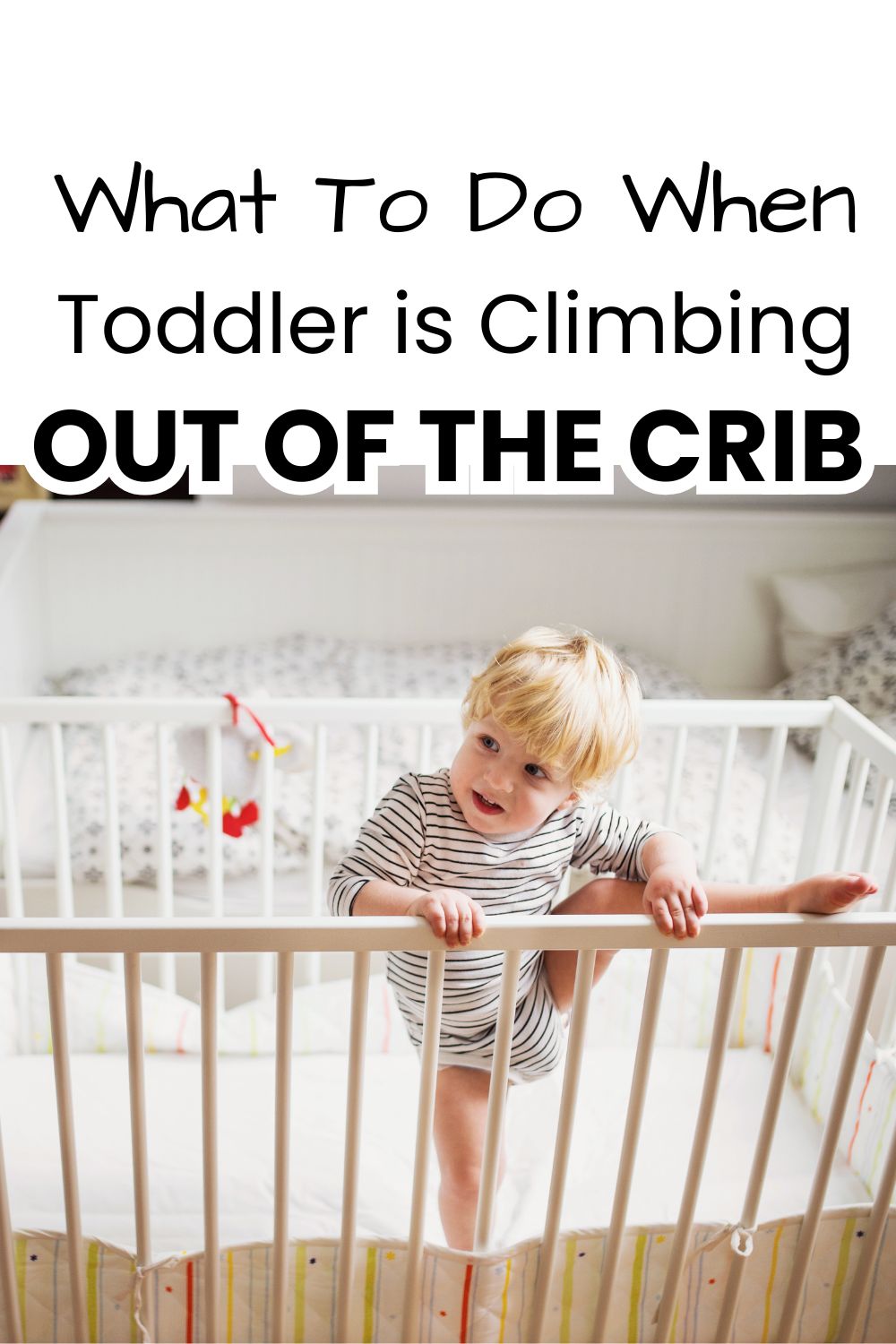
Is your toddler climbing out of the crib? Learn why it happens, how to keep your toddler safe, and how to know when it’s time to transition to a bed.

You hear a thud. Then little footsteps. Then your toddler appears in the doorway, grinning like he just won a gold medal.
Yep — he’s figured out how to climb out of the crib.
For a lot of us, this moment feels like it comes out of nowhere. One nap he’s happily playing with his lovey until he drifts off, and the next he’s swinging a leg over the crib rail like it’s an obstacle course. It can feel a little unsettling the first time it happens, but I promise you, it is incredibly common, and there is a lot you can do about it.
Let’s talk about why this happens, how to keep your toddler safe in the meantime, and how to know if it’s simply time to make the move to a bed.
Post Contents
- Why Toddlers Climb Out of the Crib
- Safety First
- How to Discourage Crib Climbing
- When Climbing Out Means It’s Time for a Bed
- What If You’re Not Ready to Make the Move Yet
Why Toddlers Climb Out of the Crib
Climbing out of the crib usually comes down to two things happening at once: your toddler’s body is capable of it, and your toddler’s mind wants to do it.
Physically, toddlers are gaining the strength, balance, and coordination to hoist themselves up and over a rail. Developmentally, toddlers are hungry for independence. This is the same drive behind wanting to pick out their own clothes or insisting they can pour their own milk. Once your toddler realizes the crib isn’t actually a boundary anymore, of course she wants to test it. That’s not defiance so much as it is a toddler being a toddler.
This tends to show up anytime from about 18 months to 2.5 years old, though some toddlers never attempt it at all, and others try it much earlier if they’re especially motivated climbers.
>>>Read: Surviving the “I Do It Myself!” Phase
Safety First
Before you worry about training or transitions, make sure your toddler’s crib and room are as safe as possible. A toddler who has figured out how to get out of the crib may do it again, even in the middle of the night, so it’s worth taking these steps right away rather than waiting to see if the behavior sticks:
- Lower the mattress to its lowest setting. This alone makes climbing out much harder and softens any fall.
- Clear the crib. Remove bumpers, large stuffed animals, or anything your toddler could use as a step to boost herself up and over.
- Baby-proof the room. If your toddler is loose in the middle of the night, you want the room itself to be a safe place for her to be in. Secure furniture, cover outlets, and remove anything breakable or dangerous.
- Think about a crib tent. These used to be marketed as an easy fix, but they’ve since been flagged as a safety hazard due to entrapment risk. Some say it is best to avoid them altogether. I will say, however, that I have many friends who have used this with no issues, and it saved their sanity (including a friend with twins). If you do use it, you will probably want a video monitor so you can keep track of the kiddo while they sleep and make sure everything is fine.
>>>Read: Sleep Routine Ideas to Get Your Baby Sleeping Well
How to Discourage Crib Climbing
If you aren’t ready to move to a bed yet, there are some things you can try first.
Turn the Crib Around
If your crib has one taller side, turn that side to face outward and push it into a corner. Having only shorter sides available makes it noticeably harder to get a leg over.
Try a Sleep Sack
A sleep sack limits leg movement just enough that swinging a leg over the rail becomes much more difficult. Some parents even put it on backward so it can’t be unzipped in the night. This is a simple, low-effort tool that can buy you real time.
Reinforce Obedience During the Day
This one might surprise you, but it matters more than almost anything else on this list. Your toddler’s willingness to stay in the crib at night is closely tied to how she responds to your instructions during the day. If you tell your toddler “stay” and she doesn’t, that same pattern is likely to show up at bedtime. Working on first-time obedience in everyday moments — mealtime, playtime, getting dressed — pays off at naptime and bedtime too. If you have a video monitor where you can watch your toddler, you can watch at nap time or after you have put your toddler to bed and tell them to lay back down if you see them up and trying to climb out.
>>>Read: First Time Obedience Tips
Keep the Crib and Room Boring
A dark room without toys or exciting things to look at gives your toddler less reason to want to get up and explore. Save the stimulation for waketime, and let sleep spaces stay calm and low-key.
Respond Calmly, Not Dramatically
If you catch your toddler climbing, a simple, calm “no, stay in your crib” goes a long way. Try not to overreact, laugh, or make a big scene, even if a small part of you thinks it’s impressive. Toddlers are quick to repeat anything that gets a big reaction out of mom or dad, good or bad. Wait and react after your toddler is out of sight and earshot.
Keep in mind that none of these strategies are a permanent fix. A mattress lowered all the way, a sleep sack, or a stern reminder might work well for weeks or months, and then one day your toddler figures out a workaround anyway. That’s normal. It doesn’t mean you did something wrong. It usually just means she’s ready for the next step.
When Climbing Out Means It’s Time for a Bed
Crib climbing is one of the clearest signs that your toddler may be ready to transition out of the crib altogether. If your toddler is also showing interest in potty training, understands and follows instructions well, and is close to that 12-24 month range (give or take), it may be time to start thinking seriously about the move to a bed.
>>>Read: Transitioning from a Crib to a Bed
This is a big transition, and I know it can feel scary. Will naptime fall apart? Will bedtime turn into a nightly negotiation? Will you lose all the sleep progress you worked so hard for?
The good news is that for most toddlers, especially those who are used to following your instructions during the day, this transition goes far more smoothly than parents expect. The crib was never really what kept your toddler in bed — your word was. Once you carry that same expectation over to the bed, most toddlers adjust well.
>>>Read: What To Do When Your Toddler/Child is Getting Out of Bed
What If You’re Not Ready to Make the Move Yet
Maybe your toddler is young for the transition, maybe you have a new baby who needs the crib, or maybe you’re just not ready to give up that contained, predictable sleep space quite yet. That’s okay too. There’s no rule that says the very first climb-out has to mean an immediate move to a bed.
Try the safety measures and deterrents above first. Many toddlers who make one dramatic escape attempt settle right back down once mom or dad responds consistently and calmly. If the climbing continues and becomes a nightly (or nightly-attempted) event despite your best efforts, that’s usually your sign that it’s time to stop fighting it and make the switch.
Conclusion
A toddler climbing out of the crib can feel like the end of predictable sleep as you know it, but it’s really just another normal milestone on the way to more independence. Focus on safety first, try a few simple deterrents, and keep working on obedience during the day. When the climbing becomes persistent, take it as your cue that your toddler is ready for the next stage: a big-kid bed.
Whatever stage you’re in right now, know that this phase passes, and on the other side of it is a toddler who sleeps well in a bed all her own.
Related Posts
- One Nap Schedules Perfect for Your Toddler
- 2 Year Old Sleep Problems – How To Solve Them!
- How To Deal with the 2 Year Old Sleep Regression
- What to Do When Your Toddler Cries at Nap Time