
Find the best amount of time your toddler should be awake between naps — and why getting it right makes all the difference for great daytime sleep and a smooth evening.

If you’ve been following along with Babywise, you already know that waketime length — the amount of time your baby is awake between sleep periods — is one of the single most important levers you can pull for great naps. But here’s what many parents don’t realize: that doesn’t stop when your baby turns one.
When I recently shared a graphic on Optimal Waketimes for 0–12 Months, so many of you asked for a toddler version too. Ask and you shall receive! (I love knowing what you actually need, so always feel free to leave feedback.)
Why Waketime Length Still Matters for Toddlers
It isn’t only babies who need their waketime length (also known as wake windows) dialed in. Toddlers are just as sensitive to the timing of sleep — sometimes even more so, because their internal clocks are becoming more regulated and they have stronger opinions about everything.
Here’s what goes wrong when waketime isn’t right:
Too much waketime before nap: An overtired toddler produces excess cortisol (the stress hormone) to stay awake. This actually makes it harder to fall asleep, not easier. You’ll often see a toddler who fights the nap, takes forever to settle, wakes early, or skips it entirely — and then melts down spectacularly by 5 p.m.
Too little waketime before nap: An undertired toddler simply isn’t ready for sleep. Their sleep pressure (the biological drive to sleep) hasn’t built up enough. The result? They lie in the crib wide awake, chatting or fussing, and sometimes never actually sleep — which, again, leads to a rough evening for everyone.
Getting waketime right is the foundation. Bedtime routines, sleep environments, and schedules all matter — but if your toddler’s wake windows are off, those other pieces can’t save you.

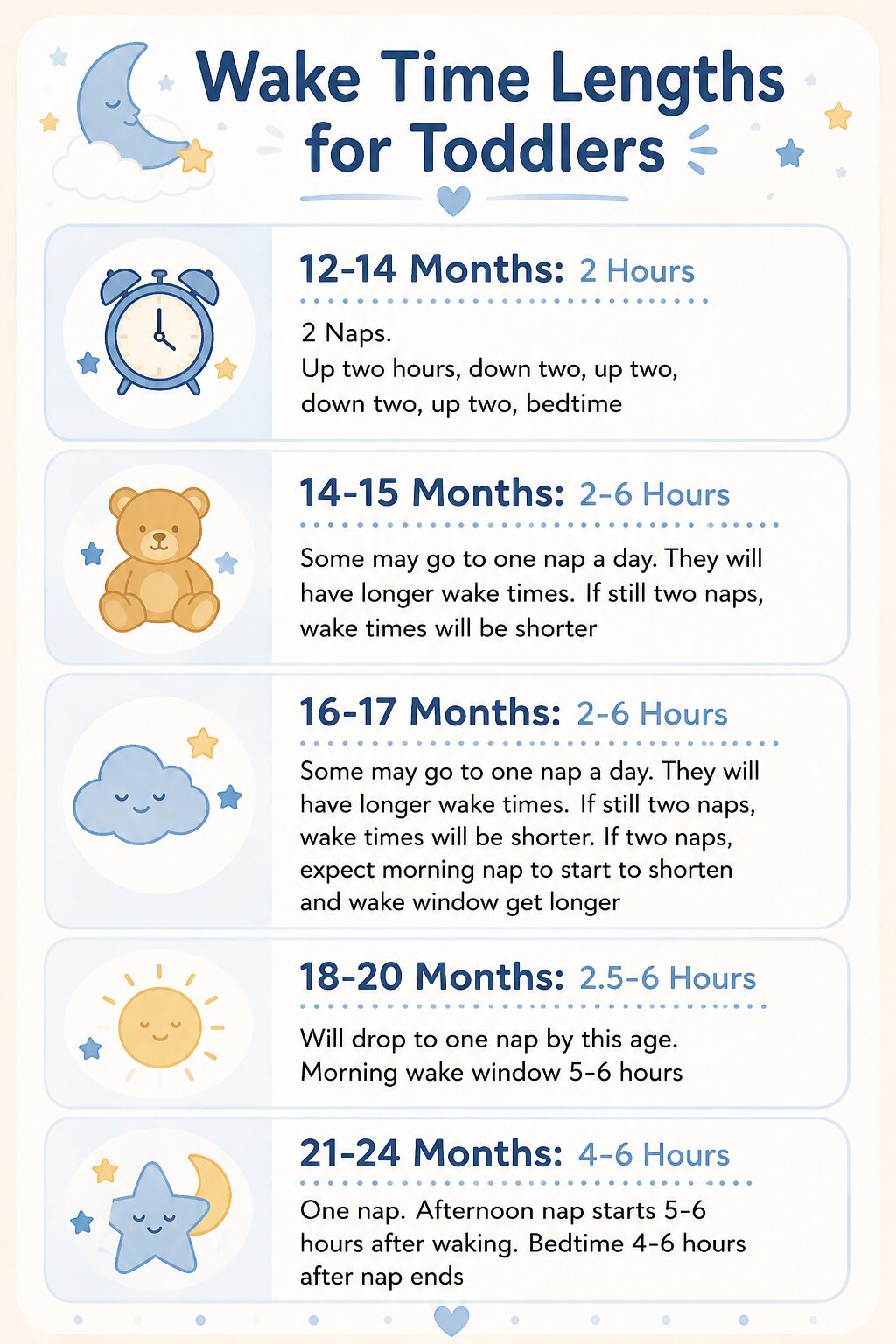
Optimal Waketime Chart: 12–24 Months
Here are the general waketime length guidelines for toddlers. These are ranges because every child is different, and your toddler’s ideal window can shift as they grow, drop naps, or go through developmental leaps.
| Age | Typical Waketime Length |
|---|---|
| 12–14 months | 2 hours |
| 14–15 months | 2-6 hours |
| 16–17 months | 2-6 hours |
| 18–24 months | 2.5-6 hours |
Note: These windows apply to the time before the nap. Waketime after the nap (before bedtime) is often longer, especially as toddlers consolidate to one nap.
(You can also view and download this chart in my Chronicles Book of Logs ebook.)
How to Find Your Toddler’s Personal Sweet Spot
The chart above gives you a starting point, but your child’s optimal waketime is something you observe and fine-tune. Here’s how I approach it:
Start in the middle of the range. If your 15-month-old is having nap trouble, try a 3-4-hour wake window and watch what happens. Is she falling asleep quickly and sleeping a full nap? You found it. Is she lying awake for 45 minutes? Try adding 15 minutes next time.
Adjust in small increments. When I was working on waketime with my kids, I moved in 5–15 minute increments — not giant jumps. Toddlers don’t need you to overhaul the schedule all at once. Small adjustments give you cleaner data on what’s actually working. Yes, even 5 minutes can make the difference with a toddler!
Watch for sleepy cues, but don’t rely on them alone. Toddlers are notoriously good at pushing through tiredness when they’re having fun. You might not see yawning or eye-rubbing until well past the optimal window. The clock matters as much as the cues.
Log it. Keep a simple sleep log for a week. What time did they wake? What time did they go down for nap? Did they fall asleep quickly? How long did they sleep? Patterns emerge faster than you’d expect.
What to Expect at Different Ages Within This Range
12–14 Months: Still on Two Naps (Maybe)
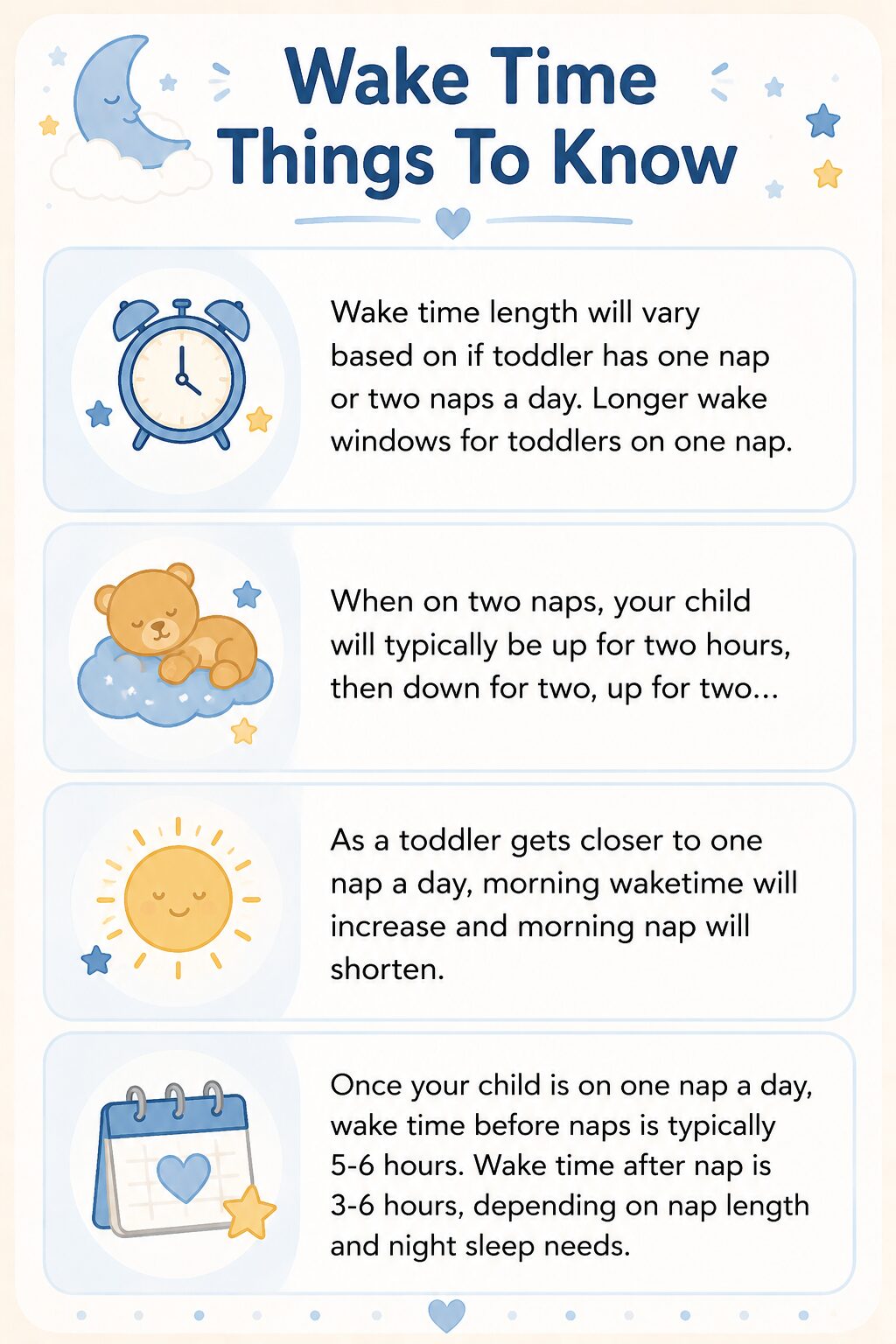
Toddlers should still be taking two naps at 12 months, and that’s completely normal. Because of this, wake windows are shorter — typically 2 to 2.5 hours before the first nap and 2-2.5 hours before the second.
If you’re seeing your toddler resist the second nap consistently, you might be approaching the nap transition. But don’t rush it — dropping the second nap too early can create an overtired toddler who’s miserable by late afternoon.
14 months is the earliest you want to move to one nap. At that point, your first wake window will increase.
15–18 Months: The Transition Zone
This is often the trickiest stretch. Some toddlers drop to one nap at 15 months; others hold on until 17 or 18 months. You’ll often have a period of inconsistency where some days your toddler sleeps fine with two naps and other days the second nap is a disaster.
During this transition, it’s okay to oscillate. Do two naps on days your toddler wakes early or seems extra tired; do one nap on days when morning waketime stretches naturally. The single-nap wake window during this age is typically 5–6 hours before nap time.
18–24 Months: Solidly One Nap
By 18 months, most toddlers are on one solid nap, usually after lunch. Wake windows at this age tend to run 5–6 hours before nap, with a longer window of 5–7 hours between nap wake-up and bedtime.
One common mistake at this age: letting the nap run too long (or too late), which pushes bedtime later and later. If your toddler’s bedtime is creeping past 8:30 p.m. and it’s a struggle, check when the nap is ending. A nap that ends after 3:30 p.m. is often the culprit.
Signs Waketime Is Off
Not sure if the schedule is the problem? Here are the most common red flags:
Signs of too-long waketime (overtired):
- Takes a long time to fall asleep despite being clearly tired
- Short naps (45 minutes or less)
- Wakes crying from naps
- Extremely fussy in the hours before nap or bedtime
- Early morning waking
Signs of too-short waketime (undertired):
- Plays happily in the crib but doesn’t sleep
- Takes a very long time to fall asleep without seeming distressed
- Nap feels forced — they’re just not tired yet
- Skips nap entirely but isn’t a wreck afterward
A Note on Consistency (and Grace for the Hard Days)
Toddler sleep is rarely perfectly smooth. Teething, developmental leaps, illness, travel, time changes, and new siblings (!) all throw things off. If you’ve had a few rough nap days, don’t panic and assume the schedule is permanently broken.
Start by asking: Has anything changed? New tooth coming in? Just started walking? New baby in the house? These all legitimately disrupt sleep, and your toddler will usually reset once the disruption passes.
One reader shared that her 13-month-old had been sleeping wonderfully until they moved to a new house — suddenly he was up at 5 a.m. and ready for a 5:30 p.m. bedtime. The advice? A new home can feel like an extended vacation to a toddler’s nervous system. Give it time, don’t reinforce the early rising by bringing him out of bed, and gently push bedtime later in small increments as things settle.
Another reader had a 14-month-old who had naturally transitioned to one nap, sleeping beautifully in the morning but rarely taking an afternoon nap. The fix wasn’t forcing the second nap — it was accepting that her son had moved on, keeping an afternoon rest time (in the crib or quiet play), and adjusting her expectations.
These are real situations, and they’re normal. Toddler sleep takes patience and observation.
Quick-Reference FAQ
My 12-month-old used to nap great and now fights naps. What happened? The 12-month sleep regression is real. It often coincides with walking and a big leap in cognitive development. It usually passes within 2–4 weeks. Stick with your schedule, check wake windows, and ride it out.
My toddler wakes up 45 minutes into the nap every day. Is this a waketime problem? Possibly. A 45-minute wake is often a sleep cycle issue — your toddler isn’t yet linking sleep cycles independently. But overtiredness can also cause this. Try extending waketime by 15 minutes and see if it helps.
What if my toddler’s wake window before the nap and before bedtime is very different? That’s normal! The post-nap wake window is almost always longer than the pre-nap one. A typical 18-month schedule might look like: wake at 7 a.m., nap at noon (5-hour window), wake from nap at 2 p.m., bedtime at 7:30 p.m. (5.5-hour window). Both windows are within range.
My toddler isn’t sleeping well no matter what I try. When should I worry? If you’ve been consistent with schedule, environment, and wake windows for 2+ weeks and sleep is still a significant problem, it may be worth talking to your pediatrician to rule out anything medical (ear infections, reflux, sleep apnea in toddlers). For behavioral sleep issues, see the sleep problems section of this blog.
Related Posts You’ll Love
- Babywise Sample Schedules: 12–15 Months Old
- Babywise Sample Schedules: 16-18 Months Old
- Dropping the Morning Nap: A Complete Guide
- Sleep Regression: Causes, Ages, and What to Do
- Two-Year-Old Sleep Regression
- 2-Year-Old Sleep Problems — How to Solve Them
- Optimal Waketimes for 0–12 Months
- Dropping the Morning Nap Transition Time
Caring about naps and night sleep doesn’t end when your baby becomes a toddler — and it won’t end after that, either. But with the right wake windows, a predictable schedule, and a little patience, your toddler can be a fantastic sleeper. You’ve got this.
You can view this graphic below on this blog–you can bookmark the page or Pin the image. You can also view it on my Drive. I have added it to my Chronicles Book of Logs. When you purchase that ebook, you will have it included.


This post first appeared on this blog in May 2016
Hi Valerie! I live by your blog and am so grateful for you and the effort you put in to helping parents! I did Babywise with my older daughter and it worked like a dream but could use your help with my son. We have had a lot of changes during my sons first year and I feel like I haven't been able to give his sleep the attention it needs. He is 13 months, 11 days today and our issue is that he is repeatedly waking at 5:00am each day. (We just moved into a new house 2 weeks ago and prior to that he was a very good sleeper). He takes 2 great naps each day but because of the early waking he is ready to go to bed each night at 5:30pm… How do I get back on our 7 to 7 routine?? Help please!! (I should mention, he has blackout shades and all the comforts of home in his room. And my daughter (3 years) is waking early now too…. Is this just a sun issue?)
Hi Sarah! So glad to know the blog is helpful for you! I would say it is mostly if not fully due to the move. That can take some time to get used to sleeping in a new place. It is like being on vacation for weeks!For the early bedtime, just slowly work back so instead of a 5:30 bedtime, you are doing 5:45. After a few days, do 6:00. Continue that.But is he still napping? If he is napping, I would let he make up of sleep happen during nap, not a really early bedtime. Make sure he isn't getting out of bed at 5:30. When he wakes up at that time, you can go in and tell him that it is still night time and he needs to go back to sleep. So don't get him out of bed until the time you want him getting up.Good luck!
Thanks so much Valerie for responding! He is still napping and will sleep about 4-5 hours during the day. You're saying I should limit that to where he may sleep longer at nighttime? I had sort of been using the "sleep begets sleep" method praying he would snap out of it. 🙂 Thanks again!
Help me thank hacckintechnology after being scammed of $1500 he helped me find my cheating wife he helped hack her whatsapp gmail and kik and i got to know that she was cheating on me , in less than 24 hours he helped me out with everything hackintechnology is trust worthy and affordable contact [email protected] IF U Need Any Help ?*University grades changing *Bank accounts hack *Twitters hack *email accounts hack *Grade Changes hack * load bank account any amounts*Website crashed hack *server crashed hack *Retrieval of lost file/documents *Erase criminal records hack *Databases hack *Sales of Dumps cards of all kinds *Untraceable Ip *Individual computers hack *Websites hack *Facebook hack *Control devices remotely hack *Burner Numbers hack *Verified Paypal Accounts hack *Any social media account hack *Android & iPhone Hack *Word Press Blogs hack *Text message interception hack *email interception hack- See more at:[email protected]
Should you ever require the services of a hacker, i implore you to try your very best to hire only professionals. [email protected] will increase your chances of getting your job completed. i was able to hire the services of an elite, asides the fact that i was provided a permanent solution to the service he rendered me but he gave a very efficient customer experience. he carried me along with every process and didnt leave me in the dark.contact him via email/phone [email protected] or +1 916 378 4978 Tell him i reffered you.He will help you
i met a guy called Sam ,he helped me hack into my spouse INSTAGRAM,KIK,FACEBOOK AND GMAIL. Now i can monitor my spouse day to day messages and activities with out him knowing .he is very kind and i compensated him after his services. contact him at : [email protected]. Number:+16066579237.INSTAGRAME: Samhoffman3.. …you can try him out?
If you know you not are ready for a relationship why get into one and still cheat and liar. I and my wife has been married for some years now,Lately she has been hiding her phone from me and keeping Late nights. I was curious about her cheating on me.I had no proof and no one to run to.I contacted a Private investigator who linked me up with Mr James([email protected]) via email. He understood me well and helped me spy on my cheating wife.He gave me the password to my wife's Gmail and Facebook account and linked all my spouse WhatsApp and phone conversation to me, to find out the truth. I just want to openly say thank you. Contact him today if you need help. [email protected]
My wife was so smooth at hiding her infidelity so I had no proof for months, I was referred to some hacker and decided to give him a try.. the result was incredible because all my cheating wife's text messages, whatsapp, facebook and even phone conversations was wired directly to my cellphone. [email protected] helped me put a round-the-clock monitoring on her and I got concrete evidence and he showed me proof..if your spouse is an expert at hiding his cheating adventures contact him via email/phone [email protected] or +1 916 378 4978 Tell him i reffered you.He will help youY
If you need to hire a real hacker to help spy on your partner's cell phone remotely, change your grades or boost your credit score. Contact this helpline 347.857.7580 or the email address [email protected]
Hello, my name is Dave Gray, I’m on my late forties. I just want to use this medium to say a very big thank you to Jonny for the great thing you did for me as my wife wanted to ruin my life and take all our life savings together. It was a hard way and a bad one to experience at this time in my life. I was able to get my own share of the money by using this great hacker my coworker introduced me to him to hack into her cell phone to enable him receive the transfer code after he hacked into our bank account via Online banking system. His name is Jonny Belter. ([email protected]) I know a lot of people are going true this in the world today. If you can see my message do not hesitate to contact him immediately and he also handles all hacking jobs you want. Facebook, Whatsapp, snapchat, viber, instagram DM, email hack, telephone conversation, Imo, voice notes, videos, pictures, criminal records, change of school grades, credit card hack and bank account hack. email him and get a quick response. ([email protected])
Hello, my name is Dave Gray, I’m on my late forties. I just want to use this medium to say a very big thank you to Jonny for the great thing you did for me as my wife wanted to ruin my life and take all our life savings together. It was a hard way and a bad one to experience at this time in my life. I was able to get my own share of the money by using this great hacker my coworker introduced me to him to hack into her cell phone to enable him receive the transfer code after he hacked into our bank account via Online banking system. His name is Jonny Belter. ([email protected]) I know a lot of people are going true this in the world today. If you can see my message do not hesitate to contact him immediately and he also handles all hacking jobs you want. Facebook, Whatsapp, snapchat, viber, instagram DM, email hack, telephone conversation, Imo, voice notes, videos, pictures, criminal records, change of school grades, credit card hack and bank account hack. email him and get a quick response. ([email protected])
Hello, my name is Dave Gray, I’m on my late forties. I just want to use this medium to say a very big thank you to Jonny for the great thing you did for me as my wife wanted to ruin my life and take all our life savings together. It was a hard way and a bad one to experience at this time in my life. I was able to get my own share of the money by using this great hacker my coworker introduced me to him to hack into her cell phone to enable him receive the transfer code after he hacked into our bank account via Online banking system. His name is Jonny Belter. ([email protected]) I know a lot of people are going true this in the world today. If you can see my message do not hesitate to contact him immediately and he also handles all hacking jobs you want. Facebook, Whatsapp, snapchat, viber, instagram DM, email hack, telephone conversation, Imo, voice notes, videos, pictures, criminal records, change of school grades, credit card hack and bank account hack. email him and get a quick response. ([email protected])
Should you ever require the services of a hacker, i implore you to try your very best to hire only professionals. [email protected] will increase your chances of getting your job completed. i was able to hire the services of an elite, asides the fact that i was provided a permanent solution to the service he rendered me but he gave a very efficient customer experience. he carried me along with every process and didnt leave me in the dark.contact him via email/phone [email protected] or +1 916 378 4978 Tell him i reffered you.He will help you
Confront your cheating spouse with evidence, i was able to spy on my cheating ex phone without finding out…..it really helped me during my divorce …you can contact ([email protected]) call and text (305) 771-2040 for spying and hacking social networks, school servers, icloud and much more, viber chats hack, Facebook messages and yahoo messenger, calls log and spy call recording, monitoring SMS text messages remotely, cell phone GPS location tracking, spy on Whats app Messages, his services are AFFORDABLE ……………………………… ONLY GOD CAN THANK HIM FOR ME
Sorry I know this is an older post, but I have a 14month old who only has one nap a day for about a month now. He is up around 8am, sometimes 8:30 and goes down 3 hours after getting up with no problems. If I miss that window or try to stretch it we get crazy meltdowns. Then he usually naps 2 hours so is up by 1 or 1:30. I try another nap 3 hours after that but he has rarely fallen asleep for it for the past month. He goes to bed around 7 then maybe 7:30. So he is up for like 6 hours and mostly ok but lately has been melting down over things lately in the evening. I’m guessing the 2nd nap is too close to bedtime and messes with things so he doesn’t sleep. He acts sleepy and plays in his crib in darkened room with noise machine and I’ve left him in there half hour and longer but no nap. So now I treat it as a rest time. Should I try to stretch it to 4 hours and see what happens or just accept this is what it is? I wonder too if waking him at 7 would give more daytime for naps? Any advice you can give is appreciated!
Hello!
I would try extending time between morning wakeup and the first nap if possible, but not at the expense of the nap. I would try adding five minutes to the waketime length (yes, just 5!) and see what happens. If he still sleeps well, add another five and another five until he does not sleep well anymore.
Does he have independent playtime? If not, I would add that in. And while the morning nap is so early, I would stick with your afternoon rest time.
Part of his meltdowns can just be age appropriate. This is an age when they really start to have little tantrums. So read up on the tantrums posts and discipline posts for help on that. This is a good one to start with: https://www.babywisemom.com/mini-fit/
Hello,
My 2.5yr old is a great sleeper, she still needs a nap in the afternoon and tends to have an hour to an hour and a half as I wake her at 2.30pm as we’ve been having difficulty with her falling asleep at bedtime.
She normally has “chill out time” from 6.30-7pm which is often watching a tv programme (she has very little through the day and is very busy most of the time) then Bath, pjs, story and milk all with a low lamp on, then normally in bed for 7.30pm however she’s not falling asleep until 9pm! She’s quite happy and often is just laid quietly in her bed. She has a white noise app which plays a shh sound for 20mins. I’ve tried playing gentle music too but it’s not helped.
Do you have any suggestions? I don’t really want to stop her afternoon nap as I feel she still needs it and if she doesn’t have it is over tired at bedtime and is unsettled.
Thanks in advance
Cathy
Hello! This is actually super normal for this age! I will link a couple of posts to help you: https://www.babywisemom.com/2-year-old-sleep-problems/
https://www.babywisemom.com/two-year-old-sleep-regression/
Hey Valerie–Love your stuff! We’ve followed your wake time chart since my son was a newborn. He is 16 months (was born a month early–premie) and has started not taking good afternoon naps. This is our current schedule: 7 wake, 9:30 nap, wake around 12, 2:30-4:30 nap, 8 bedtime. I have found that if he sleeps past noon and I don’t wake him up for lunch, he will sleep until 1 or so and refuse to take his afternoon nap. I’d like him to eventually drop his morning nap (library playtime, ward playgroup, swim days, etc. are all in the morning). He is usually solid on morning nap but often talks to himself in his crib for 30 min-1 hr. (or more) before he falls asleep for a short nap in the afternoon. He is very vivacious and always cries when it is nap time and he has to come inside or stop playing. Should I keep waking him up at noon for lunch? Should I change his waketime length in the morning? My goal is for him to eventually drop morning nap and just take a solid nap after lunch. He has only been walking for 5 weeks and got his first sibling (new baby brother) 10 weeks ago. Ideas? Thank you!
Hello!
I am wondering if he is ready for just one nap a day. Have you considered that? He is in the normal range for dropping to one nap. Check this post out: https://www.babywisemom.com/dropping-morning-nap-guide/