
Baby waking at night? Solve the mystery with this comprehensive troubleshooting guide. Identify whether it’s hunger, habit, pain, or sleep needs—then apply the right solution to finally get your baby (and you!) sleeping through the night. How to solve baby’s nighttime sleep issues and get baby sleeping through the night. Get your baby on a solid sleep schedule.
A complete troubleshooting guide — from identifying why your baby wakes to step-by-step fixes that finally get everyone sleeping through the night.

While daytime naps are something every parent wants to get right, nighttime sleep is something we all need to get right. A well-rested baby is a happier, calmer baby — and a well-rested parent is a more patient, present one. The two go hand in hand.
Here’s something reassuring to know from the start: all people, babies included, wake briefly between sleep cycles throughout the night. That is completely normal. The goal isn’t to stop night wakings entirely — it’s to help your baby develop the ability to transition back into the next sleep cycle on her own, without needing you to help her get there. Once she has that skill, everyone wins.
This guide covers the most common reasons babies wake at night — both consistently and sporadically — and walks through exactly how to address each one. Think of it as a troubleshooting flowchart for nighttime sleep.
Post Contents
- Why Diagnosing the Root Cause Matters
- Babywise Mom Book of Logs
- Reasons Baby Wakes Consistently Every Night
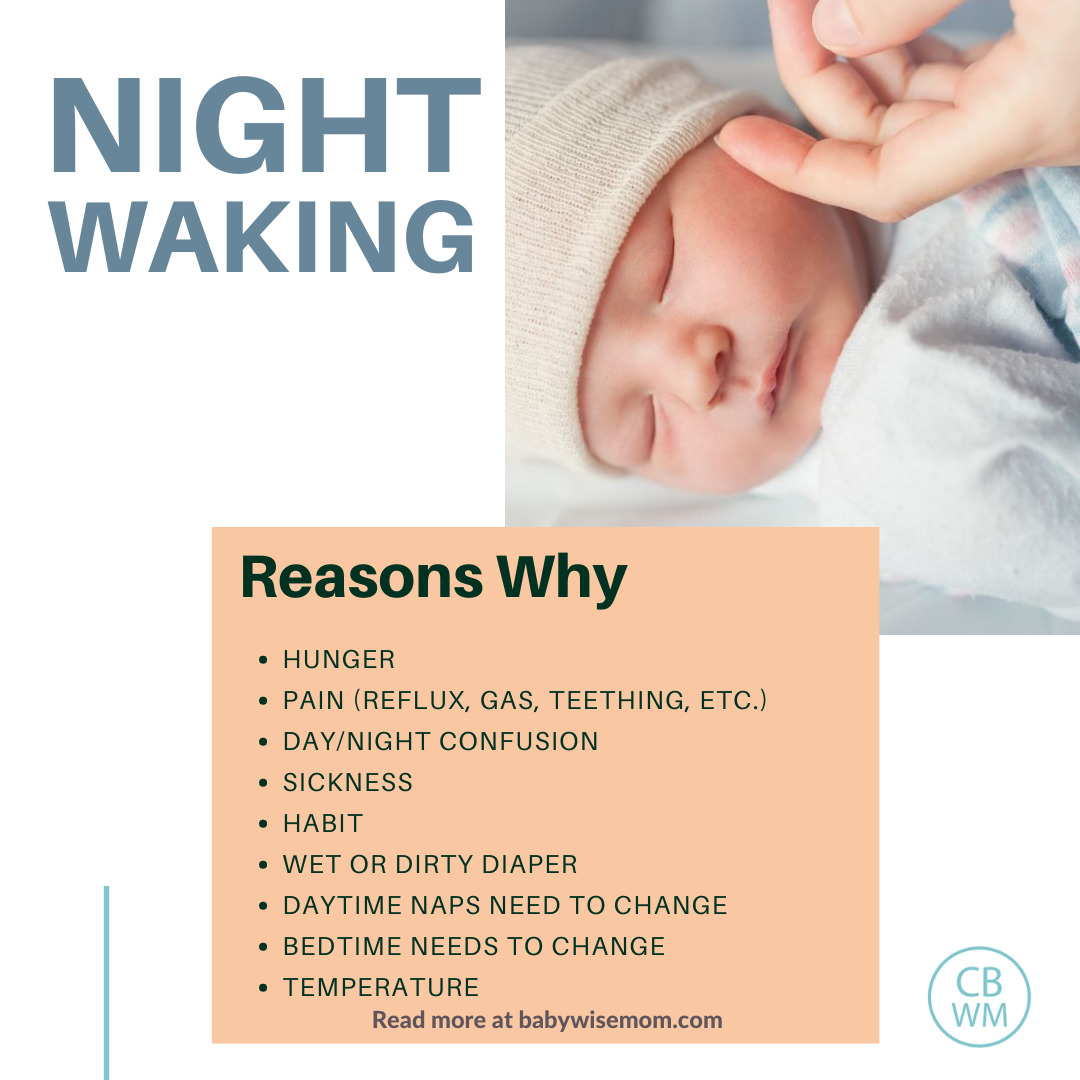
- Hunger
- Pain or Discomfort
- Day/Night Confusion
- Habitual Waking
- Wet or Soiled Diaper
- Too Much or Too Little Daytime Sleep
- Too-Late Bedtime
- Temperature
- Noise
- Light (Especially Sunlight)
- Social Waking
- Developmental Quirk
- Realistic Expectations
- Reasons Baby Wakes Sporadically
- Quick Reference: Baby Sleep Needs by Age
- How to Solve Night Waking: Step by Step
- Notes on hunger:
- Sleep Training Options Explained
- Frequently Asked Questions
- The Bottom Line
- Related Sleep Posts
Why Diagnosing the Root Cause Matters
Before reaching for a solution, you have to understand the problem. This sounds obvious, but it’s the step most parents skip — and it’s why so many sleep strategies fail, even well-researched ones.
Think of it like a car that won’t start because you ran out of gas. If your car won’t run, but you assume it’s the starter, no amount of tinkering with the starter will solve anything if you are really out of gas. The same logic applies to your baby. If she’s waking because she’s hungry, no amount of cry-it-out training will fill her belly. If she’s waking out of habit at 4:47 AM every single night, adding an extra feeding won’t help.
“You can’t apply the proper ‘how’ until you have identified the ‘why.’ Pick the why first, then choose the how.”
This guide is organized to help you find your why first, then guide you to the right how.
💡 Pro Tip: Keep a Sleep Log Tracking your baby’s wake time, feeding amounts, nap lengths, and bedtime for 3–5 days is one of the most powerful diagnostic tools available. Patterns that are invisible day-to-day become obvious on paper. Note the exact time baby wakes, how long she cried, and whether she took a full feed.

Babywise Mom Book of Logs
Babywise Mom book of tracking sheets to keep track of everything you need to know to get your baby on a fabulous schedule and sleeping well.
This is my Book of Logs PDF. This is invaluable to troubleshooting naps, night, and other problems you encounter with a baby.
Reasons Baby Wakes Consistently Every Night
If your baby wakes at roughly the same time every night — or multiple times every night without fail — that’s consistent waking. Here are the most common culprits.
Hunger
This is the first thing to rule out, especially for babies under 6 months. If your baby isn’t getting enough calories during the day, she will make up for it at night — she has no other choice.
The classic test: feed her when she wakes. Almost every baby will take some of a feeding, whether hungry or not, but only a truly hungry baby will take a full feeding. If she drains the breast or finishes a full bottle, hunger is real. If she takes a few sips and drifts back off, she likely woke for another reason.
You can also try this reverse test: help her back to sleep without feeding. If she wakes again 45–60 minutes later, hunger is probably the cause. If she sleeps through until morning, it probably wasn’t.
What to do: If your baby is hungry at night, you can:
- Try to add a feeding during the day
- Try to add more food at each feeding during the day
Add a feeding to the daytime schedule — move to a 2.5–3 hour interval if you’ve been stretching longer. Consider adding a dreamfeed (a late-evening feeding while baby is still drowsy) or cluster feeding in the evening. Don’t extend your daytime schedule until you’ve conquered the night.
Pain or Discomfort
Pain is one of the most underestimated sleep disruptors. Reflux, gas, teething, an ear infection, or even pajamas that are too tight can keep a baby from settling through the night.
>>>Read: How To Help Your Reflux Baby Sleep
Ask yourself: Is baby arching her back when feeding? Spitting up frequently? Pulling at her ears? Does she seem fine during the day but miserable at night (when she’s lying flat)? These are all signs that discomfort may be the issue.
What to do: Address the physical cause directly. If reflux is suspected, speak to your pediatrician about positioning and medication options. For gas, try bicycle-leg exercises before bedtime. For teething, a cool teething ring before the sleep window can help take the edge off. You cannot sleep-train away pain.
>>>Read: What To Do If Your Baby Has Gas
Day/Night Confusion
Newborns are born without an established circadian rhythm — they have no internal sense of day versus night. Their melatonin cycles need to be entrained by light and social cues over the first few weeks of life. Until that happens, they may be their most awake at 2 AM.
What to do: During the day, keep the house bright, engage actively with baby, and let in natural light. At night, keep lights dim, voices low, and interactions minimal and businesslike. The contrast itself is the training. Read more about day/night confusion here.
Habitual Waking
Once a baby has woken at the same time for several nights, her body clock can lock it in as a biological pattern — even after the original reason for waking (hunger, pain, etc.) is long gone. This is sometimes called a “conditioned waking.”
The tell: the waking is eerily precise and predictable. Baby wakes at 4:47 AM on the dot, five nights running, regardless of how much she ate at bedtime.
What to do: Try the Wake to Sleep method from Tracy Hogg’s Baby Whisperer: gently rouse baby shortly before her habitual wake time, stimulating just enough to shift her into a new sleep cycle. This often breaks the pattern within a few nights. This is something I did with McKenna was purely by accident. One night, we had friends over so I didn’t do her dreamfeed until midnight instead of 10ish. That night, she passed over her habitual waking time and never went back!
Wet or Soiled Diaper
Don’t overlook this one. Many babies sleep right through a wet diaper; some absolutely cannot. If your baby is waking reliably and you can’t find another cause, check whether she’s consistently wet when you go in. If my kids were close to the weight limit of a diaper, I put them in the next size up at night. You have to buy two sizes of diapers, but you will eventually buy the bigger size anyway.
What to do: If baby is near the upper weight limit of her current diaper size, size up at night — the larger diaper has more absorbency. Many parents swear by overnight-specific diapers (like Huggies Overnites) for babies who are heavy wetters. It’s a small change that sometimes solves the problem immediately. Huggies Overnites (affiliate link) worked really well for both Brayden and McKenna.
>>>Read: How To Diaper Baby at Night for Optimal Sleep
Too Much or Too Little Daytime Sleep
Daytime and nighttime sleep are more tightly connected than most parents realize. Sleep begets sleep — a baby who is chronically overtired during the day will often sleep worse at night, not better, because cortisol levels rise when sleep pressure is too high for too long.
Conversely, a baby who sleeps too much during the day may not have enough sleep pressure built up by bedtime to make it through the night.
How do you know if there is too much sleep versus not enough sleep? If your baby was sleeping at night well, then started waking more often, you might need to drop a nap. If your baby has never slept well, I would start by addressing not enough sleep before dropping naps.
You can also tell by your baby’s age. A four month old needs 3 naps, so if you have 3 naps, you can bet you do not need to drop a nap.
What to do: Compare your baby’s nap schedule to age-appropriate recommendations. If baby was sleeping well at night and then started waking again, consider whether it’s time to drop or shorten a nap. If baby has never slept well at night, start by protecting daytime sleep rather than cutting it. Use your baby’s age as a guide: a 4-month-old should still be on 3 naps.
>>>Read: Dropping Naps: A Quick Reference
Too-Late Bedtime
This is the most counterintuitive sleep fact: keeping a baby up later does not make them sleep later or longer. In fact, a chronically late bedtime leads to a cortisol spike that typically results in early morning wakings and worse-quality nighttime sleep overall.
What to do: Most babies sleep best with a bedtime between 7:00 and 8:00 PM. If your baby is consistently waking early or frequently, try moving bedtime 15–30 minutes earlier for a week and observe. Many parents are shocked to find this alone solves their night-waking problem. Pair a consistent bedtime with a calming, predictable bedtime routine — bath, feeding, dimmed lights, lullaby.
>>>Read: The Complete Guide to Finding Your Child’s Ideal Bedtime (By Age)
Temperature
Being too hot or too cold is a surprisingly common and overlooked cause of night waking. Babies can’t adjust their own blankets or clothing. Their sleep environment needs to do the work for them.
Know your baby’s individual preferences — one of my daughters slept terribly with socks on; another slept terribly without them. Pay attention to how baby feels when you check on her: a hot, sweaty neck suggests she’s too warm; cold hands and feet (especially in winter) suggest she’s too cool.
What to do: Aim to keep the room between 68–72°F (20–22°C). Dress baby in appropriately weighted sleep sacks for the season. TOG ratings on sleep sacks make this easier to calibrate.
>>>Read: Dressing Baby for Best Sleeping
Noise
Household noise — a sibling, a garage door, a parent leaving for an early shift — can be a consistent cause of waking if it happens at the same time each morning. Many parents don’t connect these two events until they notice the timing.
When Kaitlyn was a newborn, she would wake at a certain time in the morning no matter how long it had been since she last ate. I realized it was around the time my husband got up for work. After that realization, we moved her to her own room at night. White noise can help with a baby waking from noise.
What to do: If noise is the culprit, consider white noise in the nursery. A consistent, moderate white noise machine masks sudden sounds (like a sibling or a dog barking) and can dramatically improve sleep continuity. Moving baby to her own room is another option if she’s currently in yours.
Light (Especially Sunlight)
The sun is a powerful circadian signal. It was such a problem for all of my babies. As daylight saving shifts the sunrise or as seasons change, even a very well-sleeping baby can suddenly start waking at 5:00 AM when the light begins streaming in.
What to do: Install blackout curtains or blinds in the nursery. A truly dark room — where you genuinely can’t see your hand in front of your face — makes a real difference, especially in summer or in rooms with east-facing windows. Do what your baby needs. With Kaitlyn, she just needed her blinds shut, while McKenna needed dark blinds to help block the sun more.
>>>Read: Early Morning Waking and the Sun
Social Waking
This sounds strange, but some babies — particularly younger siblings who receive less one-on-one daytime attention — learn that night wakings are a reliable time to get undivided parental attention. The pattern can become self-reinforcing.
What to do: Keep nighttime interactions minimal, calm, and business-like. No talking, smiling, or eye contact beyond what’s necessary. At the same time, make sure baby is getting warm, engaged one-on-one time during the day so the need is being met then.
I was always careful to not make nighttime fun for any of my children. I didn’t make it miserable, I just kept it all business.
When I fed Kaitlyn in the middle of the night, I didn’t talk to her or smile at her. I avoided all eye contact with her. It could be really hard when she sometimes tried to strike up a conversation.
I found this policy to be easy with Brayden. He and I got plenty of one-on-one in the day. But with my girls, the day could be hectic, so I treasured those night visits. It was a quiet time for us to be together
The night waking wasn’t, however, something I wanted to keep up forever. So I did not engage.
If you suspect social visits are the cause of your baby waking at night, don’t socialize in the night. You would also want to make sure she gets the one-on-one attention she needs from you in the day.
Developmental Quirk
Is your baby just waking and talking? A review of page 132 in Babywise tells you that around 2-3 months old, many babies will wake and talk to themselves for up to an hour, and that phase can last over a month. This isn’t something specific to Babywise babies, either. This happens with many babies.
Realistic Expectations
Sometimes “nighttime sleep problems” are actually a definition problem. A baby who falls asleep at 7:30 PM and wakes at 5:00 AM has slept 9.5 hours. That is developmentally excellent for a young baby — and worth celebrating, even if 5 AM still feels like the middle of the night to you.
As your baby matures, the wake window will naturally push later. For now, adjust your expectations to what is appropriate for your baby’s age, not your ideal wake time.
Reasons Baby Wakes Sporadically
Sporadic waking is different: your baby generally sleeps well, but there are unpredictable nights when she wakes. This is not only normal — it’s to be expected. Most babies don’t go from “never sleeping through” to “always sleeping through” in one step. Progress is nonlinear.
Key Insight: Progress Is a Spiral A baby who slept through at 8 weeks may revert at 10 weeks, then sleep through again at 12. This doesn’t mean you failed. It means development is happening. Stay the course. Kaitlyn and McKenna were both this way, especially McKenna. Not fun, but just the way it is. Be assured it is very normal.
Do not think that once your baby has slept through the night one night or even several nights that baby will never again wake up in the night.
Be wary of the idea that if they did it once, they could do it always.
I didn’t start a baby schedule with my first until he was 9 weeks old, and when he was only three weeks old I remember there were nights he would sleep 8 or 9 hours straight.
Other nights he would be up a couple of times. I remember distinctly when he was 7 weeks old there was a random day he nursed 4 times in the day.
I say that to illustrate that a baby doing something one day doesn’t mean they can always do it. When it comes to sleeping through the night, sleeping longer stretches gives you the indicator that they are moving toward it, but I think most babies sleep through, then will revert back and wake up, then sleep through, then revert back….
Here are the most common causes of sporadic night waking:
Hunger. If your baby suddenly starts waking in the night again, try adding more feedings, adding solids, or adding more food at each feeding.
One night I woke up at about 2:30 AM STARVING. I was so hungry my stomach ached. I had eaten as I always do the day before. I managed to fall asleep without eating, but it made me realize that sometimes babies could wake up in the night who normally sleep through and be legitimately hungry for no apparent reason. They might be able to go back to sleep, or they might not.
>>>Read: Is Baby’s Night Waking from Hunger?
Growth Spurts. During a growth spurt, your baby’s caloric needs spike rapidly. Even if she’s eating well in the day, her body may demand more at night. Common growth spurt windows are around 2–3 weeks, 6 weeks, 3 months, and 6 months — but every baby is different. During a spurt, respond to hunger fully, even at night. The extra feeds are temporary, usually lasting only a few days.
Nap Schedule Change. Too many naps in the day? Maybe it is time to drop a nap, or shorten one.
Wonder Weeks / Developmental Leaps. Babies go through predictable periods of intense brain development — sometimes called “wonder weeks” — during which sleep is commonly disrupted. Baby isn’t sick and isn’t hungry; her brain is simply too busy to settle easily. Expect extra fussiness and night waking at these milestones, particularly around weeks 5, 8, 12, 19, 26, 37, 46, and 55.
Teething. Not all babies experience sleep disruption from teething, but many do — especially with the first few teeth. Pain typically peaks in the days just before a tooth erupts. If baby is drooling more than usual, gnawing everything in sight, and waking at night when she normally doesn’t, teething is worth considering. Consult your pediatrician about safe teething pain relief.
Illness. A stuffy nose, ear infection, or sore throat can make it genuinely difficult or impossible to sleep. If baby seems sick, respond to her needs fully — this isn’t the time for sleep training. Once she has recovered, give her 2–3 days to find her rhythm again before intervening.
Disrupted Routine Days. A day of travel, a party that ran late, a skipped nap, an unusually early start — these can all ripple into a rough night. If you know a disruption happened, cut yourself (and baby) some slack. Get back to your normal routine the next day and give it 1–2 nights to recalibrate.
>>>Read: Managing Disruptions to the Routine
Sleep Props. You might be experiencing a sleep prop gone wrong. A sleep prop is anything external that helps baby fall asleep — rocking, nursing to sleep, a pacifier, being held. Props themselves aren’t inherently bad, but if baby can’t replicate them independently when she wakes between sleep cycles at 2 AM, she’ll need your help every time. If a prop has worked fine for weeks and suddenly starts causing multiple night wakings, it may have crossed the line from comfort to dependency.
>>>Read: When Sleep Props are Okay and When to Avoid Them
Seasonal Light Changes. As seasons change, sunrise shifts. A baby who slept beautifully through March may start waking at 5 AM in June when daylight arrives an hour earlier. This catches parents off guard every year. Blackout curtains are the fix.
Normal Sleep Maturation. For some babies, sporadic waking is simply part of the gradual process of developing the skill to sleep through the night. They sleep through, they revert, they sleep through again. With each iteration, the sleeping-through stretches get longer and the reversions get shorter. This is normal biology, not a sign that something is wrong with your approach.
Quick Reference: Baby Sleep Needs by Age
Use this info to check whether your baby’s total sleep and nap schedule aligns with developmental expectations. Misalignment in either direction — too much or too little daytime sleep — can directly cause nighttime sleep problems. Read much more at Sleep Totals: How Much Sleep Should Your Child Get?
Here is how many naps you can expect from your baby:
- 0-3 Months = 4-5 naps a day
- 3-4 Months = 4 naps a day
- 4-6 Months = 3 naps a day
- 6-10 Months = 2-3 naps a day
- 10-12 Months = 2 naps a day
Night sleep should always start around 7-8 PM. This is true even if you have a dreamfeed at night. You still want to consider bedtime to be around 7-8 PM, so when you put your baby down at that time of day, it is bedtime and not a nap.
With this information, this is the range of sleep totals you should be working toward for your baby:
- 0-3 Months = 16-22 hours a day (yes! Newborns need a lot of sleep)
- 3-4 Months = 15-22 hours a day
- 4-6 Months = 14.5-20 hours a day
- 6-10 Months = 13-19 hours a day
- 10-12 Months = 13-18 hours a day
Note: These are general guidelines, not rigid rules. Individual babies vary. Use these as a starting point for your own observations.
How to Solve Night Waking: Step by Step
Now that you have a solid list of possible causes, here is the framework for working through them systematically. The key principle: change one thing at a time. If you change multiple variables at once, you won’t know what worked — or what made things worse.
If you can’t decide which thing is the reason for baby waking in the night, do not try both of them at once. I suggest you change one thing at a time. Otherwise you might fix one issue, but start a new one at the same time.
For example, you might think “It could be hunger but it could be a nap needs to be dropped.” If you add a feeding and drop a nap the same day, you could be fixing a real hunger issue but creating a sleep issue because your baby was not actually ready to drop that nap.
Once you have decided why you think your baby is waking in the night.
Pick the appropriate how for your why. If your baby is cold, dress her warmer. If your baby is hungry, try adding feedings to the day. In the sections above, I linked a lot of helpful posts to help address the issue.
- Address Hunger and Pain First. These are physiological needs. No sleep strategy will override genuine hunger or real pain. Rule both out before trying anything else. If your baby is under 6 months, hunger should be your primary suspect for any consistent night waking.
- Audit the Sleep Environment. Check temperature, light levels, noise, and diaper type. These are easy wins. Fix any obvious environmental problems before addressing behavioral ones. A $30 blackout curtain or an overnight diaper might be all that’s needed.
- Review the Daytime Schedule. Are feedings frequent enough? Are naps age-appropriate? Is bedtime early enough? Many nighttime problems are actually daytime schedule problems in disguise. Tracy Hogg’s advice — get the days consistent first and the nights will follow — is sound. Focus your energy on the day.
- Work on Independent Sleep Skills During the Day. Daytime naps are the training ground for nighttime sleep. If your baby can’t fall asleep independently at nap time, she won’t be able to do it at 2 AM either. Practice self-settling during naps first — it’s lower stakes and you’re both less exhausted.
- Choose Your Night Intervention Strategy. Once you’re confident baby doesn’t need the waking (hunger and pain are ruled out, environment is solid, schedule is appropriate), you can choose how to handle the actual waking. See the section below for a breakdown of approaches.
- Stay Consistent for 5–7 Days. Whatever approach you choose, give it a meaningful trial. Most sleep changes take at least a few nights to produce results. Changing tactics every other night prevents progress. Note: if something genuinely seems wrong — baby seems sick, in pain, or inconsolably distressed beyond crying — always trust your parental instincts over any sleep method.
⚠️ Don’t Address Multiple Things at Once It’s tempting to simultaneously drop a nap, add a dreamfeed, and move bedtime earlier. Resist this urge. If something goes wrong — or right — you won’t know which change caused it. One variable at a time, 5–7 days of data, then reassess.
Notes on hunger:
If you are not sure about hunger, try these things.
Feed Baby More: If baby is hungry, increase the food in the day if your baby is hungry. Try adding a feeding. If you are on a four hour schedule, go back to a three hour schedule. If you are on a three hour schedule, add a dreamfeed or cluster feed.
Feed Baby Less: If baby isn’t really hungry, you can try decreasing the amount eaten in the night. If you bottle-feed, offer less in the bottle. If baby takes 6 ounces, do 4 for a few nights. Then do 2-3. Slowly cut back.
If you breastfeed, decrease the amount of time spent nursing, or offer only one side, or both. That is what I did with Kaitlyn, and this fixed the problem.
Do this only if your child is not in need of food at night. You have to decide if your child is ready or not. How do you know? One obvious way is if your baby isn’t really eating in the night. Another is if your baby is eating in the night but then not eating for the first feed of the day.
Help baby relax with this baby bedtime lotion from 8 Sheep Organics
Sleep Training Options Explained
Your baby needs to have the skill to fall back asleep independently, no matter the reason for waking. Be sure you are working to help your baby learn to self-soothe. Read about my favorite sleep training books here.
Tracy Hogg says in Secrets of the Baby Whisperer to tackle daytime naps first, night will follow (page 268). I completely agree with this statement. This is advice I have long been giving moms who are trying to establish a consistent routine.
Focus on getting your day set and then after some consistency, night should follow suit. Some babies do need some training at night, but wait until days are going really well. It is too hard to train all day and all night at first.
Once you’ve addressed all the practical causes above and your baby is ready, you can choose a sleep training approach. Here’s an honest overview:
Cry It Out (Extinction). Baby is placed in her crib awake and parents do not return until morning (or a predetermined time). For many families this works quickly — sometimes in one to three nights. The key is full commitment: starting and stopping partway through resets the process and can make things harder. If you’re not prepared to ride out several nights of crying, this may not be the right method for your family right now. Do not start and stop cry it out over and over.
Graduated Extinction (Ferber Method). Parents check in on baby at progressively longer intervals (3 minutes, then 5, then 10, etc.), offering brief verbal reassurance but not picking baby up. The check-ins are meant to reassure the parent as much as the baby. This tends to take a bit longer than full extinction but many families find it more emotionally manageable.
Gentle / No-Cry Methods (Fading, Pick Up/Put Down, Shush-Pat). These approaches involve gradually reducing parental assistance — staying nearby but doing progressively less. The Baby Whisperer’s Pick Up/Put Down method and Hogg’s Four S’s fall into this category. They take longer but cause less crying. They work particularly well when started early (before 5–6 months) before sleep associations are firmly entrenched.
Wake to Sleep. For babies with habitual, clockwork-precise night wakings, this technique (gently stirring baby 45–60 minutes before the habitual wake time) interrupts the pattern without any crying. It requires a few nights of your own interrupted sleep, but many parents find the investment pays off quickly.
💡 My Personal Approach I never did cry-it-out at night with my own children — not because I am against it, but because I wasn’t personally willing to follow through consistently. I used the Four S’s method with my last two babies, and they worked beautifully once I had their days consistent. Do what works for your family and what you can sustain.
>>>Read: Gentle Sleep Training: The Four S’s
You might not be able to do CIO in the night. If so, I don’t blame you. I haven’t ever done it at night. You can try helping baby fall back asleep by shh-ing, patting, rocking, etc.
Some moms use pacifiers. Some do Pick Up/Put Down by the Baby Whisperer. Sometimes just getting baby used to sleeping through helps her get over the hump so she can do it on her own. We really like The Four S’s from Hogg and used that to gently sleep train our last two babies.
💡 Set the Room Up: Make sure baby’s bedroom is set up ideally for the best sleep. See my post on what is essential to the babywise bedroom for more.
Check The Complete Guide to Troubleshooting Short Baby Naps post on this blog and run through possibilities there. There might be something that typically impacts naps that is impaction your baby at night.
Pay attention to what is going on when baby wakes. Be analytical and introspective. Trust your instincts. Try one thing for a few days to a week, if it doesn’t work, go back to brainstorming to think of the next most likely reason for waking.
Frequently Asked Questions
At what age should my baby be sleeping through the night?
This can depend on your definition of “through the night.” Most babies are physiologically capable of going 8–12 hours without a feeding somewhere between 4 and 6 months, though there is wide variation. Breastfed babies may need a nighttime feed a little longer than formula-fed babies. “Sleeping through the night” in clinical terms often means a 5-hour stretch, which can be done by 5 weeks old if baby is ready — parents usually have a longer window in mind. Both definitions are valid depending on your baby’s age.
My baby was sleeping through the night and then suddenly stopped. What happened?
This is one of the most common and frustrating sleep experiences parents have, and it’s almost always temporary. The most common culprits are a growth spurt, a developmental leap (wonder week), the 4-month sleep regression (a real change in sleep architecture), teething, or an illness. Go back through the checklist in this post and address any underlying cause. Don’t panic — most regressions resolve within 2–4 weeks.
What is a dreamfeed and does it help?
A dreamfeed is a feeding you offer between roughly 10:00-11:00 PM — after baby has gone to sleep for the night but before you go to bed yourself. You gently pick baby up, feed her while she’s in a drowsy or light-sleep state, then put her back down. The goal is to “top her off” so she makes it longer into the night without waking hungry. It works very well for many babies between about 6 and 16 weeks. Some babies never take to it, and it typically stops working well after 6–7 months.
How do I know if my baby is waking from hunger or habit?
The timing test is helpful: habit wakings tend to occur at a very consistent, precise time each night. Hunger wakings are more variable in timing. The feeding test also helps: if baby takes a full feeding (drains one breast, or finishes most of a bottle), she was genuinely hungry. If she takes a little and drifts off, or doesn’t seem interested in the breast/bottle, hunger is less likely. Age matters too — a 2-month-old on a 3-hour schedule very likely still needs a night feeding; a healthy, well-growing 7-month-old who eats well all day probably doesn’t.
>>>Read: Is Baby’s Night Waking from Hunger?
Is the 4-month sleep regression real?
Yes — and it’s technically a permanent change, not a regression you “get through.” At around 4 months, baby’s sleep architecture shifts to become more adult-like, with clearly delineated light and deep sleep cycles. This means baby now wakes more fully between cycles and needs to learn to get herself back to sleep — a skill she didn’t need before. The 4-month “regression” is actually an opportunity: it’s the perfect window to introduce independent sleep skills if you haven’t already.
>>>Read: Baby’s 4 Month Sleep Regression: What To Do
Does white noise actually help babies sleep?
For many babies, yes. White noise masks sudden environmental sounds (a sibling, a dog, a car door) that might otherwise jolt a baby into a full wake between sleep cycles. It also mimics the sound environment of the womb, which many newborns find calming. Use a consistent, moderate volume (around 50–60 dB — roughly the level of a shower) and place the machine across the room rather than directly next to baby’s head. There’s no evidence that gradual weaning off white noise is necessary; many children use it happily for years.
The Bottom Line
Night waking is normal. Needing to wake up every two hours for years is not. The difference almost always comes down to diagnosing the right cause and applying the right response — consistently, and one change at a time.
Start with the basics: enough food in the day, a dark and comfortable room, an age-appropriate schedule, and an early enough bedtime. Fix those four things and you’ll solve the majority of sleep problems without any formal sleep training at all.
If you’ve worked through those and still have consistent night waking, move to the sleep training section and choose the approach you can follow through on. The approach matters less than the consistency with which you apply it.
Your baby can learn to sleep through the night — and so can you. It takes patience and troubleshooting, but it happens for the vast majority of families. You’ve got this.
Related Sleep Posts
- Night Sleep Tips for Baby–Preschoolers
- 5–6 AM Night Wakings: What To Do
- Early Morning Wakings: A Complete Guide
- Baby Not Sleeping Through the Night? 11 Tips
- The Basics of the Dreamfeed
- Cluster Feeding to Get Baby Sleeping Longer
- Sleep Begets Sleep: Why Naps Matter at Night
- CIO Bootcamp: A Complete Guide
- The Wonder Weeks and Sleep
- Circadian Rhythm and Baby Sleep
- Finding Your Baby’s Ideal BedtimeS
- Sleep Training: All Methods Explained

This post was originally published on this blog in January of 2010.