Just when sleep was good again, the 15-month regression hits. Night wakings, nap battles, bedtime fights — it’s all normal. Here’s exactly what to do (and what not to do) to get through it.

You survived the 12-month sleep regression. Things settled down, your toddler found her groove again, and you let yourself exhale. And then — right around 15 months — the wheels come off again.
Night wakings are back. Nap time feels like a negotiation. Bedtime, which used to be easy, now involves tears (maybe from both of you). You’re wondering if something is wrong, if you somehow broke her sleep, or if this is just… your life now.
Nothing is wrong. You didn’t break anything. What you’re likely dealing with is the 15-month sleep regression — and like the one before it, it has a very normal cause, a beginning, and an end.
What Is the 15-Month Sleep Regression?
The 15-month sleep regression is a period of disrupted sleep that tends to hit right around — you guessed it — 15 months. It can show up anywhere from 14 to 18 months, and it tends to catch parents off guard because they weren’t expecting another regression so soon after the last one.
Like all sleep regressions, it’s driven by significant developmental changes happening in your toddler’s brain and body. It’s not a sign that something has gone wrong with your sleep routine. It’s a sign that your child is growing in big ways.
The 15-month regression can look like:
- Sudden night wakings after weeks or months of sleeping through
- Resisting naps or taking much longer to fall asleep
- Fighting bedtime when it used to be smooth
- Waking earlier in the morning than usual
- Increased clinginess and fussiness throughout the day
- Waking up and calling for you — and not wanting you to leave again
Sound familiar? Let’s talk about why it happens.
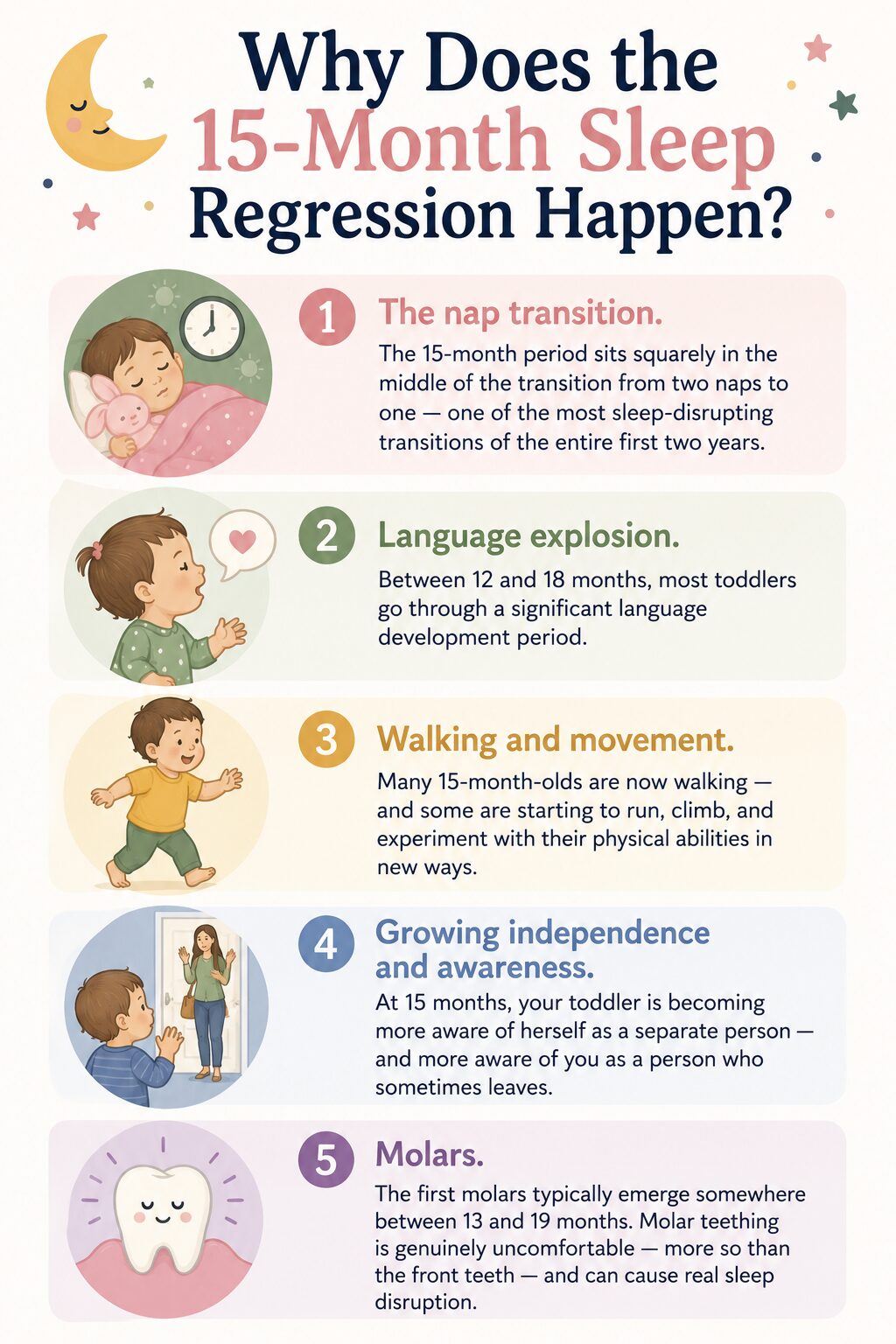
Why Does the 15-Month Sleep Regression Happen?
Your 15-month-old is not the same baby she was three months ago. The developmental changes happening right now are significant, and they have a direct effect on sleep.
The nap transition. This is the big one. The 15-month period sits squarely in the middle of the transition from two naps to one — one of the most sleep-disrupting transitions of the entire first two years. Some children make this transition closer to 14 months; others hold onto two naps until 17 or 18 months. But right around 15 months, many toddlers are in the thick of it, which means their nap schedule is in flux and their total sleep is inconsistent from day to day. The overtiredness that results can make nights harder and create a frustrating cycle.
>>>Read: Dropping the Morning Nap Transition Time
Language explosion. Between 12 and 18 months, most toddlers go through a significant language development period. They’re working hard to understand words, connect words to objects, and begin producing language themselves. That kind of cognitive work is demanding, and it doesn’t stop at bedtime. A brain that is busy acquiring language is a brain that can have a harder time winding down.
Walking and movement. Many 15-month-olds are now walking — and some are starting to run, climb, and experiment with their physical abilities in new ways. Motor development and sleep have always had a complicated relationship. When your toddler is mastering a new physical skill, her brain is processing it around the clock, including during the night.
Growing independence and awareness. At 15 months, your toddler is becoming more aware of herself as a separate person — and more aware of you as a person who sometimes leaves. This can fuel separation anxiety even in children who seemed to have moved past it. The awareness that you are not in the room when she falls asleep can be enough to make falling asleep — and falling back to sleep — feel harder.
Molars. The first molars typically emerge somewhere between 13 and 19 months. Molar teething is genuinely uncomfortable — more so than the front teeth — and can cause real sleep disruption that may overlap with (and amplify) the regression. If your child seems to be chewing on everything, drooling more than usual, or particularly irritable with eating, molars may be a factor.
How Long Does the 15-Month Sleep Regression Last?
Most regressions last two to six weeks. The 15-month regression tends to fall in that same range, though it can feel longer if it’s overlapping with the nap transition, which can stretch on for weeks or months on its own.
Here’s the honest truth: the 15-month stretch can be trickier than the 12-month one precisely because the nap transition adds a layer of complexity that doesn’t resolve quickly. You may feel like things improve and then get hard again as she works through the transition. That back-and-forth is normal.
What you’re aiming for is staying consistent — not reacting to every rough night by overhauling your approach. Patience and consistency are your most powerful tools right now.
The Nap Transition: What You Need to Know
Because the nap transition is so central to the 15-month regression, it’s worth spending some time on it.
When your child moves from two naps to one, it doesn’t happen overnight. There’s a messy middle period — sometimes lasting several weeks — where she seems to need two naps some days and only one on others. She might take a great morning nap and then refuse the afternoon one, leaving her overtired by dinner. Or she might resist the morning nap entirely, make it to one long afternoon nap, and then have an early bedtime.
Signs she may be ready to transition:
- Consistently refusing one nap (usually the morning one) even when you know she’s tired
- Taking a long time to fall asleep for the second nap when she does take it
- Night sleep and morning wake time are not affected by dropping one nap
Signs she’s not quite ready:
- She still takes both naps willingly on most days
- When she skips a nap, she falls apart by late afternoon
- She’s crankier and sleeping worse at night when on one nap
If she’s not ready, don’t force the transition. Hold onto two naps until the signs are clearer. An overtired toddler is harder to put to sleep and harder to keep asleep — pushing the nap transition too early can make the regression significantly worse.
For a full guide on dropping the morning nap, see my post Dropping the Morning Nap Full Guide
How to Get Through the 15-Month Sleep Regression
The core principle here is the same one I emphasized for the 12-month regression: your job is to maintain your existing sleep habits, not to introduce new ones.
When your toddler is waking at night and crying for you, every instinct says to do whatever it takes to get everyone back to sleep. I understand. But the habits you introduce during a regression tend to stick around long after the regression is gone — and then you’re left solving a different sleep problem.
Here’s what to do instead:
1. Hold your routine. Your bedtime routine is an anchor. Keep it the same: same order, same length, same ending. When everything else feels unpredictable to your toddler, the routine tells her what’s coming next and signals that sleep is safe. Don’t skip it, abbreviate it dramatically, or change it during the regression.
2. Respond without reinforcing. You can go in when she cries without creating a new sleep crutch. Check on her, reassure her with your voice and a quick touch, and leave. Give her the chance to resettle on her own. If she knows how to fall asleep independently, those skills are still there — she just needs a bit of support to use them right now.
3. Watch wake windows carefully. At 15 months, most toddlers still need 2-6 hours of wake time between sleep periods — sometimes slightly longer if they’ve made the full transition to one nap. Putting her down too early means she’s not tired enough to fall asleep. Putting her down too late means she’s overtired, which paradoxically makes sleep harder. Watch her cues and your clock.
>>>Read: Optimal Waketime Lengths for Toddlers 12-24 Months Old
4. Move bedtime earlier if naps are rough. If naps have gone poorly and she’s clearly overtired by early evening, move bedtime earlier — sometimes significantly. A 6:00 or 6:30 PM bedtime during a rocky patch is completely reasonable and often results in better night sleep than a later bedtime would.
5. Practice separation during the day. If separation anxiety is driving the nighttime clinginess, address it in the daytime. Do regular independent play sessions. Step out of the room and return. Play peekaboo. Let her experience — many times a day — that you leave and you come back. This builds the security that makes bedtime separations easier.
>>>Read: How To Start Independent Playtime Late
6. Don’t assume more food will fix it. It’s tempting to wonder if your 15-month-old needs a bigger dinner or a bedtime snack to sleep better. If she’s eating well during the day, hunger is unlikely to be the root of nighttime waking during a regression. Adding a feeding at night can create a new habit that’s hard to break — and it usually doesn’t solve the problem anyway.
7. Let her practice new skills during the day. If she’s climbing everything, give her safe opportunities to do it during awake time. If she’s working on walking, give her floor time. The more she can practice physical skills while she’s awake, the less her brain needs to process them at 2 AM.

The Babywise Mom Nap Guide
The Babywise Mom Nap Guide eBook helps you establish successful naps from birth through the preschool years. It is a great resource!
Gary Ezzo, co-author of Preparation For Parenting and On Becoming Babywise, states: “Whether it is talking about establishing good nap behavior or offering solutions to sleep disruptions, this is a practical resource that I trust and recommend. The book is well laid out and answers just about every question a new or seasoned mom might have about babies, toddlers and sleep. We view this as more than a nap guided; it is a resource of encouragement that comes with compassion.”
What NOT to Do During the 15-Month Regression
Don’t bring her into your bed — unless that’s a habit you’re fully committed to long-term. Co-sleeping introduced during a regression tends to become an expectation that is very hard to walk back.
Don’t overhaul her schedule mid-regression. If her schedule was working before the regression hit, give it time before you decide it needs a complete overhaul. What looks like a schedule problem during a regression often rights itself once the regression passes.
Don’t force the nap transition before she’s ready. If she’s still taking two naps willingly, don’t push one just because her peers have dropped to one. Every child is different.
Don’t abandon sleep training gains. If your child knows how to fall asleep independently, don’t walk back all of that work because of a few hard nights. The skills are still there. Stay the course.
Don’t compare timelines. Some children have the 15-month regression for ten days. Others have three or four hard weeks. Neither means you’re doing it wrong.
When to Call the Pediatrician
In most cases, the 15-month regression resolves on its own. But check in with your child’s doctor if:
- Sleep disruption lasts longer than 6–8 weeks with no improvement at all
- Your child seems to wake in genuine pain or distress repeatedly
- You notice snoring, labored breathing, or pauses in breathing during sleep
- She seems to be losing skills she had mastered, not just going through a rough sleep patch
Your pediatrician is always a good first call when something doesn’t feel right.
You’ve Done This Before
Here’s the thing about the 15-month regression: you’ve already survived a regression. You know the pattern. You know it ends. You know what it feels like when the fog lifts and your toddler is sleeping well again — because you’ve experienced that.
This is more of the same. It’s hard, and it’s temporary, and the best thing you can do is hold steady.
Keep the routine. Don’t add new habits. Trust the work you’ve already done. Your toddler has the skills to sleep well — she’s just going through a season that’s making it harder to access them.
It will pass. It always does.
Related Posts
- The 12-Month Sleep Regression
- Dropping the Morning Nap Transition Time
- One Nap Schedules Perfect for Your Toddler
- Timing Naps for Toddlers
- Babywise Sample Schedules: 12-15 Months Old
- Babywise Sample Schedules: 16-18 Months Old