
When to drop each nap, signs your child is ready, and how to make the transition smooth

Every parent eventually faces the moment when a nap that used to be a guaranteed reset starts causing more drama than rest. Your toddler is suddenly bouncing off the walls at naptime, or your baby fights the morning nap so hard you wonder if it’s even worth it. Sound familiar?
This guide walks you through every nap transition from birth through preschool — when to expect it, what signs to watch for, and exactly how to handle the change. Whether this is your first child and you have no idea what’s coming, or your third and you just need a quick refresher, this page has you covered.
The Nap Timeline at a Glance
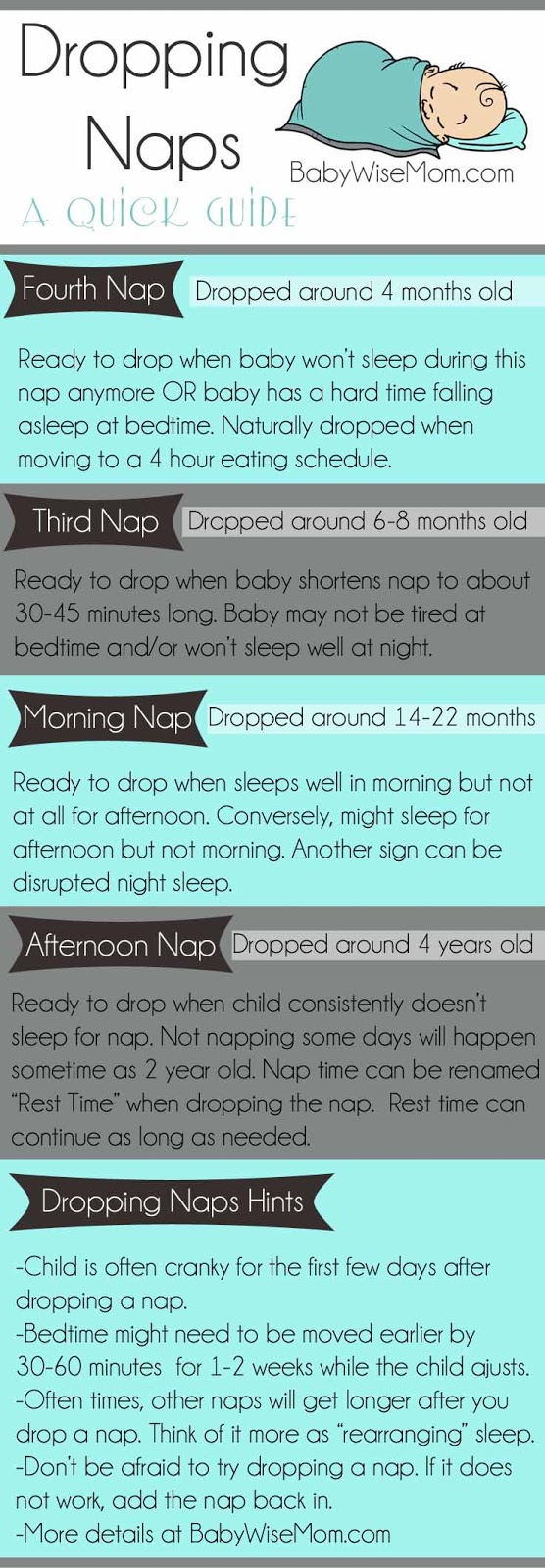
I know some people really like hard copies of things. I made a printable version and uploaded it to my Drive account. You can get your free copy here.
I have also added it to my eBook, Chronicles of a Babywise Mom Book of Logs. When you purchase these, this sheet will be included. If you have already purchased, you can download for free at the link above.
| Age | Number of Naps | Typical Awake Window |
|---|---|---|
| Newborn (0–5 weeks) | 6-8 naps | 30–60 minutes |
| 5–8 weeks | 4–8 naps | 45–75 minutes |
| 3–4 months | 3–4 naps | 75–90 minutes |
| 6–8 months | 2–3 naps | 2–2.5 hours |
| 8–18 months | 2 naps | 2–3.5 hours |
| 14–36 months | 1 nap | 4–6 hours |
| 3–4 years | 0-1 naps/rest time | All day |
Keep in mind these are averages. Some babies drop naps earlier; others hold on longer. Your child’s temperament, nighttime sleep quality, and daily schedule all play a role. Always follow your child’s cues alongside the general timeline.
Dropping to 4 Naps (Around 5–8 Weeks)
When It Happens
Newborns naturally consolidate sleep as their nervous systems mature. Most babies begin dropping from 5–6 short naps to 4–5 naps somewhere between 5 and 8 weeks of age. This isn’t something you typically need to engineer — it happens on its own as wake windows lengthen.
Signs Your Baby Is Ready
- Taking longer to fall asleep at the start of each nap
- Staying awake contentedly for longer stretches (60–75 minutes instead of 45)
- Naps themselves are getting longer and more consolidated
What to Do
Simply allow wake windows to stretch naturally. At this stage, don’t try to force a rigid schedule. Instead, watch the clock and your baby’s sleepy cues. When your baby hits that 60–75 minute mark of awake time, begin your nap routine.
One thing to watch: Overtiredness is the enemy of good naps. A baby who has been awake too long will produce cortisol (a stress hormone), which actually makes it harder to fall asleep and stay asleep. Catching the sleepy window before overtiredness sets in is the whole game at this stage.
Dropping to 3 Naps (Around 3–4 Months)
When It Happens
Around the 3–4 month mark, most babies are ready to consolidate to 3 naps per day. Wake windows are now stretching to 60–90 minutes (some closer to 2 hours by 4 months), meaning there’s simply not room for 4–5 naps in a day without pushing bedtime very late.
Signs Your Baby Is Ready
- Consistently fighting one of the four naps (often the late afternoon one)
- Wake windows reaching 90 minutes before showing tired signs
- Bedtime is creeping later and later to accommodate all the naps
- Naps are starting to lengthen and become more predictable
What to Expect
At this point, you’ll typically have:
- Morning nap: About 1–1.5 hours after waking for the day
- Midday nap: The longest nap of the day for many babies
- Late afternoon catnap: A shorter, bridging nap (30–45 minutes) to get to bedtime without overtiredness–but this can be a 2 hour nap
The late afternoon catnap is often the first to go when transitioning to 2 naps, so don’t be surprised if it feels inconsistent.
>>>Read: Moving Baby From 4-3 Naps: All You Need to Know
Dropping the Evening Nap: 3 Naps to 2 Naps (Around 6–8 Months)
When It Happens
The transition from 3 naps to 2 naps typically happens between 6 and 8 months, though some babies are ready as early as 5 months and others hold on until 9 months.
Signs Your Baby Is Ready
- Consistently refusing the third (evening) nap
- Falling asleep easily and sleeping solidly for 2 naps, but the third is a battle
- Bedtime is too late because of the third nap
- Nighttime sleep is being disrupted (too much daytime sleep can steal from night sleep)
The Transition
When you drop the third nap, you’ll need to adjust bedtime earlier — often by 30–60 minutes. This is one of the most counterintuitive things for new parents: putting a baby to bed earlier often results in better, longer nighttime sleep (because you’re catching them before they’re overtired).
Common mistake: Parents often wait for the evening nap to be refused consistently for weeks before dropping it. In reality, if your baby has been refusing it more days than not for 1–2 weeks, it’s time to let it go and move bedtime earlier.
Sample 2-Nap Schedule (7-month-old):
- 7:00 AM — Wake for the day
- 9:30–11:00 AM — Morning nap
- 2:30–4:00 PM — Afternoon nap
- 7:30 PM — Bedtime
>>>Read: Dropping the 3rd Nap: Impact on Baby’s Schedule
Dropping the Morning Nap: 2 Naps to 1 Nap (Around 14–18 Months)
When It Happens
This is often the most disruptive nap transition for families, and it tends to happen between 14 and 18 months. Some children are ready as early as 12 months; others don’t make the switch until closer to 2 years. Don’t rush this one — dropping the morning nap too early is a common cause of toddler sleep problems.
Signs Your Toddler Is Ready
- Consistently taking 30+ minutes to fall asleep for the morning nap
- One nap is being cut short because the other nap is too close
- Nighttime sleep is being disrupted — early morning wakings or resisting bedtime
- On days when the morning nap is skipped (e.g., due to an errand), your toddler does fine on one nap and sleeps well at night
- Your toddler is showing these signs consistently for at least 2 weeks, not just occasionally
What to Watch Out For
The biggest pitfall is confusing a nap regression (a temporary phase) with readiness to drop a nap. Around 10-12 months, many toddlers go through a developmental leap that temporarily disrupts naps. This is not a sign that the morning nap needs to go — it usually resolves on its own in 2–6 weeks.
>>>Read: Dropping the Morning Nap Transition Time
Rule of thumb: If your child is under 14 months and fighting the morning nap, wait it out. If they’re 15+ months and have been consistently showing readiness signs for 2+ weeks, it’s time.
How to Transition
Two strategies work well:
Option 1: Cold turkey. Drop the morning nap entirely and move to one midday nap around 12:00–12:30 PM. Expect a few rough weeks while your toddler adjusts. Keep an early bedtime (7:00–7:30 PM) during this period.
Option 2: Gradual shift. Over 1–2 weeks, slowly push the morning nap later (by 15–30 minutes every few days) until it becomes a midday nap. This is gentler for some children.
Sample 1-Nap Schedule (16-month-old):
- 7:00 AM — Wake for the day
- 12:30–2:30 PM — Single nap
- 7:30 PM — Bedtime
>>>Read: Dropping the Morning Nap Full Guide
Dropping the Last Nap: Moving to Rest Time (Around 3–4 Years)
When It Happens
Most children drop their last nap somewhere between 3 and 4 years old. Some high-energy or lower-sleep-need kids drop it closer to 2.5; others nap happily until age 5. Both are within the normal range.
Signs Your Preschooler Is Ready
- Taking 45+ minutes to fall asleep at naptime regularly
- Napping makes bedtime a struggle — your child isn’t falling asleep until 9:00 or 10:00 PM
- Your child skips the nap and still goes to sleep at a reasonable bedtime without being a complete mess
- This pattern holds for 2+ weeks consistently
The Mistake Parents Make
Many parents drop the nap entirely and then wonder why their child is a tornado by 5:00 PM. The answer isn’t necessarily to reinstate the nap — it’s to introduce rest time.
Introducing Rest Time
Rest time is a non-negotiable quiet period (usually 1–1.5 hours) where your child is in their bed with books, quiet toys, or an audiobook. They don’t have to sleep, but they do have to be quiet and still.
Benefits of rest time:
- Gives your child’s nervous system a genuine break mid-day
- Prevents the late-afternoon meltdown that comes from overstimulation
- Gives you a predictable break in your day
- Some children will still fall asleep occasionally, especially on high-activity days
- Teaches children to self-regulate and enjoy quiet time — a valuable life skill
Tips for a successful rest time:
- Start rest time at the same time every day for consistency
- Use a visual timer or an “OK to wake” clock so your child knows when it’s over
- Begin with 30 minutes and gradually extend to 60–90 minutes
- Rotate the toys or books available to keep it fresh
- Stay consistent — the first 1–2 weeks are often the hardest
>>>Read: How to Do Rest Time Instead of Naps
Sample No-Nap Schedule (3.5-year-old):
- 7:00 AM — Wake for the day
- 1:00–2:00 PM — Rest/quiet time
- 7:00–7:30 PM — Bedtime
>>>Read: Preschoolers and Naps: Dropping the Last Nap Info
Tips for Every Nap Transition
1. Expect a 2–6 week adjustment period. Every nap transition disrupts your child’s sleep rhythms. Short naps, fussiness, and early morning waking are normal during the adjustment. Consistency is your best tool.
2. Protect bedtime. When dropping a nap, always move bedtime earlier temporarily. An overtired toddler produces cortisol that makes nighttime sleep harder, not easier. An earlier bedtime is almost always the right call during a transition. I recommend having bedtime 30-60 minutes earlier for 1-2 weeks while the child adjusts.
3. Watch for overtiredness, not just awake windows. The wake window guidelines are helpful, but your child’s actual cues matter more. Red eyes, ear-pulling, yawning, decreased coordination, and crankiness all signal it’s time for sleep, regardless of what the clock says.
4. Don’t drop a nap during other big changes. If you’re in the middle of sleep training, starting daycare, traveling, moving, or dealing with illness, hold off on the nap transition. Stack too many changes and everyone suffers.
5. Give it two full weeks before deciding it’s not working. Many parents abandon the new schedule after a few hard days. Most transitions genuinely start to smooth out after 10–14 days of consistent effort. If it turns out you shouldn’t have dropped the nap, you can add it back in.
6. One step at a time. Don’t try to shift the schedule, move bedtime, and drop a nap all in the same week. Make the nap change first, let it settle for a week or two, then fine-tune the rest.
7. Rearranging sleep. Think of dropping a nap more of “rearranging sleep” than dropping the nap. Other naps might get longer and/or bedtime moves up.
>>>Read: Dropping Naps: A Quick Reference
Frequently Asked Questions
My baby dropped a nap earlier than the typical age. Is that okay?
Yes — the ages listed in this guide are averages, not rules. Some babies are naturally lower sleep-need and transition earlier. The key is that the transition sticks (consistent improved sleep overall) and your child is thriving and not chronically overtired.
What if my child goes back to needing the nap they just dropped?
This happens, especially during illness, growth spurts, or major developmental leaps. It’s okay to temporarily reintroduce a nap for a few days during these periods. Don’t worry that you’re “undoing” the transition — most children return to the new schedule naturally once the disruptive phase passes.
My toddler fights the one remaining nap. Does that mean it’s time to drop it?
Not necessarily. Nap resistance is extremely common in toddlers and doesn’t automatically mean the nap needs to go. First, check whether your toddler is getting the right amount of total sleep in 24 hours. If nighttime sleep is solid and your toddler genuinely seems rested without the nap for 2+ weeks consistently, then yes — it may be time. If they’re still tired and just being stubborn, the nap stays.
How do I handle nap transitions at daycare vs. home?
This is a genuinely tricky situation. Communicate with your daycare provider about where your child is in the transition. If daycare still puts all toddlers down for a nap, but your child is dropping it, ask if they can do quiet/rest time instead. On non-daycare days, follow the age-appropriate schedule as closely as you can.
Will dropping a nap hurt nighttime sleep?
Done correctly, it shouldn’t — and it often improves nighttime sleep. Too much daytime sleep can push nighttime sleep later or cause early-morning waking. The key is always adjusting bedtime appropriately when a nap is removed.
Related Posts
Want to go deeper on any of these transitions? Check out these related posts:
- The Best Ages for Dropping Baby’s Naps
- Dropping the Morning Nap: Full Guide
- Dropping the 3rd Nap: What to Expect
- Dropping Naps: Moving to Rest Time
- Baby Wake Windows by Age
- Sleep Begets Sleep: Why Daytime Naps Matter for Night Sleep
If you still have questions, please ask! When I get the same questions over and over, I know I have a gap in my information and I work to fix it. So ask away!

This post first appeared on this blog in April of 2016
I’m trying to drop the 3rd Nap. My daughter is 10 months. She was sleeping from 8:30pm-5am-ish for about a month. Before that she was waking up every 2-3 hours. Now since I’ve tried to drop the 3rd nap she’s waking up earlier and earlier every night. She’s not settling on her like she used to. Her room is connected to our room and she wakes now whenever the tiniest bit of movement is made. This was not the case before. I don’t know what I’m doing wrong. CIO is not working like it used to.
Here’s her old schedule
6:30-7 wake/feed
9am nap
10:30a wake/feed
12:30p nap
2:00p wake/feed
4:00p nap
5:00p wake/feed
7:00p dinner
8:30p bed
5am wake for milk back to bed until 6:30-7a.
New schedule
6:30-7a wake/feed
9:30a nap
11:00a wake/feed
2:00p nap
3:30p wake/feed
4:00p snack
6:30-7p dinner
8:00p nurse/bedtime
FYI: My daughter has never slept more than 10 hours a night and naps for only 1 hour & 30 minutes. I’ve seen a 2 hour nap but it’s never been consistent.
Hello!
Have you ever tried an earlier bedtime? It might be that she is waking earlier because she is overly tired. Often when a nap is dropped, you just rearrange that sleep time, not just drop it, so either the other naps would need to get longer or bedtime would need to move up.
If that cannot happen with your schedule, I would try adding the third nap back in and see how it goes.