Is it a night terror or a nightmare? Learn how to tell the difference in your toddler, what to do in the moment, and why neither one is a sleep regression.

You hear it from down the hall: a scream that makes your heart jump out of your chest. You race into your toddler’s room, and she is sitting straight up, eyes wide open, panicking. You pick her up, say her name, tell her you’re right here. And she looks straight through you. She might even push you away.
If that has ever happened at your house, know this is not abnormal. What you saw was frightening for you, and it is almost always far scarier to watch than it is to live through. But that scene, and the very different one where your toddler wakes up crying, clinging to you, and telling you about a “scary monster,” are two completely separate things. One is a night terror. The other is a nightmare. They need different responses from you, and neither one means your child’s sleep is falling apart.
Let’s walk through how to tell them apart, what to do in the moment, and where they fit (and don’t fit) alongside sleep regressions.
Night Terrors vs. Nightmares at a Glance
The easiest way I know to sort out which one you’re dealing with is to look at three things: when it happened, how your child acted, and what she remembers the next morning.
Night terrors tend to happen in the first part of the night, usually within the first couple of hours after your child falls asleep. MedlinePlus describes them as most common in the first third of the night, often between midnight and 2 a.m. Your child is technically still asleep, even if her eyes are open. She may scream, thrash, sweat, or breathe fast, and she won’t respond to you the way she normally would. Most kids have no memory of it the next day.
Nightmares come later, in the second half of the night, when we spend more time in dreaming (REM) sleep. Your child actually wakes up. She’s scared, she knows you’re there, she wants to be held, and she can often tell you about it, even if all she can say is “monster” or “dark.”
>>>Read: Nightmares vs. Night Terrors: How To Help Your Child Through Each
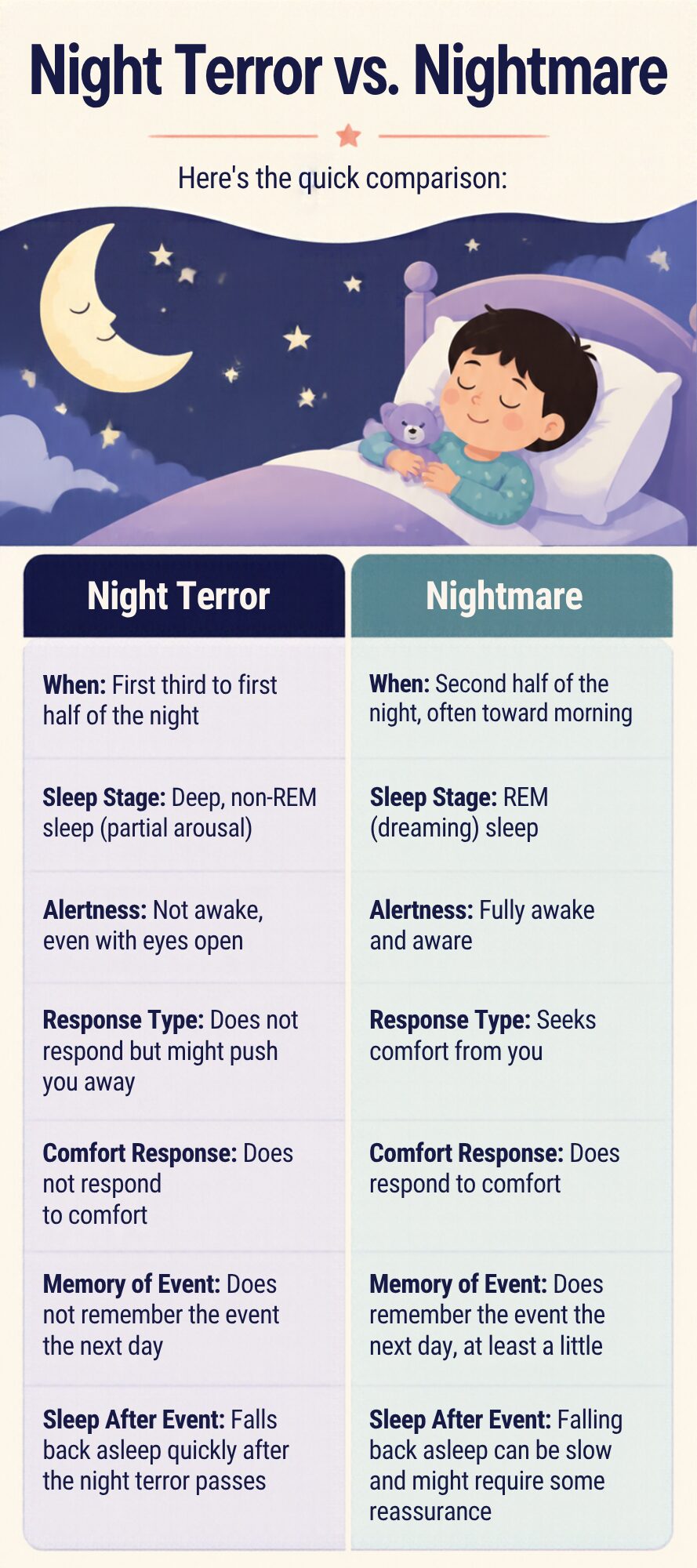
Here’s the quick comparison:
Night Terror
- When: First third to first half of the night
- Sleep Stage: Deep, non-REM sleep (partial arousal)
- Alertness: Not awake, even with eyes open
- Response Type: Does not respond but might push you away
- Comfort Response: Does not respond to comfort
- Memory of Event: Does not remember the event the next day
- Sleep After Event: Falls back asleep quickly after the night terror passes
Nightmare
- When: Second half of the night, often toward morning
- Sleep Stage: REM (dreaming) sleep
- Alertness: Fully awake and aware
- Response Type: Seeks comfort from you
- Comfort Response: Does respond to comfort
- Memory of Event: Does remember the event the next day, at least a little
- Sleep After Event: Falling back asleep can be slow and might require some reassurance
What is a Night Terror
A night terror is not a bad dream. This is the part that surprises most moms. Night terrors happen as a child is coming up out of deep sleep and gets partially stuck between sleeping and waking. Her body is active and her brain is not fully awake, so it can look like she’s in terrible distress while she isn’t actually experiencing a scary dream at all.
During an episode, your toddler may sit up, cry or scream, thrash around, or even get out of bed. Her eyes may be open, but she isn’t seeing you. Episodes commonly last anywhere from a few minutes to around 10 to 30 minutes, and in some cases longer, and then she quietly lies back down and goes right back to sleep.
This can be really disconcerting. My oldest child, Brayden, had night terrors. Fortunately my husband had night terrors as a child, so he recognized it right away and we were able to respond appropriately and without stress.
When Do Night Terrors Start
Here’s where I want to be careful, because you’ll see a lot of different numbers online. Night terrors can show up in the toddler years, but they are most common in the preschool years. MedlinePlus lists ages 3 through 7 as the most common window, and the pediatric sources I looked at agree that they’re less common at 18 months to 2 years and become more common as your child approaches 3 and beyond. So if your 2-year-old is having them, you’re not unusual, and if they start closer to 3 or 4, that’s very normal too. Most children simply grow out of them. But if you have a toddler waking in the night, it is less likely that it is a night terror and more likely that it is a nightmare just based on age.
What To Do During a Night Terror
This is the part where your instincts will work against you, so let me say it plainly: your job during a night terror is to keep your child safe, not to wake her up.
Stay close and keep an eye on her. Speak softly and calmly if you want to, but don’t expect her to respond. Gently guide her back to bed if she’s up and moving, and make sure nothing in the way could hurt her. Children’s hospital guidance points out that a child in the middle of a night terror can bump into walls, fall down stairs, or hurt herself on furniture, so this is a good moment to double-check that the room is safe and that stairs or doors are blocked off.
Resist the urge to shake her awake, shout her name, or turn on bright lights. Waking a child out of a night terror can leave her more confused and upset, and it often makes the episode last longer. Hugging her tightly can also make her fight you harder, since she doesn’t know it’s you. Most of the time the most helpful thing is to wait it out. It will end, she’ll settle, and she’ll be sound asleep again soon, usually with no idea any of it happened.
The next morning, you don’t have to bring it up. It’s you who has the memory of it, not her.
What Causes Night Terrors
Honestly, nobody knows exactly. What we do know is that they seem to be tied to a still-maturing nervous system, and that they can run in families. If you or your husband had night terrors or sleepwalked as a child, your toddler is more likely to as well. There are also some well-known triggers:
Being overtired is the big one, and it’s the one we can actually do something about. Fever or illness, stress or big changes (a new sibling, travel, a move), and a disrupted schedule can all set the stage too. Nothing you did as a mom caused this, and a single hard day doesn’t cause it either.
We also found that extreme temperatures at night led to night terrors. We also found that air blowing directly on Brayden led to more night terrors. So when his room was hot in the summer, we turned a fan on but made sure it did not blow on him directly.
What Is a Nightmare
A nightmare is a real dream that scares your child enough to wake her up. Because she’s fully awake afterward, you’ll see a very different child than you do with a night terror: she’s frightened, she wants you, and she’s usually easy to reach. She may remember something about the dream, and she may be afraid to go back to sleep.
Nightmares are a normal part of growing up. Cincinnati Children’s notes that they tend to follow a child’s developmental stage, so toddlers often dream about being separated from their parents, while preschoolers move on to monsters and the dark. Some toddlers begin having nightmares around age 2 to 2½, and they become much more common between ages 3 and 6 as imagination really takes off. A toddler who can now pretend, but can’t yet tell for sure what’s real, has the perfect recipe for a scary dream.
How To Comfort a Toddler After a Nightmare
Nightmares call for the opposite response of a night terror. Go to her, keep your voice low and warm, and give her the reassurance she’s asking for. A cuddle, a quick check that everything is okay, and a calm “you’re safe, Mommy’s right here” is usually all it takes.
If you want to help her settle, a few things tend to work well. Keep the lights low rather than turning on every light in the house. Offer a stuffed animal or lovey, or a soft night light. Keep the comfort brief and boring so that the middle of the night doesn’t become an exciting event, and then tuck her back in with her normal sleep routine. You can talk about the dream in the morning, in the daylight, when it feels much smaller. Fears you address during the day often shrink when the next night comes around.
If you’ve noticed more nightmares lately, take a look at what she’s seeing and hearing in the evening. Scary shows, books, or even a tense family evening can show up in a toddler’s dreams. If screens are part of your evenings, my family media standards post will help you set clear boundaries.
>>>Read: What To Do When Your Child Has Nightmares
Why These Aren’t Sleep Regressions
I hear from so many moms who are sure that a night terror means their toddler is in a sleep regression, so let’s clear this up, because the difference really matters for what you do next.
A sleep regression is a stretch of time, usually a few weeks, when a child who had been sleeping well starts struggling: resisting naps, fighting bedtime, waking repeatedly, or waking too early. Regressions are tied to developmental leaps (walking, talking, a new burst of independence) and, with consistency from you, they pass.
A night terror or a nightmare is a single event. It’s a one-time interruption of an otherwise normal night. A toddler can have one in a night and then sleep perfectly for the next two weeks. She may have an occasional run of them and then not for months. That pattern, an isolated episode rather than a sustained change in how she sleeps, is the clue that you’re not dealing with a regression.
Of course, a regression and these night disruptions can overlap. A toddler going through a big developmental leap may be more overtired and more likely to wake, and an overtired toddler is more likely to have a night terror. So if you’re seeing both, don’t panic and don’t overhaul everything. Look at the big picture instead. Sleep problems in toddlers often come back to the basics: enough sleep, a good schedule, and a consistent routine.
>>>Read: Night Sleep Tips
Keeping Night Terrors and Nightmares Less Likely
You can’t prevent every night terror or nightmare, but this is where a Babywise-style routine really earns its keep, because the biggest thing you can control is overtiredness. Sleep experts consistently point to being overtired as one of the most common triggers for night terrors, and sleep deprivation can make nightmares more frequent too. So the best prevention is also the most familiar to you: protect sleep.
>>>Read: Overstimulation for Toddlers
Keep naps on schedule. A skipped or short nap often shows up as a hard night, and a toddler who’s pushed past her wake time often has a harder time settling into deep, restful sleep. If you need a refresher, my posts on wake windows and naps will help you get your daytime rhythm back on track.
Keep bedtime consistent, and if night terrors are happening often, try moving bedtime earlier for a week or two to see whether it helps. A calm, predictable wind-down before bed (the same few steps in the same order every night) gives her body and brain a clear signal that sleep is coming.
>>>Read: Toddler Sleep Routines to Help Them Sleep
Be aware of stress and big changes, too. A new baby, travel, or a change in routine can ripple into sleep, so keep as much as you can steady while she adjusts. Our tips for traveling without wrecking the schedule might come in handy with the holidays coming up.
Finally, make her room a place that feels safe and cozy: dark enough for good sleep, comfortable, and with a night light if she likes one. If she’s been dealing with nightmares, daytime conversations about her fears (and a little extra cuddle time before bed) go a long way.
Waking Toddlers BEFORE a Night Terror
If night terrors keep happening at roughly the same time every night, there’s one more strategy that several children’s hospitals mention: note the time for several nights, then gently rouse your child about 15 minutes before it usually happens, and do this for about a week. It sounds strange, but the idea is to interrupt the sleep cycle before the partial arousal kicks in. It isn’t for everyone, and it’s worth chatting with your pediatrician before trying it, but it’s a tool worth knowing about if the terrors are frequent.
When To Call the Doctor
The vast majority of night terrors and nightmares are a normal part of growing up, and most children outgrow them. That said, it’s worth a call to your pediatrician if:
- Night terrors are happening frequently (Children’s Wisconsin suggests checking in if they occur more than twice a week)
- If they’re lasting a long time (more than 20 to 30 minutes)
- If they’re happening in the second half of the night instead of the first
- If your child is getting hurt or nearly getting hurt during episodes
- If night terrors come with other things like sleepwalking or loud snoring and labored breathing
- If nightmares are getting more frequent or your child seems distressed during the day
- If your mama gut says something is off, trust it and make the call
Conclusion
The next time you hear that scream in the night, I hope you’ll remember that you know what you’re looking at now. If she’s looking right through you, stay close, keep her safe, and let it pass. If she’s awake and reaching for you, scoop her up and love on her. Either way, this phase is temporary, it doesn’t mean you’ve done anything wrong, and most little ones leave it behind as they grow.
And if you want more help with the whole toddler sleep picture, you’ll find it all in my Sleep Problems and Toddler sections.
>>>Read: Sleep Problems in Kids
This post is for general information and is not medical advice. If you’re worried about your child’s sleep or safety, please talk with your pediatrician.
Related Posts
- 15-Month Sleep Regression: What It Is and How to Get Through It
- 18 Month Sleep Regression: How to Help
- 2 Year Old Sleep Problems – How To Solve Them!
- How To Deal with the 2 Year Old Sleep Regression
- How to Help Preschoolers Work Through Their Fears
- What To Do When Your Child is Scared of the Dark
- Solve Sleep Problems for Toddlers and Preschoolers
- Timing Naps for Toddlers
Sources and Further Reading
- MedlinePlus: Night Terrors in Children
- Cincinnati Children’s: Nightmares and Night Terrors
- Children’s Wisconsin: Night Terrors vs. Nightmares
- Michigan State University Extension: Helping Your Child with Nightmares or Night Terrors