
If your baby is taking short naps — or fighting sleep altogether — there’s one foundational variable you need to get right before anything else will work. Here’s what it is and how to find it.
If you want your baby to take a long, restorative nap, your baby cannot be awake for too long before going down. That’s the first thing to understand when you’re troubleshooting short naps — and it’s the piece most parents overlook.
But here’s the part that surprises many moms: waketime (aka wake window) that is too short can cause the exact same short nap problems as waketime that is too long. It cuts both ways.
What Is “Optimal Waketime” — and Why Does It Matter So Much?
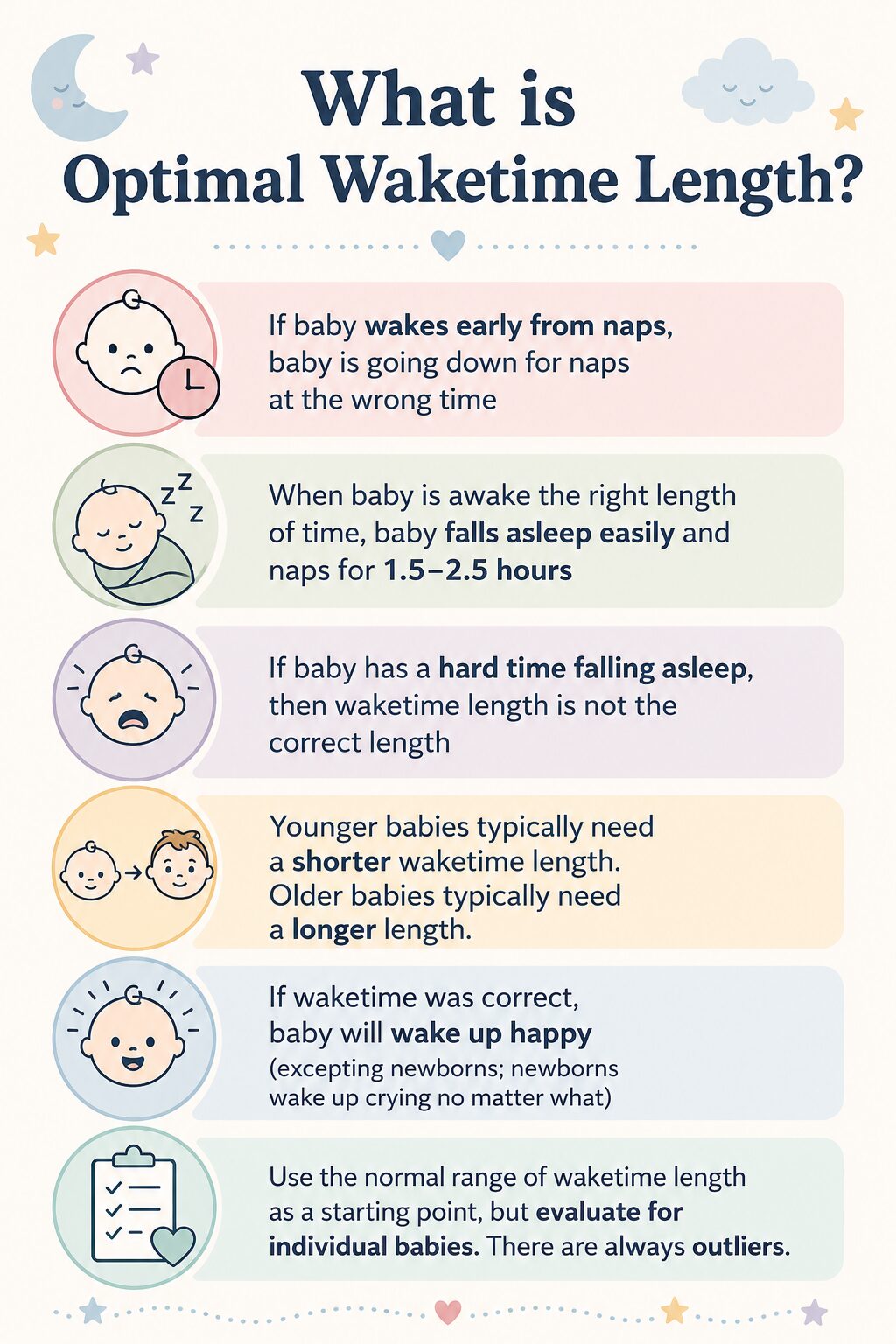
In order for your baby to fall asleep easily on her own and take a good, full nap, she must be awake for the correct length of time before going down. Not too long. Not too short. Just right — what I call her optimal waketime.
This is the cornerstone. The foundation everything else is built on.
Here’s why this matters so much: you can have everything else working in your favor — a consistent routine, a dark room, white noise, a full belly, a great sleeper by temperament — and still have short naps if the waketime length is off. You simply cannot get anything else right enough to compensate for a waketime that’s wrong.
That’s not meant to discourage you. It’s meant to focus your energy in the right place.
How I Compiled These Numbers
The waketime ranges I share on this site are based on almost two decades of surveying and working with Babywise parents — real families, real babies, real results. These are not theoretical numbers pulled from a textbook. They reflect what actually works for babies who are accustomed to getting routine naps and having sleep be a regular, predictable part of their day.
I’ve included ranges rather than single numbers intentionally. There will always be babies with high sleep needs who need shorter waketimes, and babies with low sleep needs who can handle longer ones, and everything in between. Most babies will fit within these ranges, though there are always outliers on either side.
Trust yourself. You are the expert on your baby, and these numbers are your starting point — not a rigid prescription.
Optimal Waketime Length by Age
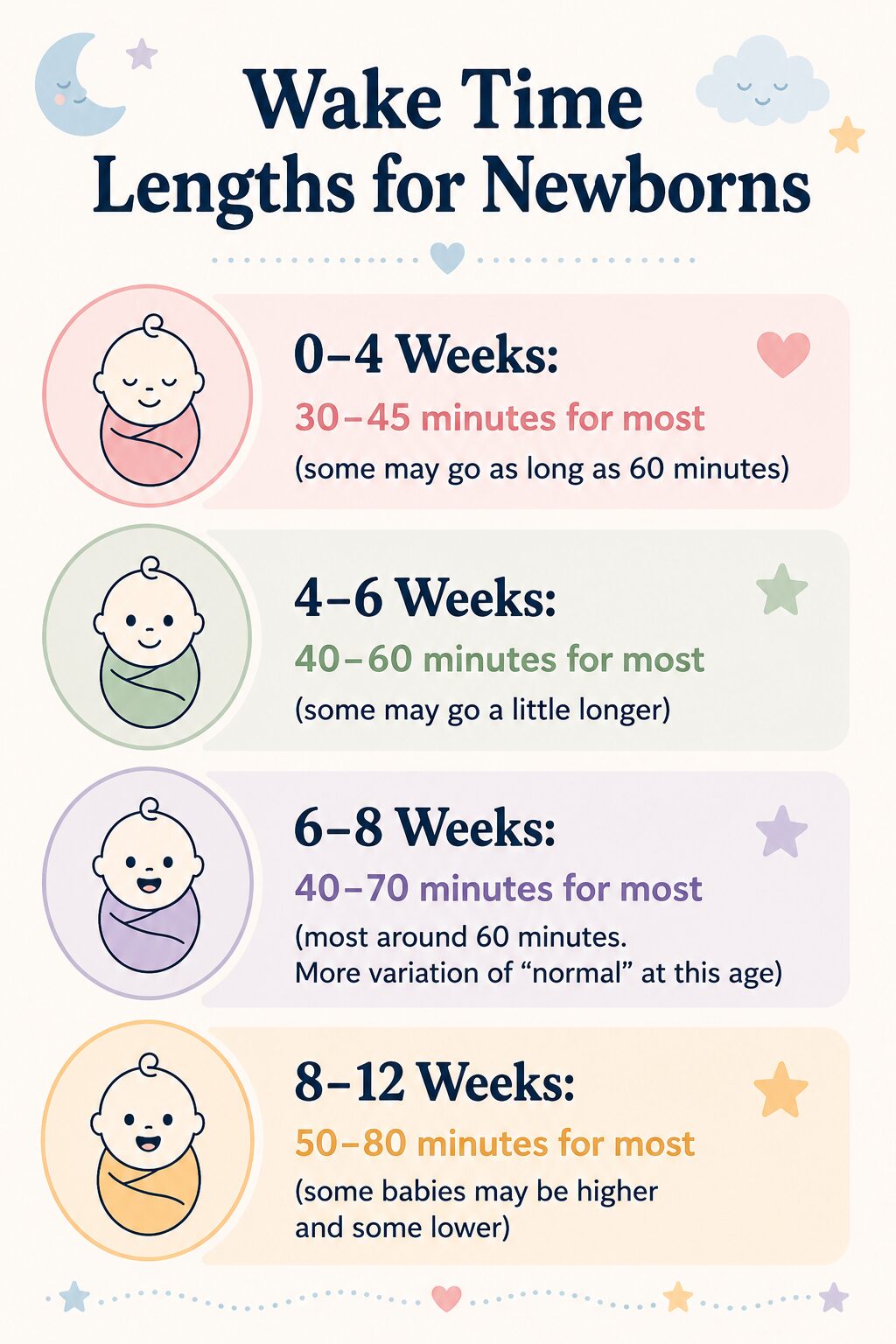
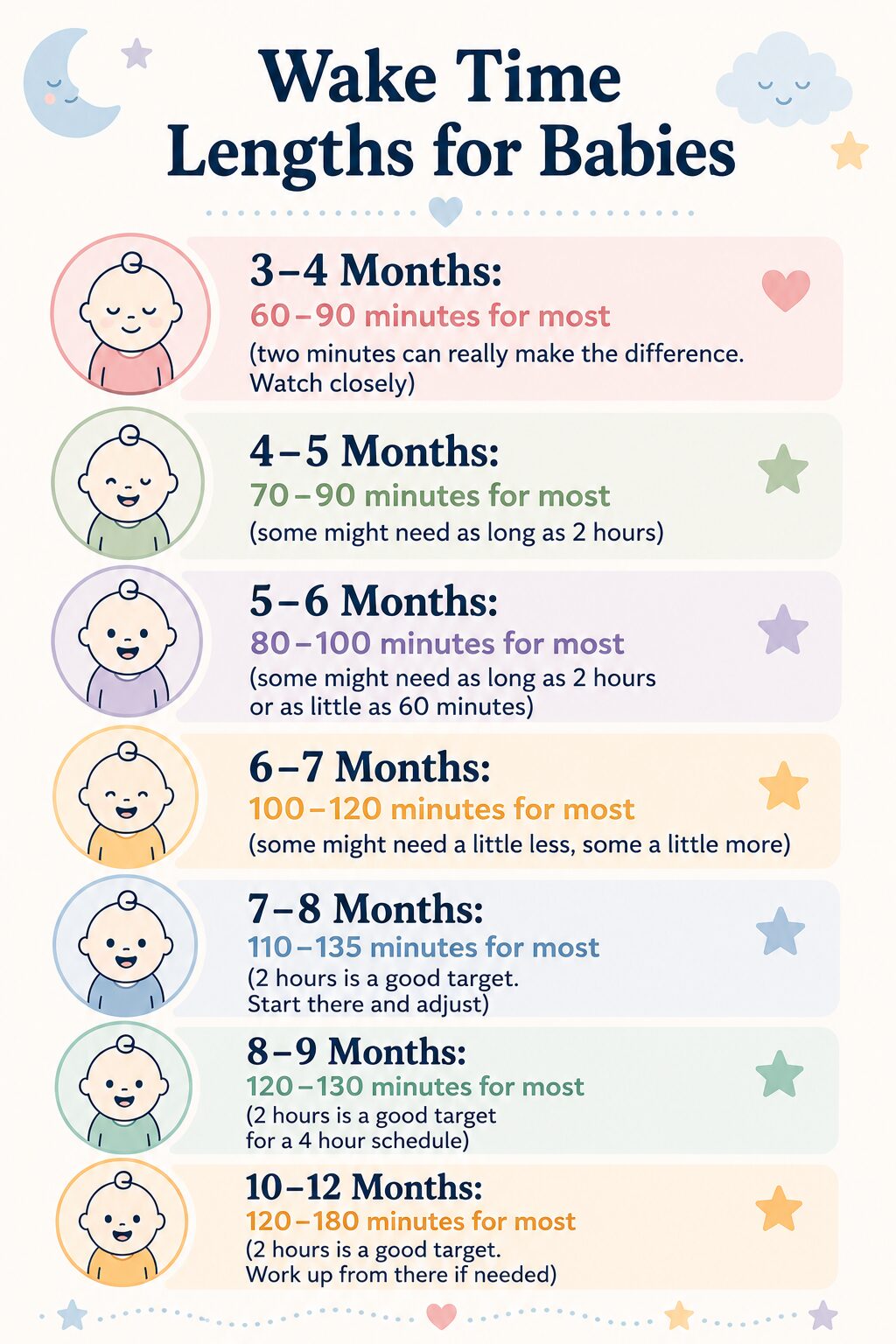
(See the infographic and free PDF worksheet linked below for the full visual reference.)
The general principle: the younger the baby, the shorter the waketime. A newborn may only be awake for 30-45 minutes from the start of one feeding to the start of the next nap. By the time a baby reaches several months old, waketimes extend — but by how much, and when, depends on the individual baby.
Start with the average for your baby’s age. If that doesn’t produce the nap results you’re hoping for, adjust — either adding a little time or pulling it back — and observe what changes.
The range also widens as babies get older. A newborn’s waketime range is quite narrow; an older baby has more flexibility on either end. This is normal and expected.
>>>Read: Adding Waketime to Your Newborn’s Day
The Tricky Part: Optimal Waketime Is Always Changing
Probably one of the most frustrating realities of this process is that optimal waketime doesn’t stay fixed. What worked perfectly two weeks ago might be too short today. Your baby is growing, developing, and changing constantly — and her sleep needs shift right along with her.
I’m not telling you this to make the process feel impossible. I’m telling you so you’re not blindsided when a schedule that was working suddenly stops working. It doesn’t mean you did something wrong. It means your baby is growing, and it’s time to adjust.
This is just part of life with a baby: staying aware of waketime is your new ongoing job. It becomes second nature quickly, and the payoff is absolutely worth it.
How to Find Your Baby’s Optimal Waketime
Finding optimal waketime is a process, not a one-time fix. Here’s how to approach it:
Step 1: Start with the average for your baby’s age. This gives you the best starting point rather than guessing from scratch. Most babies cluster near the middle of the range, so average is a reasonable first experiment.
Step 2: Watch and take notes. A baby who is put down too early may not be tired enough to fall asleep and will fuss or play. A baby who is put down too late will be overtired — she may seem wired or fussy rather than tired, and will have trouble settling even though she desperately needs sleep. Overtiredness is sneaky; it can look like your baby isn’t tired when she actually needs sleep urgently.
Step 3: Adjust in small increments. If naps are short or your baby is struggling to fall asleep, try adding 5–10 minutes to waketime and observe the result over a few days. If your baby seems to be fighting sleep at the start but naps well once she goes down, she may need a slightly shorter waketime.
Step 4: Track changes over time. Waketime lengthens gradually as your baby grows. You’ll notice the signs: she starts waking earlier from naps, or seems genuinely not tired when you try to put her down at her usual time. These are signals that it’s time to nudge waketime a little longer.
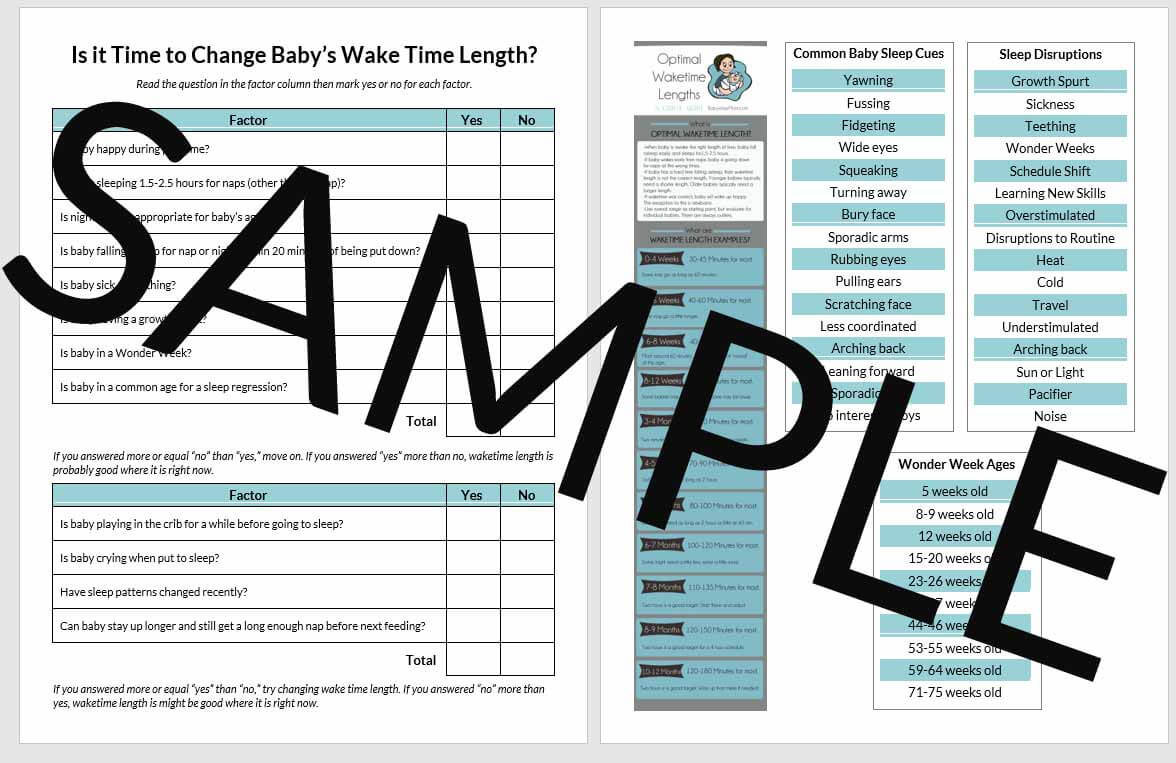
I’ve created a free Wake Time Length Worksheet to help you work through this systematically. It takes the guesswork out of deciding whether to extend waketime or not — and it includes the optimal waketime infographic as well. You’ll get it when you sign up for my email series on wake time length.


Why This Works: Sleep Begets Sleep
One important principle that underlies all of this: sleep begets sleep. Babies who are getting good, regular naps during the day sleep better at night. Babies who are chronically overtired or under-rested have a harder time sleeping well around the clock.
This is why getting waketime right isn’t just about naps in isolation — it’s about setting up your baby’s entire sleep rhythm. Good daytime sleep supports good nighttime sleep, and vice versa.
The numbers I share are designed for babies who are accustomed to napping on a regular basis. If your baby is newer to routine naps, be patient — it may take a little time for the rhythm to establish itself, and the ranges will become more reliable once sleep is more consistent overall.
What to Do Once You Find Optimal
Once you’ve landed on the right waketime, or wake window, for your baby at her current age and stage, the naps tend to fall into place. She falls asleep more easily. She stays asleep longer. You get a real break. She wakes up genuinely refreshed.
This is the payoff. It is absolutely worth the experimentation it takes to get there.
Keep in mind that “optimal” will shift — so stay observant, keep trusting your instincts, and be willing to revisit this whenever something that was working stops working. A nap regression is often less about sleep itself and more about a waketime that needs to be nudged longer.

Got a baby, a schedule, and a million questions? Join the Babywise Mom community and get answers from moms who get it. https://community.raptive.com/babywisemom
Resources to Help You
Free Wake Time Length Worksheet Download my free worksheet and optimal waketime infographic to figure out whether your baby’s waketime needs to be extended — and by how much.
Babywise Mom Log Ebook My ebook of logs gives you a ready-made system for tracking your baby’s schedule, naps, feedings, and waketime so you can spot patterns and make adjustments with confidence. It also includes the infographic and other helpful references.
Free Wake Time Length Worksheet
Be sure to check out my free Wake Time Length Worksheet to figure out if you should extend wake time or not.
Related Posts
- How To Calculate Waketime Length
- Optimal Waketime Length: Finding Baby Wake Windows
- When and How to Extend Baby’s Wake Time Length
- Wake Time Length (Wake Windows) — Full Guide
- Waketime Length for Newborns
- Tips Know When it is Time to Extend Baby Awake Time
- How Long Should a Newborn Be Awake Between Naps
- How to Calculate Waketime When Baby Wakes Early
- Just When You Got It… Everything Changes
- Sleep Begets Sleep: Why Daytime Naps Matter for Night Sleep
- The Babywise Mom Book of Naps

You can view this graphic online here. If you click on the graphic, it will enlarge. You can also get a PDF file for free here.

This post first appeared on this blog in May of 2016