Can you really work from home with a baby? With the right routine, yes. See how Babywise Sleep Solutions wake windows, longer naps, and independent playtime create reliable work blocks at every age, plus a sample day and tips for when the schedule goes sideways.
Are you trying to work from home but also be a mom to your little one? It can be done! Babywise Sleep Solutions is super helpful to set up a predictable day that you can work around.
How Babywise Sleep Solutions Can Help You Work From Home
Working from home with a baby sounds great until you sit down at your laptop, the baby wakes up after twenty minutes, and your carefully planned morning disappears. Most of the time the problem isn’t the amount of work. It’s the unpredictability.
I have been writing about Babywise since 2007, and I have raised four kids with it. The thing I hear most from parents who work from home is that they just want a day they can plan around. That is exactly what Babywise Sleep Solutions (formerly On Becoming Babywise) gives you. Babywise will not send your baby off to play quietly for eight hours. But it will give your day a predictable shape, with predictable naps, predictable playtimes, and a predictable bedtime. Once you can predict those, you can schedule your work around them.
In this post, I’ll walk you through the Babywise principles that create real work time, what that looks like at each age, a sample work-from-home day, and some realistic tips for the days the schedule doesn’t cooperate.
This post contains affiliate links.
Why Predictability Is the Secret to Working From Home With a Baby
Most advice about working from home with a baby boils down to “work while baby naps.” That is great advice if you know when the nap will happen and how long it will last. For a lot of parents, that is exactly the problem. Naps are short, random, and different every day, so there is never a block of time you can count on.
Here is what changes with Babywise. Your baby’s day follows the same repeating pattern every day, and each piece of that pattern has a purpose. Because the pieces are consistent, you start to know that the morning nap begins around 9 and will probably last until about 11. That is a two-hour window you can put on your calendar. Add a second nap and a daily stretch of independent playtime, and suddenly you have the building blocks of an actual work day.
We do have to remember reality. A newborn is a newborn, and no method turns those first weeks into a productive work stretch. And some jobs, especially ones heavy on meetings, will need childcare no matter how beautifully your baby sleeps. But for many parents, a structured day is the difference between constantly scrambling and quietly getting things done.
>>>Read: How To Successfully Do Babywise Sleep Solutions
The Babywise Principles That Create Work Time
The great thing about Babywise is days get very predictable. That means you can plan your work day around your kiddo’s routine. Will things come up that require you to be flexible? Yes. But most days will be consistent.
A Consistent Morning Wake-Up Time Anchors Your Day
Of all the Babywise steps, a consistent morning wake-up time is the one I list first, and it matters just as much for your work day as it does for your baby. Babywise suggests waking your baby at the same time each morning, within a thirty-minute window. If you want your day to start at 7, you might pick 6:45 to 7:15, or 7:00 to 7:30, and stick with that range. When I am establishing a routine with a new baby, I aim for super consistency, and I find that it works the fastest.
Why does this help you work? Because everything else in the day hangs off that wake-up time. Feedings, wake windows, naps, and bedtime all follow from it. If you know your baby wakes at 7, you know roughly when the first nap will land, and you can plan your first call or your first big task around it.
As a working parent, that means you can get up and get ready before your baby is awake so that you can start working as soon as your baby starts that first nap.
>>>Read: What Time To Start Baby’s Day
Eat Wake Sleep Gives Your Day a Rhythm
The whole Babywise day is built on the eat/wake/sleep cycle. Baby wakes, eats, has some awake time, then sleeps. Then baby wakes, eats, plays, and sleeps again, all day long. The order is the point. Because baby eats right after waking instead of being fed to sleep, baby takes full feedings and goes down for naps awake.
That last part is a huge deal for a working parent. When your baby can fall asleep without you rocking or nursing her through it, your hands are free the moment you lay her down. And because the cycle repeats, you get several natural openings in the day instead of one lucky one.
Correct Wake Windows Mean Longer Naps
Naps are where most of your work time will come from, so you want them to be long ones. Most Babywise naps run about 1.5 to 2 hours, and the biggest factor in how long baby sleeps is getting the wake window right. If baby is awake too long or not long enough, you will often see slow falling asleep or early waking. A baby who can also self-soothe will make it through the sleep transition that happens about every 45 minutes instead of waking up at the end of one cycle.
>>>Read: Optimal Waketime Length: Finding Baby Wake Windows
Every baby is different, and the right wake window changes as your baby grows, so there is some trial and error involved. When you get it right, you will see it. Baby falls asleep quickly, takes a good nap, and wakes up happy. For you, that means a two-hour block you can trust instead of a forty-five minute surprise.
Make sure you watch your baby for the right wake window. Do not distract yourself with work while baby is awake and miss that wake window. If you put baby down for a nap late, the nap will not go well.
>>>Read: The Cornerstone for Good Baby Naps
Independent Playtime Is Your Second Work Shift
This is the Babywise tool that nobody tells you about, and it is honestly one of my favorite parts of the whole method. Independent playtime is a daily stretch when your child plays alone in a safe space. It starts in a crib or playpen and later moves to a bigger space like a room. It is wonderful for your child, who builds focus, creativity, and attention span. And it gives you a period in the day without a child right by your side, a great time to cook, make phone calls, or get some work done.
>>>Read: Independent Playtime: The Ultimate Overview
My kids all took to it a little differently. Kaitlyn loved it from the start. By 11 months she was doing it twice a day, with a 20 to 30 minute stretch in the morning and a 40 to 45 minute stretch in the afternoon. Brayden was not a fan. We started later with him, and I only did it once a day. But by the time he was nearly 3, he looked forward to it and would play happily for an hour to an hour and a half.
Here are the general lengths from On Becoming Babywise II. These are guidelines, not rules. Start with 5 to 10 minutes once or twice a day for a young newborn, then 10 to 20 minutes twice a day for the first few months. Once baby can sit independently, 15 to 30 minutes twice a day works well. A crawler can handle 30 to 45 minutes at least once a day, and by 15 to 20 months you can work up to about an hour. From 18 months on, 60 to 90 minutes in a room is common, and many families keep it going through the preschool years.
>>>Read: Independent Playtime Lengths by Age
You can start independent playtime at any age, so if you’re reading this with a toddler, you haven’t missed the window. Just don’t turn it into an all-day event. Keep it in the normal range for your child’s age so he doesn’t come to hate it.
Independent playtime means you have a time period each day when your child is awake and you are free to work. This is especially helpful as your child gets older and starts to drop naps. If you intend to continue to work from home for years, you will want to make sure you have independent playtime in your day each day. That way you can have blocks of time to work even once your child has just one nap a day.
A Consistent Bedtime and Dreamfeed Protect Your Evenings
Babywise recommends a bedtime that is 10 to 12 hours before your morning wake-up time. I personally go for 12, so a 7 AM wake-up means a bedtime between 7:00 and 7:30 PM. An early bedtime gives you a real stretch of evening to finish up work, or better yet, to rest.
>>>Read: Importance of Consistent Bedtime for Babies
Then there is the dreamfeed, a late feeding around 10 PM. It is mostly there for your benefit. It gives baby one last feeding before you go to bed so that baby sleeps more of the hours you do. Some babies just don’t take to it, and that is okay. But I found it so valuable that I put real effort into getting my babies to do it.
Here is why this matters for work: it is very hard to do good work on broken sleep. The goal of all of this isn’t a spotless schedule. It is more sleep for everybody in the house.
>>>Read: The Basics of a Dreamfeed
Parent Directed Means You Plan Around Your Life
One of the things I love most about Babywise is that it is parent-directed. Babywise is PDF, Parent Directed Feeding, and the word that matters is directed. You are not following your baby’s every whim, and you are not obeying a rigid clock either. You feed your baby when she is hungry (Babywise says so many times), you adjust for growth spurts, and you tweak things for your own baby’s needs.
>>>Read: Parent Directed Feeding (Babywise PDF) Explained
That same flexibility is what lets you work with this method rather than against it. If you have an important call on Thursday, you can plan around it. If one day goes sideways, you go back to the routine the next day. Babywise works because you understand the why behind the guidelines and then adapt them to your real life.
>>>Read: Adjusting for Context Using Babywise
What Work Time Looks Like at Every Stage
The amount of work time you will find in a Babywise day depends a lot on how old your child is. The ages below come from the Babywise books and my own experience, and I list the youngest age you can reasonably expect something. Plenty of babies get there later.
- Newborn: expect small pockets of time. Be gentle on yourself. Baby will take lots of naps that are 1.5-2.5 hours long. Those naps can be your work times. Baby is only awake for 30-60 minutes at a time, so it will just mean 30-60 minute breaks from work throughout the day.
- 4-6 Months: your baby will still take 1.5-2 hour naps. You baby will likely only nap 3 times a day, but the good thing is the schedule is a lot more predictable. You can also have an independent playtime each day.
- 6-9 Months: your baby will move from 3 naps to 2 naps at some point during this age range (unless they hold on to the third nap until 10 months old). You will have two naps plus an indepdendent play each day.
- 9-12 Months: your baby will have two naps plus an independent playtime.
- 12-14 Months: your pretoddler might start to have one of the two naps be rough. You still do two naps each day, though. You will have independent playtime each day, also.
- 14-22 Months: You will move to one nap sometime between 14-22 months old. Then you will have independent playtime in the morning sometime and a long afternoon nap each day.
- 23 Months and Older: You will stick with one nap until your child is an older preschooler–3-4 years old. Once your child stops napping, continue having rest time in the afternoon. This is usually about an hour long. So you will get a break in the morning with independent playtime and a break in the afternoon with a nap when you know you can focus only on work.
The Newborn Months
If you have a brand new baby, remember the first couple of weeks are for recovering and getting to know your baby. Babywise suggests not worrying about feeding times or schedules for the first two weeks, and that is a great time to simply not work if you can swing it. After that, a newborn eats 8 to 10 times a day, about every 2.5 to 3 hours, with lots of short naps. Realistically, you will get small pockets of work time, not long blocks. That is normal, and it won’t last forever. If you want a way to simplify those first weeks, my sleep hierarchy for newborns is a good place to start. If you have flexibility on when to start working again, give yourself a lot of grace. Take as much maternity leave as you can.
>>>Read: My Sleep Hierarchy For Newborns
Three to Six Months
Somewhere around four months most babies settle into three naps a day. It is also often a rough age for sleep, so be ready for a bumpy patch. But as wake windows lengthen and naps firm up, you will start to see real blocks of time open up. Independent playtime can start to stretch, too.
Six to Twelve Months
This is where working from home with Babywise gets so much easier. By six months, naps are typically 1.5 to 2.5 hours each, and the third nap (when baby still takes it) tends to be a short one of about 45 minutes. Many babies move to two naps by around 8 months. Two long naps plus a crawler who can play alone for 30 to 45 minutes gives you a very workable day.
Toddlers and Beyond
As toddlers get bigger, naps consolidate and independent playtime grows. Babywise suggests moving from playpen to roomtime between 18 and 22 months, though my kids moved at different times. Brayden started around 14 to 15 months, Kaitlyn at 12 months, and McKenna not until about 20 months. Roomtime is mom-directed structured playtime alone, and for preschoolers and school-age kids, it is still a lifesaver, especially during long breaks and summers.
>>>Read: Roomtime: Structured Playtime Alone for Kids
>>>Read: How Independent Playtime Saved Our Homeschool
A Sample Babywise Work From Home Day
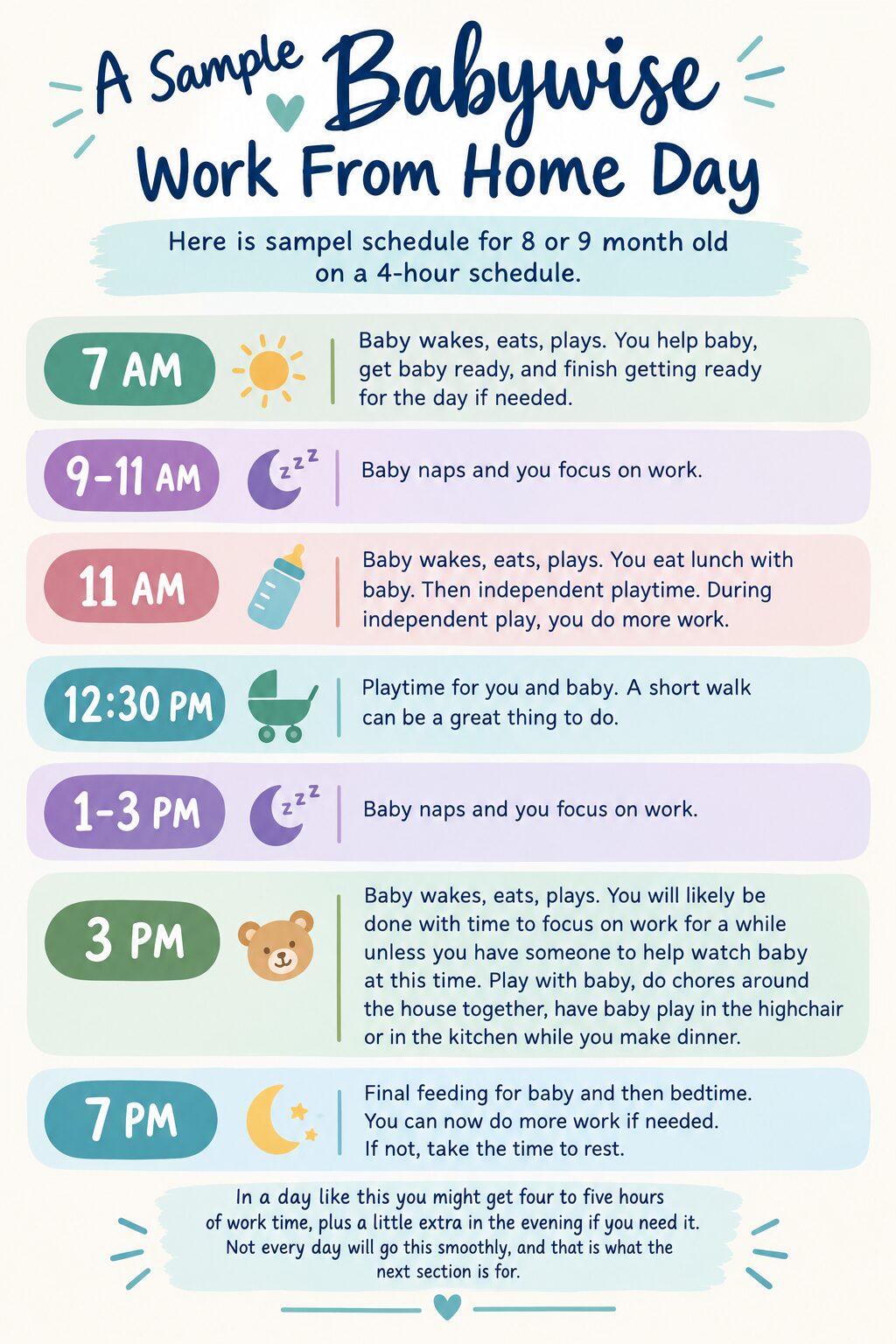
Here is an illustration of what a day might look like for an 8 or 9 month old on a 4-hour schedule. This is a sample to show you the pattern, not a prescription. Your baby’s wake windows and nap lengths will be a little different, and you can see lots of real schedules on my sample schedules page.
7 AM – Baby wakes, eats, plays. You help baby, get baby ready, and finish getting ready for the day if needed
9-11 AM – Baby naps and you focus on work
11 AM- Baby wakes, eats, plays. You eat lunch with baby. Then independent playtime. During independent play, you do more work.
12:30 PM – playtime for you and baby. A short walk can be a great thing to do
1-3 PM – Baby naps and you focus on work
3 PM – Baby wakes, eats, plays. You will likely be done with time to focus on work for a while unless you have someone to help watch baby at this time. Play with baby, do chores around the house together, have baby play in the highchair or in the kitchen while you make dinner.
7 PM – Final feeding for baby and then bedtime. You can now do more work if needed. If not, take the time to rest.
In a day like this you might get four to five hours of work time, plus a little extra in the evening if you need it. Not every day will go this smoothly, and that is what the next section is for.
>>>Read: Babywise Sample Schedules
Tips for Making It Work in Real Life
Protect the nap first. Naps are the backbone of your work day, so guard them. Use them for the work that takes real concentration, and save the easy stuff, like emails and quick tasks, for independent playtime.
Set up the space before you need it. Independent playtime goes best when the space is safe and the toys are ready. Spend an hour childproofing and picking out a few toys before you try to rely on it for work. A simple toy rotation can keep things fresh.
>>>Read: How To Child-Proof Your Space for Independent Playtime
Build up slowly. If your child is new to independent play, start with short stretches and work up. A timer can help for older kids. If your toddler won’t stay put or resists at first, that is very common, and I have posts to walk you through it.
>>>Read: A Simple Toy Rotation for Busy Moms
Plan for off days. Growth spurts, sleep regressions, teething, and illnesses are going to happen, and they will throw off your plans. Have a backup in mind, whether that is your partner, a grandparent, or a sitter. And try not to mess with wake windows during a regression, since that can make things worse once it passes.
>>>Read: Sleep Regressions: Causes, Ages, and What to Do
Keep your expectations honest. Some days you will get the full work day. Other days you will get ninety minutes and a lot of grace. Working from home with a baby is a season, and the structure you build now pays off for years.
>>>Read: When Your Child Won’t Stay in Independent Playtime
Work From Home With Babywise FAQs
Here are some common questions about working from home while using Babywise Sleep Solutions.
Can I work from home with a newborn
You can, but set your expectations for small pockets of time rather than long blocks. Newborns eat 8 to 10 times a day and nap often. The first two weeks are best spent recovering and bonding if you can. After that, a gentle routine and a simple independent playtime of 5 to 10 minutes can give you a little breathing room, and the work blocks grow as your baby does.
How long can my baby play alone while I work
It depends on age and personality. Babywise guidelines run from 5 to 10 minutes for a young newborn up to about an hour for a one-year-old, and 60 to 90 minutes for toddlers and older kids. Some days will be shorter and some longer, and it is always best to go with what your individual child can handle.
What if I am starting Babywise late
It is never too late. You can start independent playtime and a consistent routine at any age, and I have a whole guide for starting Babywise late.
>>>Read: Starting Babywise Late Guide
>>>Read: How To Start Independent Playtime Late
Do I have to do cry it out
No. Babywise needs your baby to be able to fall asleep on her own, but you can choose any method of sleep training. My personal favorite is a gentle one that I call the Four S’s, though I have done cry it out and have tips for that route, too.
>>>Read: Sleep Training According to Babywise
>>>Read: Gentle Sleep Training: The Four S’s
What if my baby takes short naps
Short naps are very often a wake window issue, or a baby who is still learning to connect sleep cycles. If your baby wakes at the 45-minute mark, check wake windows first, then work on self-soothing. Adjust wake windows slowly, in about five-minute steps, and give each change a few days.
>>>Read: The Babywise Mom Nap Guide
Conclusion
Working from home with a baby will never be effortless, but it can be a lot more manageable when your days have a rhythm. A consistent wake-up time, the eat/wake/sleep cycle, well-timed naps, daily independent playtime, and an early bedtime turn a chaotic day into one you can plan around. You get blocks of focused time, your baby gets the sleep and structure she needs, and your family gets a calmer home.
If you are just getting started, grab Babywise Sleep Solutions (affiliate link) and my Babywise first year overview, then print my free Babywise schedule cheat sheet so you can see what to expect at each age. And if you want tips delivered straight to your inbox, join my weekly email list. I’m cheering you on, mama.
Related Posts
- 7 Realities of a Work From Home Mom
- 8 Ways to Stay Productive as a Work-at-Home-Mom
- Babywise Enables Me to Stay Home
- Babywise Tips for Working Parents
- Newborn Parent Sleep Deprivation: Strategies That Actually Help