Wanting to sleep train your baby but not comfortable with cry-it-out? The fading method offers a gentle, gradual way to help your baby learn independent sleep skills with fewer tears and small step-by-step changes that actually last.
If you are looking for a gentle, gradual approach to sleep training, the fading method deserves a close look. It is one of the least abrupt ways to help your baby learn to fall asleep independently — and for parents who are not comfortable with cry-it-out but still want real, lasting results, it can be a great fit.
I want to be clear up front: there is no single “right” sleep training method. The best method is the one that works for your baby, suits your parenting style, and that you can follow through with consistently. I have covered many sleep training methods on this blog, and the fading method is one worth understanding well before you decide whether it is right for you.
Let’s walk through everything you need to know.
Post Contents
- What Is the Fading Sleep Training Method?
- Types of Fading Sleep Training
- Best Ages for the Fading Method
- How To Do Fading Sleep Training Step by Step
- How to Handle Night Wakings During Fading
- How Long Does Fading Sleep Training Take?
- Pros of the Fading Method
- Cons of the Fading Method
- Tips for Fading Sleep Training Success
- How Fading Compares to Other Sleep Training Methods
- Is the Fading Method Right for You?
What Is the Fading Sleep Training Method?
The fading sleep training method — sometimes called “fade it out,” camping out, or the gradual withdrawal method — is a gentle approach to sleep training where you slowly reduce the amount of help you give your baby at sleep time until they can fall asleep on their own.
The idea is simple: rather than making an abrupt change (like suddenly leaving the room and letting your baby cry), you make small, gradual reductions in your sleep-helping behavior over the course of days or weeks. You “fade out” your involvement a little at a time until it disappears entirely.
If you currently rock your baby completely to sleep, for example, you might start by rocking until they are very drowsy, then until they are just sleepy, then until they are simply calm, and eventually not rocking at all. Each step is a small change, and your baby has time to adjust to each one before you move to the next.
The fading method is generally considered one of the gentler sleep training options — but it is important to be realistic: it is not entirely without tears. Some crying is common with any sleep training method, including fading. The difference is that the crying tends to be less intense and less prolonged than with cry-it-out methods, because you are never making a dramatic change all at once.
>>>Read: Sleep Training Methods: 7 Different Ways to Train Baby
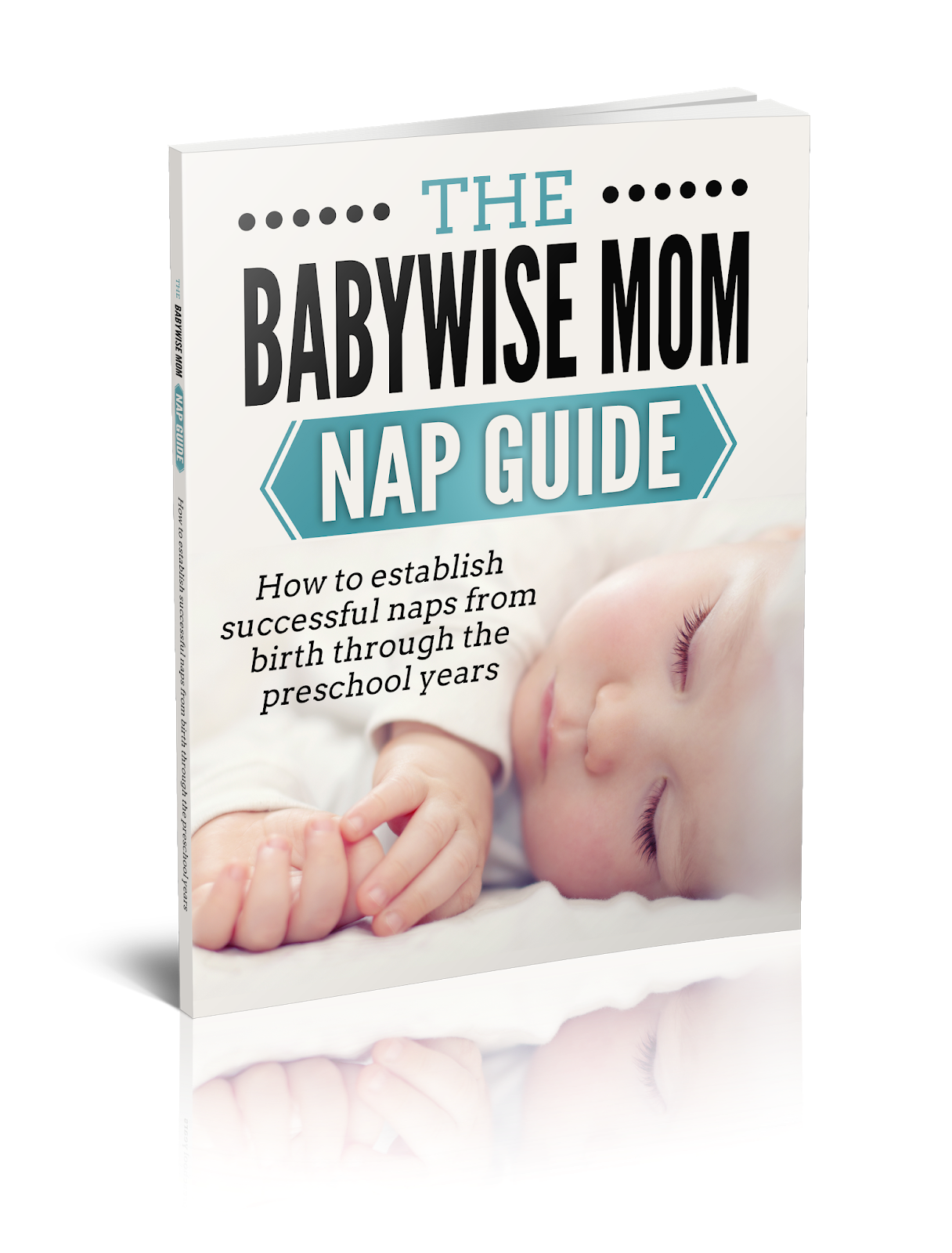
The Babywise Mom Nap Guide
The Babywise Mom Nap Guide eBook helps you establish successful naps from birth through the preschool years. It is a great resource!
Gary Ezzo, co-author of Preparation For Parenting and On Becoming Babywise, states: “Whether it is talking about establishing good nap behavior or offering solutions to sleep disruptions, this is a practical resource that I trust and recommend. The book is well laid out and answers just about every question a new or seasoned mom might have about babies, toddlers and sleep. We view this as more than a nap guided; it is a resource of encouragement that comes with compassion.”
Types of Fading Sleep Training
There are a few variations of fading sleep training. Understanding the different forms helps you choose the approach that fits your situation best.
1. Behavior Fading (Reducing What You Do)
This is the most common form of fading and what most people mean when they refer to “the fading method.” You identify what you are currently doing to help your baby fall asleep — rocking, nursing, patting, bouncing, holding — and you gradually reduce the intensity and duration of that behavior over time.
This might look like:
- Rocking until fully asleep → rocking until drowsy → rocking briefly as part of the routine → no rocking
- Nursing to sleep → nursing until drowsy → nursing as part of the routine but putting down awake → no nursing at sleep time
- Patting in the crib until asleep → patting and then stopping → hand on back without patting → hand removed → leaving the room
The key is that each reduction is small enough that it does not feel like a dramatic change to your baby. You are chipping away at the sleep association gradually rather than removing it all at once.
2. Presence Fading (The Chair Method)
This version of fading — also called the Chair Method or Sleep Lady Shuffle — focuses on fading your physical presence out of the room rather than fading a specific behavior.
With this approach, you sit next to your baby’s crib when you put them down. You can offer soft verbal reassurance and gentle touch. Each night (or every few nights), you move your chair or your position a little further away from the crib. Eventually, you are just outside the door, and then you are not coming in at all.
This method is particularly helpful for babies who are very aware of your presence and need the security of seeing you while they learn. It also works well for toddlers who are transitioning out of your room or bed.
3. Bedtime Fading (Adjusting the Sleep Window)
Bedtime fading is a slightly different approach that focuses on the timing of sleep rather than the sleep-helping behavior. If your child is taking a long time to fall asleep at bedtime — lying there for 45 minutes or an hour before settling — this version can help.
With bedtime fading, you temporarily move bedtime later to align with when your child is actually falling asleep, then gradually shift it earlier again. This reduces the amount of awake time in the crib, which reduces frustration and crying. It is less about weaning a sleep association and more about finding and then anchoring the right sleep window.


Best Ages for the Fading Method
The fading method can technically be used at a wide range of ages, but some ages tend to see more success than others.
Babies 4–8 Months
This is often the sweet spot for beginning fading. By four months, most babies have developed enough neurologically to begin learning independent sleep skills. Sleep associations that developed in the newborn period — nursing to sleep, rocking to sleep, being held — are at the stage where they can begin to be gradually changed without significant distress.
Fading tends to work especially well in this age range because babies are old enough to benefit from sleep training but not yet in the thick of separation anxiety (which typically peaks around 8–10 months). Starting before separation anxiety sets in can make the process smoother.
>>>Read: Babywise Sample Schedules: Four Months Old
Babies 8–12 Months
This is a trickier window for any sleep training because of the natural developmental surge in separation anxiety. Babies at this age are more acutely aware of your presence and absence, which can make fading feel more protracted. That said, fading can still work in this age range — the presence fading (Chair Method) variation is often especially well-suited here because it keeps you visible while your baby adjusts.
Patience and consistency matter even more during this window.
Toddlers and Older Children
Fading is one of the better methods for toddlers and older children who have developed strong sleep habits that you want to change — whether that is a habit of being nursed to sleep, rocked, or needing you to lie down with them. The gradual nature of fading is actually well-matched to the toddler temperament: abrupt changes can trigger power struggles and strong protests, while gradual changes give toddlers time to adjust without feeling ambushed.
For children who need you to lie in their bed until they fall asleep, fading can look like gradually moving closer to the door each night over the course of several weeks.
Not Recommended for Newborns
Fading is not best for newborns. If you are looking for a method perfect for newborns, see Gentle Sleep Training: The Four S’s. I used this gentle, no-cry method on my last two babies!
How To Do Fading Sleep Training Step by Step
Here is a practical step-by-step guide for doing the most common form of fading — behavior fading, where you reduce what you do to help your baby fall asleep.
Step 1: Identify Your Current Sleep Association
Before you begin fading anything, you need to be clear on exactly what you are fading. What is the thing your baby cannot fall asleep without right now? Be specific.
- Do you nurse your baby fully to sleep?
- Do you rock until they are completely asleep?
- Do you sit next to the crib with your hand in?
- Do you lie in their bed until they drift off?
Name it clearly. You cannot fade something you have not defined.
Step 2: Establish a Consistent Bedtime Routine
If you do not already have a consistent bedtime routine, put one in place before you begin fading. A predictable sequence of events — bath, lotion, pajamas, feeding, song, prayers, book, sleep — signals to your baby’s brain that sleep is coming. This helps enormously because it means the routine itself begins to do some of the work that the sleep association has been doing.
Give the routine a week or two to become truly consistent before you start fading the sleep association.
>>>Read: Perfecting Your Babywise Bedtime Routine
Step 3: Define Your Steps
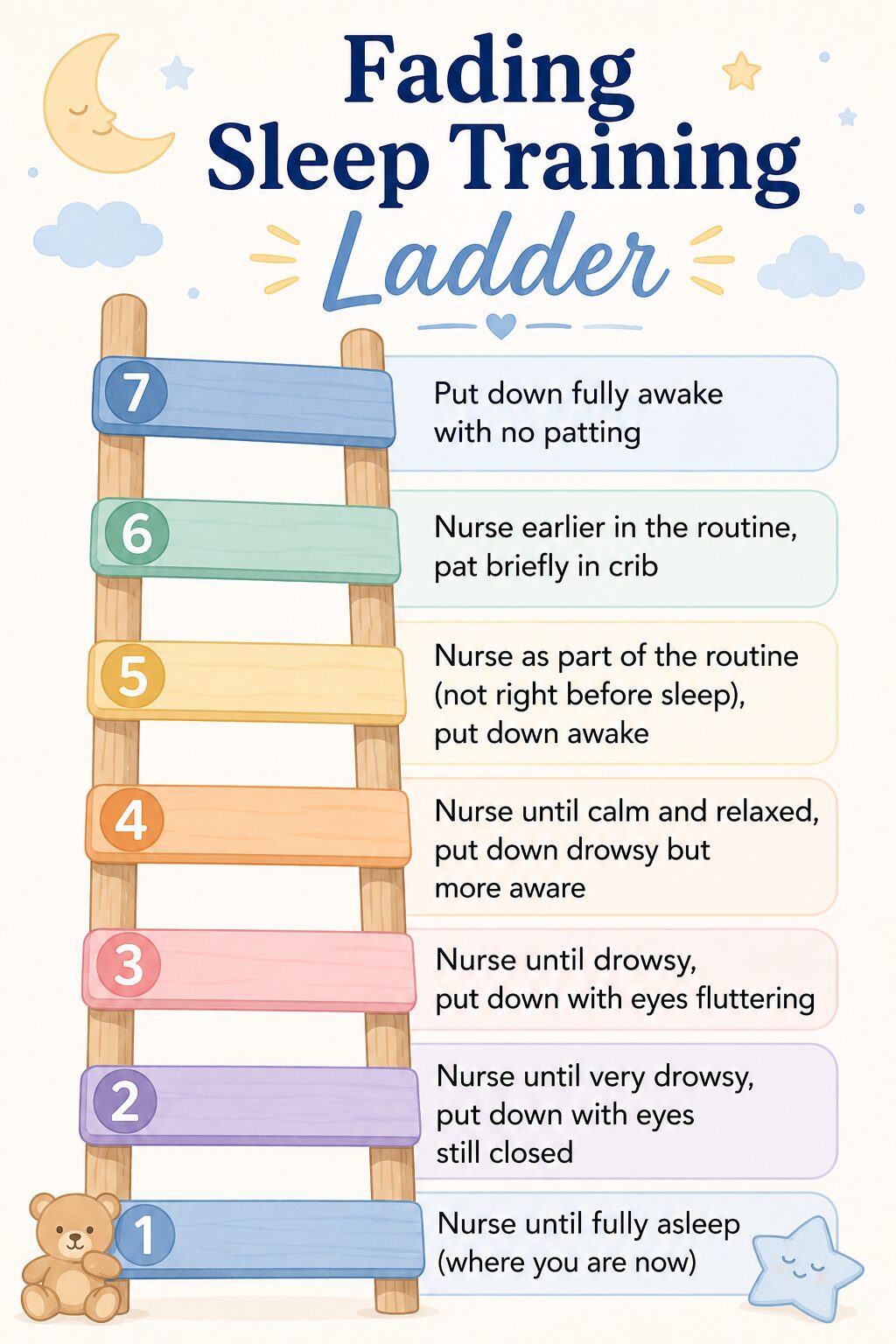
Map out your plan from where you are now to where you want to be. Think of this as a ladder — each rung is a small reduction from the last.
For example, if you are currently nursing your baby fully to sleep, your ladder might look like this:
- Rung 1: Nurse until fully asleep (where you are now)
- Rung 2: Nurse until very drowsy, put down with eyes still closed
- Rung 3: Nurse until drowsy, put down with eyes fluttering
- Rung 4: Nurse until calm and relaxed, put down drowsy but more aware
- Rung 5: Nurse as part of the routine (not right before sleep), put down awake
- Rung 6: Nurse earlier in the routine, pat briefly in crib
- Rung 7: Put down fully awake with no patting
The number of rungs and the size of each step depend on where you are starting and how quickly your baby is adjusting. There is no rule about how many steps it needs to have — the smaller the step, generally the easier the adjustment.
Step 4: Spend 3–7 Days on Each Step
Once you have your steps defined, spend several days on each rung before moving to the next. Do not rush. The whole point of fading is that gradual change is easier on your baby (and on you) than abrupt change. Think tortise and the hare. We are moving slowly. Slow and steady wins the race.
Aim for consistency at each step across both bedtime and naps. Many families find that naps are harder during sleep training than nights — this is normal. Be patient with naps.
If a particular step is causing significant distress for several days and not improving, consider whether the step is too large. You may need to add an intermediate step between where you are and where you are trying to go.
Step 5: Move to the Next Step When Ready
Your baby is ready to move to the next step when they are falling asleep fairly reliably at the current step without significant protest. “Fairly reliably” does not mean perfectly — it means more good nights than hard nights.
Do not interpret one hard night as a signal to go back a step. Babies have off days, just like we do. Stay at a step for the full planned time before evaluating.
Step 6: Respond to Night Wakings Consistently
See the section below on handling night wakings — this is an important piece of the fading process that many parents underestimate.
Step 7: Repeat the Process for Night Wakings
Once bedtime is going well, apply the same gradual approach to middle-of-the-night wakings. Use the same logic: whatever you are currently doing to resettle your baby in the night, fade it the same way you faded the bedtime association.
How to Handle Night Wakings During Fading
One of the most common questions about fading is: What do I do when my baby wakes up in the night?
The general principle is to respond at the same level you are currently at in your fading plan. If you are on Step 3 at bedtime, respond at Step 3 in the night. Consistency is what teaches your baby what to expect — if you are doing one thing at bedtime and something entirely different at 2 AM, the mixed signals slow the whole process down.
This can be genuinely hard in the middle of the night when you are exhausted. It is worth having a conversation with your spouse before you start about who is handling night wakings and what the response will be. Having a plan in advance means you are not making tired decisions in the dark.
As your baby becomes better at falling asleep independently at bedtime, night wakings almost always begin to improve naturally. Bedtime and night sleep are connected — a child who can fall asleep independently at 7 PM is practicing the exact same skill they need at 2 AM.
>>>Read: How To Solve Your Baby’s Nighttime Sleep Issues
How Long Does Fading Sleep Training Take?
Fading is a slower method than cry-it-out. It is important to go in with realistic expectations.
For most families, doing behavior fading, expect the full process to take two to six weeks. This is not a precise timeline — some babies move through steps quickly, others need more time at each stage. The more steps you have defined and the more gradually you move, the longer it will take.
Presence fading (Chair Method) often takes a similar timeline — typically two to four weeks from sitting next to the crib to being able to leave the room at bedtime.
If you are several weeks into fading and not seeing any progress at all — your baby is not adjusting to each step, crying is not decreasing, sleep is not improving — it is worth reassessing. Sometimes a different method is a better fit for a particular baby’s temperament. There is no failure in that; it is just information.
Pros of the Fading Method
It is gradual. If you read much on this website, you know I love doings “slow and steady.” Small changes are easier on both baby and parent than abrupt ones. The learning curve is spread over time, which means less intense crying and less anxiety for most families.
It works with what you are already doing. You do not have to stop cold turkey. You build on your existing sleep routine and reduce from where you currently are. This makes it feel less like abandonment and more like a natural evolution.
It can be used at many ages. Unlike some methods that work best in a narrow age window, fading can be adapted for babies, toddlers, and older children. The ladder-step approach is flexible enough to work across a wide range of situations and starting points.
Parents tend to feel better during the process. Many parents feel significant anxiety with cry-it-out methods because they are not in the room and cannot see their baby. With fading — especially presence fading — you are there. You can see that your baby is safe. For parents who need that reassurance to stay consistent, fading is often a much more sustainable approach. Babies feel the anxiety of their parents, so having mom less anxious is also good for baby.
It does not require you to ignore your baby’s cues. You are still responding to your baby; you are just responding with gradually less help. This feels more intuitive to many parents than shutting the door and not going back in.
It can be easier to commit to. The best sleep training method is the one you will actually follow through with consistently. For many parents, fading is something they can commit to more readily than a pure cry-it-out approach, which means they are more likely to see it through to real results.
Cons of the Fading Method
It takes longer. This is the primary drawback. Fading typically takes weeks rather than days. For exhausted parents who need a sleep change to happen fast, this timeline can be genuinely difficult.
Consistency is harder to maintain over weeks. It is relatively easy to commit to one hard night or three hard nights. It is harder to stay consistent for four to six weeks, especially when there are sick days, travel, holidays, developmental leaps, and life disruptions that can set the process back.
>>>Read: Sleep Training Issues: Tips to Prevent Problems
Some crying still happens. Fading is gentler than cry-it-out, but it is not a no-cry method. Most babies will cry at some point during the process, and some babies cry quite a bit even with gradual changes. If you are going in expecting zero tears, you may be disappointed.
Progress can feel slow and unclear. With cry-it-out, there is often a clear turning point — nights one through three are hard, then things improve dramatically. With fading, progress is more gradual, and the line between “this is working” and “this is not working” is blurrier. Some parents find this uncertainty harder to navigate than the more defined intensity of cry-it-out.
It requires careful planning. You cannot just decide tonight is the night to start fading without having defined your steps. A vague plan leads to inconsistent execution. Fading done without a clear ladder of steps can accidentally reinforce the sleep association rather than reducing it, because you end up responding inconsistently.
It may be harder with a very persistent baby. Some babies are temperamentally persistent — they do not give up easily and are not easily distracted or redirected. For these children, the gradual removal of a comfort behavior can sometimes trigger sustained protests that last just as long as cry-it-out would have, but stretched across weeks instead of nights. If this is your baby, a different method may serve you better.
Tips for Fading Sleep Training Success
Make Your Steps Small Enough
The most common mistake with fading is making the steps too big. If you are trying to fade nursing to sleep and you go from nursing fully to sleep to putting down wide awake in one step, that is not fading — that is cold turkey. The power of fading is in the smallness of each individual change. When in doubt, add a smaller intermediate step.
Do Not Bounce Between Steps
Moving forward one step, then retreating when things get hard, then moving forward again, teaches your baby that persistence pays off. Choose your pace and stick to it. If you need to pause at a step, pause — but try not to go backwards.
Keep Everything Else Consistent
While you are working through a fading plan, keep the rest of your baby’s routine as consistent as possible. This is not the time to also be dropping a nap, starting daycare, moving to a new room, or making other major changes. Isolate the variable you are working on.
Both Parents on the Same Page
If there are two parents in the home, both need to be executing the plan in the same way. A baby who is faded with one parent and then rocked to sleep by the other is receiving mixed messages that slow or stop progress. Have a conversation in advance, agree on the plan, and do it together.
Track Your Progress
Write down how long it takes your baby to fall asleep at each step, how much protest there is, and how night wakings go. When you are in the middle of it and exhausted, it is genuinely hard to tell whether things are improving. Having data — even rough notes — helps you see the trend and stay the course when one hard night makes it feel like nothing is working.
Use Wake Time Wisely
Sleep training works better when your baby’s wake windows are right, when they are not overtired going into sleep, and when their overall schedule is well-established. A baby who is undertired will fight sleep regardless of what method you use; a baby who is overtired will be harder to soothe and harder to resettle. Get the schedule right alongside the sleep training.
>>>Read: Baby Wake Windows by Age
How Fading Compares to Other Sleep Training Methods
It can help to understand how fading fits into the broader landscape of sleep training methods.
Fading vs. Cry It Out (Extinction): Cry it out involves putting your baby down awake and not responding until morning. It tends to produce faster results — often within three to five nights — but involves more intense crying and requires parents to leave the room and stay out. Fading takes longer but involves less intense crying and keeps parents more actively involved in the process.
>>>Read: How to Use the Extinction Method for Sleep
Fading vs. the Ferber Method (Graduated Extinction): Ferber involves leaving the room and returning at set intervals to reassure without picking up. It is faster than fading but still involves significant crying. Fading keeps you more present and reduces what you do rather than when you check in.
Fading vs. the Four S’s / Chair Method: These are closely related to fading. The Chair Method is essentially presence fading — you fade your location out of the room gradually. The Four S’s is a gentle sleep training approach that also shares some DNA with fading in that it is gradual and responsive. Four S’s is also best for newborns while fading is better for 4 months and older.
Fading vs. Pick Up Put Down: Pick Up Put Down involves picking your baby up when they cry and putting them back down once calm. It is very responsive but can be very stimulating for some babies and can actually increase crying. Fading tends to be more predictable in its approach.
>>>Read: Gentle Sleep Training: The Four S’s
Is the Fading Method Right for You?
The fading method tends to be a good fit if:
- You want to minimize crying as much as possible and are willing to trade speed for gentleness
- You are not comfortable leaving the room with your baby crying and need to be present to stay consistent
- Your baby is a toddler or older child with an entrenched sleep association that needs to be gradually unwound
- You have the time and consistency to see a four-to-six week process through without interruption
- You are dealing with a mild to moderate sleep association (not a newborn habit that requires feeding multiple times overnight)
The fading method may not be the best fit if:
- You need faster results due to severe parental sleep deprivation
- You tend toward inconsistency — gradual methods require sustained commitment over weeks, and inconsistency will derail fading faster than most other methods
- Your baby’s temperament is highly persistent and they do not adjust well to incremental changes
- You have significant life disruptions coming (travel, a new baby, a big transition) that will make maintaining consistency difficult
Remember: there is no gold standard method. Sleep training is something that simply needs to happen for your family’s health and wellbeing — the how matters far less than the doing and the consistency.
>>>Read: 5 Important Sleep Training Tips for Baby Sleep
Conclusion
The fading method is one of the gentler paths to independent sleep, and for many families it is exactly the right tool. It honors the idea that your baby can learn something new without being asked to make a big leap all at once. And it keeps you involved in the process rather than on the other side of the door.
It takes patience. It takes planning. It takes consistency over weeks rather than nights. But for the right baby and the right family, fading is a genuinely effective path to the goal every sleep-deprived parent is working toward: a baby who can fall asleep independently and sleep well all night long.
You can do this!
Related Posts
- Sleep Training Methods: 7 Different Ways to Train Baby
- Gentle Sleep Training: The Four S’s
- Everything You Need to Know About Cry It Out
- How to Use the Extinction Method for Sleep
- 5 Important Sleep Training Tips for Baby Sleep
- Sleep Training: When to Start and What to Know
- Best Baby Sleep Training Books
- How to Solve Your Baby’s Nighttime Sleep Issues
- Baby Wake Windows by Age
- Sleep Training According to Babywise
- How to Handle Sleep Disruptions