
Your baby’s sleep is getting worse, not better. Short naps, early wakings, constant crankiness—and you can’t figure out why. The culprit might be sleep deficit: accumulated sleep debt that compounds over time. Learn the warning signs, why it happens, and exactly how to fix it. If your little one is not sleeping well, it might be due to a sleep deficit, or sleep debt. Learn the signs and how to fix it.

Your baby used to sleep beautifully. Two-hour naps, peaceful nights, happy wake-ups. Then something shifted. Now naps are 30 minutes of fighting, bedtime is a battle, and your once-cheerful baby is cranky all day. What happened?
The answer might be sleep deficit—also called sleep debt or sleep deprivation. Just like your credit card debt grows when you don’t pay it off, sleep debt accumulates when your child doesn’t get enough rest day after day. And just like financial debt, sleep deficit comes with serious consequences that compound over time.
The tricky part? Sleep deficit doesn’t show up immediately. You might drop a nap or extend wake time and things seem fine for a week. Then suddenly, everything falls apart. Your toddler who slept 12 hours a night is now waking at 5am. Your baby who took solid naps won’t sleep more than 45 minutes.
Understanding sleep deficit is the key to solving many mysterious sleep problems. In this guide, you’ll learn exactly what sleep deficit is, how to recognize the warning signs before things get bad, why it makes sleep worse (not better!), and most importantly—how to fix it with strategic schedule adjustments.
I often talk about a sleep deficit when giving advice for sleeping. You need to understand what a sleep deficit is, what it looks like, why it is a problem, and what to do about it in order to help your little one get great naps and have solid nighttime sleep.
The idea of sleep deficit comes from the book Healthy Sleep Habits, Happy Child (affiliate link) written by Marc Weissbluth, M.D.
Quick Takeaways:
- Sleep deficit accumulates when babies don’t get enough sleep over time
- Effects aren’t immediate—they build over 1-3 weeks
- Common causes: dropping naps too soon, extended wake windows, and late bedtime
- Signs include short naps, early wakings, crankiness, and behavioral issues
- Recovery takes 1-3 weeks with strategic schedule adjustments
- Prevention is easier than cure—watch for early warning signs
What is a Sleep Deficit?
A sleep deficit, or a sleep debt, is what happens when your child doesn’t get enough sleep. Basically, it is the difference between the amount of sleep that should be happening and the amount of sleep that is happening. This is often referred to as sleep deprivation.
Sleep deficits grow over time. Just like if you owe money and you are paying interest each month and the amount you owe grows, if your child continually gets less sleep than is ideal, the deficit grows.
When your child isn’t getting enough sleep and the effects add up over time, you have a sleep deficit.
Everyone can have a sleep deficit, even adults. So this is something to be aware of for your baby, toddler, preschooler, tween, teen, and yourself!
A sleep debt is a problem so far as a daily schedule goes, but it is also a medical problem that can lead to health concerns for adults such as diabetes, weight gain, stroke, headaches, memory loss, and irritability, among others.
>>>Read: Sleep Totals: How Much Sleep Should Your Child Get?

What happens if there is a sleep deficit?
When your child has a sleep deficit, they are not getting enough sleep. If the sleep totals stay the same each day (or less), then the deficit will only grow. “…there is a progressive worsening in a child’s mood and performance even when the amount of lost sleep each day or night is constant” (page 116).
This is why when you make a change in sleep, it can take a couple of weeks before you see the negative effects from that sleep change. So you might drop a nap or lengthen a waketime when you shouldn’t have an not know it for a week or two. Things might seem fine at first, and then all of a sudden your little one is not sleeping well anymore.
Any time you have a sleep problem, look at the last couple of weeks and consider what has changed over the last couple of weeks.
“A constant small deficit in sleep produces a cumulative reduction in daytime alertness” (page 116).
If your child is not getting enough sleep, your child will become less alert, more grumpy, more needy, and have a harder time sleeping over time. Remember, sleep begets sleep. Overly tired children have a hard time sleeping.
This can seem illogical. We often think if we keep our child up longer, she will sleep better because she will be more tired. Sleep just doesn’t work that way. As Weissbluth says, it isn’t logical but it is biological (see page 229).
What does sleep deficit mean in real-life application?
A sleep deficit is something to watch out for when sleep changes occur. This is especially true when dropping naps. I see it most often when dropping the morning nap. That transition time is hard, and people sometimes move to just one nap a day sooner than is best for the child and things backfire.
Like Weissbluth says, sleep deficits accumulate over time. You might drop to one nap and have it be great for a few days, then things get a little muddled, and two weeks later you have a 16 month old taking a one hour nap total each day.
If you have recently dropped a nap and your child starts to have napping problems, consider the possibility that your child is not getting enough sleep and a sleep deficit has grown.
>>>Read: Adjusting the Schedule to Fix a Sleep Deficit
How Sleep Deficit Develops: A Timeline
Understanding how sleep debt accumulates helps you catch it early. Here’s a typical progression:
Week 1: The Change
- You drop your 15-month-old’s morning nap
- She now has one 2-hour afternoon nap instead of two 1.5-hour naps
- Daily sleep drops from 13 hours to 12 hours
- Overnight deficit: 7 hours per week
Week 2: Things Seem Okay
- Morning wake-up gets slightly earlier (6:15am instead of 6:45am)
- Afternoon nap shortens to 1 hour 45 minutes
- Bedtime takes longer (30 minutes instead of 10)
- She seems a bit clingier but you attribute it to development
- Deficit growing: Now missing 10+ hours total
Week 3: Cracks Appear
- Wake-up time now 5:45am consistently
- Afternoon nap down to 1 hour 30 minutes
- Takes 45 minutes to fall asleep at bedtime, protests loudly
- Noticeably cranky in late morning
- Tantrums increasing
- Deficit: 15+ hours behind
Week 4: Full Breakdown
- Waking at 5:30am or earlier
- Fighting afternoon nap, only sleeps 45 minutes-1 hour
- Bedtime is a 1-hour battle with crying
- Cranky all day, multiple meltdowns
- Clingy, whiny, difficult behavior
- Parents are exhausted and confused—wasn’t dropping the nap supposed to help sleep?
The Problem: Your toddler needed two naps until 18 months, not 15 months. The one-nap transition happened too early, and sleep debt accumulated until it broke the whole sleep system.
The Solution: Add back the morning nap temporarily (even if short), then try the one-nap transition again in 2-3 months.
This is how sleep deficit works. The effects aren’t immediate—they build over days and weeks until suddenly, everything falls apart.
The Science Behind Sleep Deficit
It seems backwards: your overtired child should crash and sleep hard, right? Wrong. Here’s what actually happens in an overtired body:
Cortisol Response When your child doesn’t get enough sleep, the stress hormone cortisol rises. Cortisol is a stimulant—it makes falling asleep harder and causes more night wakings. This is why overtired babies fight sleep desperately, even though they’re exhausted.
Sleep Cycle Disruption Quality sleep involves cycling through light sleep, deep sleep, and REM sleep. When children are overtired, they might fall into deep sleep initially but can’t maintain healthy sleep cycles. They wake between cycles and can’t resettle. This is why overtired babies take 30-45 minute “disaster naps.”
Hyperarousal State Chronic sleep deprivation puts the nervous system in a state of hyperarousal. The body can’t wind down properly. You see this in toddlers who get a “second wind” at bedtime—they’re overtired but wired, unable to calm down for sleep.
Melatonin Interference Sleep deprivation affects melatonin production and timing. Your child’s natural sleep-wake rhythm gets disrupted, causing early morning wakings, difficulty falling asleep at bedtime, and irregular nap times.
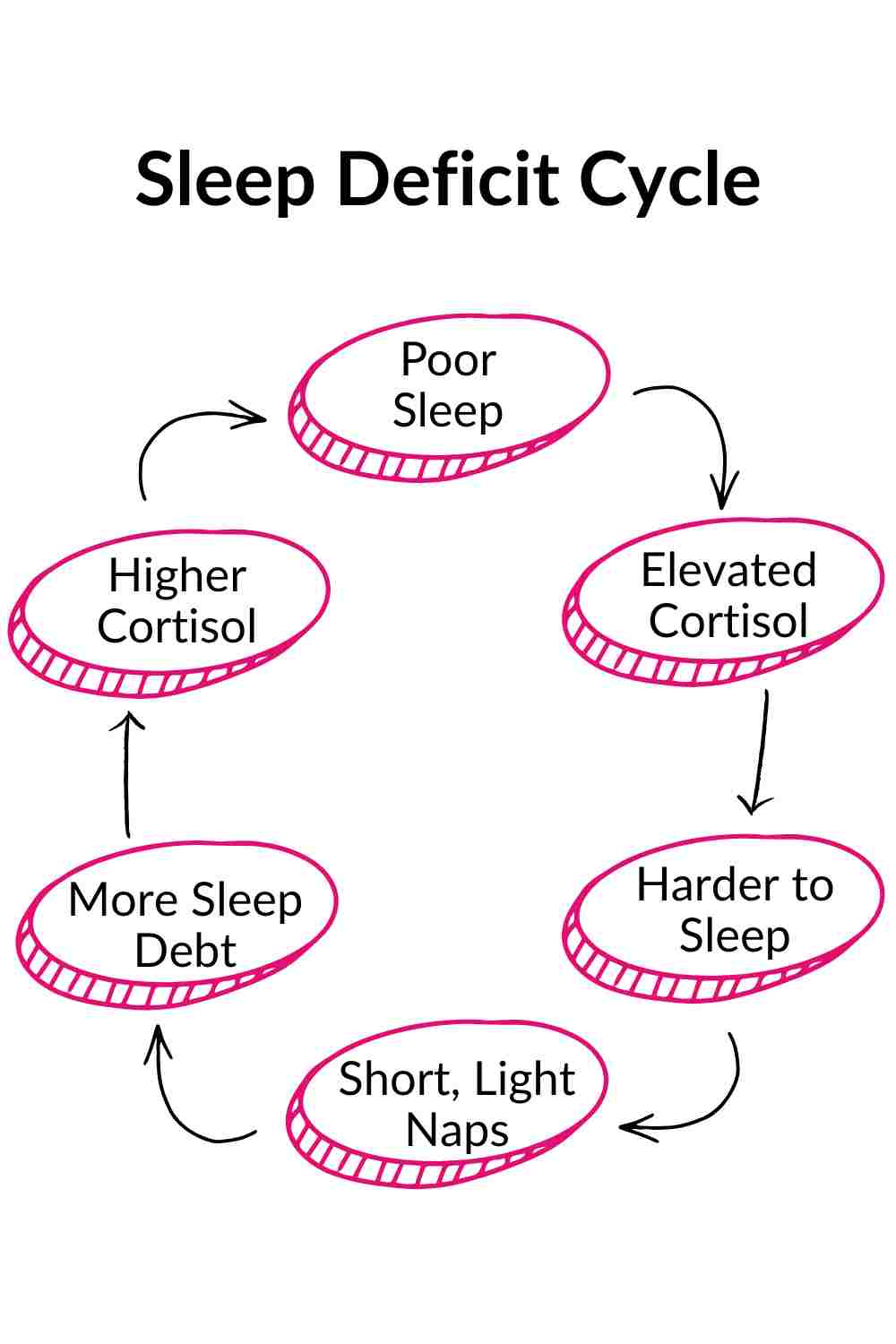
The Vicious Cycle
- Poor sleep → elevated cortisol → harder to fall asleep → shorter, lighter sleep → more sleep debt → even higher cortisol → worse sleep
Breaking this cycle requires strategic intervention, not just “waiting it out.”
As Weissbluth explains in Healthy Sleep Habits, Happy Child, sleep deficits are biological, not logical. You can’t reason your way out of them—you must address the root cause: insufficient sleep.
Signs Your Child has a Sleep Deficit
Here are some common signs of a sleep deficit:
- Your child wakes up grumpy. “Upon awakening, well-rested children are in good cheer and are able to play by themselves” (page 116). Do note, however, that most newborns wake up crying. It takes several months before you can expect a baby to start waking up happy consistently–probably around 4-6 months old.
- Your child has a hard time falling asleep.
- Your child takes short naps.
- Your child wakes early in the morning.
- Your child’s behavior is worsening. Tantrums are increasing as is disobedience.
Is it Sleep Debt or Something Else?
Not every sleep disruption is a sleep deficit. Here’s how to tell:
Sleep Deficit Indicators:
- Progressive worsening over 1-3 weeks
- Multiple signs are present simultaneously
- Happened after a schedule change
- Affects both naps AND night sleep
- Mood/behavior significantly impacted
- Resolved by adding more sleep
Normal Sleep Disruptions:
- Sudden onset (not gradual)
- Usually isolated to one area (naps OR nights, not both)
- Coincides with growth spurt, illness, or travel
- Resolves within 3-7 days on its own
- Mood relatively unaffected during wake times
- No recent schedule changes
Example 1 – Sleep Deficit: 13-month-old dropped to one nap 3 weeks ago. Nap has gotten progressively shorter (now 45 minutes), morning wake-up earlier each day (now 5:15am), bedtime takes 45 minutes with crying, tantrums all day, clingy and whiny.
Diagnosis: Sleep deficit from too-early nap transition
Solution: Add back morning nap
Example 2 – Normal Disruption: 8-month-old has slept great for months. Suddenly started waking 2x per night three days ago but naps unchanged. Still happy during day. Started pulling to stand yesterday.
Diagnosis: Developmental leap (gross motor skill)
Solution: Give extra practice during day, be patient, will resolve in days
Recognizing Sleep Deficit at Every Age
Here are some tips for recognizing sleep deficits by age.
Newborns (0-3 months) Sleep deficit is less common (they sleep 14-17 hours!) but can happen if:
- Feeding schedule is too stretched
- Environment is too stimulating
- Medical issues prevent good sleep
Signs:
- Difficulty staying awake for feedings
- Weak suck during feeds
- Excessive crying, inconsolable
- Extreme fussiness after being awake only 30-45 minutes
Babies (4-11 months) This age is prime time for sleep deficit, especially during nap transitions.
Signs:
- Taking three 30-minute naps instead of two 1.5-2 hour naps
- Waking before 6am regularly
- Taking 30+ minutes to fall asleep for naps
- Multiple night wakings (when previously sleeping through)
- Refusing second or third nap but cranky without it
- Very fussy in late afternoon/early evening
- Crying upon waking from naps instead of babbling happily
Toddlers (12-35 months) The one-nap transition (15-18 months) causes most sleep deficit issues at this age.
Signs:
- Nap under 1 hour (should be 2-3 hours at this age)
- Waking before 6am (when previously sleeping until 6:30-7am)
- Fighting bedtime for 45+ minutes
- Tantrum frequency and intensity increasing
- Meltdowns over minor frustrations
- Clinginess, neediness, regression
- Difficulty with transitions during the day
- Fighting naptime but clearly needs it (eye rubbing, yawning)
Preschoolers (3-5 years) Many drop naps during this phase, but some still need them.
Signs:
- Falling asleep in car every afternoon (signals nap still needed)
- Extreme crankiness after 3pm
- Bedtime before 7pm needed to avoid meltdowns
- Difficulty waking in morning despite 11-12 hours of sleep
- Behavioral issues at preschool (teacher reports)
- Frequent illnesses (sleep deficit weakens immune system)
- Can’t make it through day without rest
School-Age Children (6-12 years) Often overlooked, but sleep deficit common with busy schedules.
Signs:
- Difficulty waking for school
- Falling asleep during car rides
- Irritability, mood swings
- Difficulty concentrating on homework
- Behavioral issues at school
- Getting sick frequently
- Needs 10+ hours sleep but getting less
>>>Read: Tips to Get Baby Waking Up Happy From Naps
What To Do If Your Child Has a Sleep Debt
When you explain a situation to me and I say I think there is a sleep deficit going on, it means that I think it sounds like your child isn’t getting enough sleep overall and is starting to have a negative impact from the lack of sleep.
To fix the sleep deficit, you need to figure out a way to get your child having more sleep in a 24 hour period. This means you need to figure out why your child isn’t getting the sleep she needs. You might need to add in a nap. You might need to start the nap earlier in the day. You might need to have an earlier bedtime. You might even need more physical exercise and stimulation each day so she is tired enough to sleep when it is time.
Common ways to fix a sleep deficit are:
- Add in a nap
- Lengthen a nap (start earlier or let it go longer)
- Shorten waketime length
- Start bedtime earlier
- Start your day later
- Start your one nap earlier in the day
- Make sure your little one is getting enough exercise and mental stimulation to need to sleep when it is time
Now, you can’t really make up for lost sleep, but you can add in extra sleep until the body feels rested. As your little one recovers from a sleep debt, she might sleep more than she would otherwise. Once her body is caught up enough, she will settle into her new normal.
Sleep Deficit Recovery Plan: Step-by-Step
Fixing sleep deficit takes time—typically 1-3 weeks depending on severity. Here’s your action plan:
Step 1: Track Current Sleep (Days 1-3)
Before changing anything, document what’s happening:
- Wake time each morning
- Nap start time, length, how long to fall asleep, mood upon waking
- Bedtime, how long to fall asleep, night wakings
- Mood/behavior throughout day
- Any disruptions (teething, visitors, etc.)
Why: You need baseline data to see patterns and measure improvement.
Step 2: Calculate Total Sleep Needs
Compare your child’s actual sleep to recommended amounts:
Age-Specific Sleep Needs:
- Newborn (0-3 months): 14-17 hours total
- Baby (4-11 months): 12-15 hours total
- Toddler (1-2 years): 11-14 hours total
- Preschooler (3-5 years): 10-13 hours total
- School-age (6-13 years): 9-11 hours total
Example: Your 10-month-old sleeps:
- Night: 10 hours
- Naps: Two 45-minute naps = 1.5 hours
- Total: 11.5 hours (needs 12-15 hours)
- Deficit: 30 minutes-3.5 hours per day
Step 3: Identify the Root Cause
Review the “Common Causes” section above. What changed 1-3 weeks before sleep problems started?
- Did you drop a nap?
- Extend wake time?
- Have a growth spurt or developmental leap?
- Travel or have visitors?
- Start daycare?
Step 4: Choose Your Recovery Strategy
Based on age and root cause, select approach:
For Dropped Naps Too Soon:
- Add back the nap temporarily (even if baby protests initially)
- Start with 30-45 minutes
- Gradually extend as body adjusts
- Try dropping again in 2-3 months
For Extended Wake Windows:
- Shorten wake time by 15-30 minutes
- Watch for sleepy cues, don’t rely solely on clock
- Aim for calm, content baby going into crib—not overtired
For Too-Late Bedtime:
- Move bedtime earlier in 15-minute increments every 2-3 days
- Goal: Asleep by 7-7:30pm for children under 3
- Earlier bedtime often means later morning wake (counterintuitive but true!)
For Short/Poor Quality Naps:
- Start naps earlier (overtired babies can’t nap well)
- Ensure optimal sleep environment (pitch black, white noise, comfortable temperature)
- Give 15-20 minutes to resettle if waking at 30-45 minutes
For Early Morning Wakings:
- Earlier bedtime (yes, really!)
- Later morning nap start (wait until at least 9am)
- Blackout curtains (even small light leaks disrupt sleep)
Step 5: Implement Changes Consistently
- Stick to new schedule for at least 5-7 days before evaluating
- Consistency is KEY—don’t skip naps on weekends
- If one strategy isn’t working after 7-10 days, reassess
Step 6: Expect Temporary “Catching Up” Sleep
As deficit clears, your child might:
- Sleep longer naps than usual
- Fall asleep faster
- Need earlier bedtime temporarily
- Sleep later in morning
This is GOOD—the body is recovering. Once caught up, sleep will normalize to healthy patterns.
Step 7: Monitor and Adjust
After 2 weeks, reassess:
- Is total sleep closer to recommended range?
- Is mood improved?
- Are naps longer, more consistent?
- Is falling asleep easier?
- Fewer tantrums?
If YES: Continue current schedule If NO: Revisit root cause analysis
What Causes a Sleep Deficit in Children
Understanding the cause helps you fix it faster. Common culprits:
Schedule Changes Made Too Soon
- Dropped morning nap too early: The #1 cause of sleep deficit I see. Parents drop to one nap at 10-13months because baby fights the morning nap, but child still needs it.
- Dropped afternoon nap before age 3-4: Some toddlers need two naps past age 2.
- Extended wake windows too quickly: Adding 15 minutes is usually fine; adding 45 minutes causes problems. I recommend adding 5 minutes at a time.
- Dropped dreamfeed too early: Some babies need it until 9+ months.
Environmental Disruptions
- Room not dark enough: Light exposure suppresses melatonin
- Room too warm or cold: Ideal is 68-72°F
- Noise during sleep transitions: Wakes baby at 30-45 minute mark
- Uncomfortable sleep environment: Baby can’t sleep deeply if uncomfortable
Developmental Factors
- Growth spurts: Hunger wakes baby more frequently temporarily
- Wonder weeks/leaps: Brain development can temporarily disrupt sleep
- Learning new skills: Rolling, sitting, standing, walking—practice interferes with sleep
- Teething: Pain prevents quality sleep for days or weeks
- Separation anxiety: Peaks around 8-10 months and 18 months
Medical Issues
- Reflux/GERD: Pain prevents deep, restorative sleep
- Ear infections: Often undiagnosed, chronic sleep disruptor
- Food sensitivities: Can cause discomfort affecting sleep
- Sleep apnea: Loud snoring, gasping, restless sleep
- Eczema: Itching prevents quality sleep
Parenting Approaches
- Inconsistent schedule: Different wake times, nap times each day
- Skipping naps on weekends: “We were out” becomes chronic pattern
- Late bedtime: Keeping baby up to spend time with working parent
- Unrealistic expectations: Expecting 13-month-old to make it on one nap
- Missing sleep cues: Not recognizing when baby is tired
External Life Factors
- Travel: Time zones, different sleep environment
- Daycare transition: New schedule, overstimulation
- New sibling: Disrupted routine, parent attention divided
- Moving/life stress: Even babies sense family stress
- Visitors: Overstimulation, schedule disruption
The key: Identify which cause applies to YOUR child, then address it specifically.
How to Prevent a Sleep Deficit
Prevention is the ideal way to combat a sleep deficit. Follow these tips to prevent it in the future.
Watch for Warning Signs Don’t wait for full breakdown. Act when you notice:
- Naps shortening gradually over several days
- Morning wake time creeping earlier
- Bedtime taking progressively longer
- Mood slightly worse than usual
Make Schedule Changes Slowly
- Extend wake windows by 10-15 minutes at a time at the most
- Wait 5-7 days between changes
- If sleep worsens, go back to previous schedule (which means you need to write your schedule down before making changes)
Don’t Rush Nap Transitions General guidelines:
- 4 to 3 naps: 3-4 months
- 3 to 2 naps: 6-9 months
- 2 to 1 nap: 15-18 months (NOT 12-14 months!)
- 1 nap to no nap: 3.5-5 years
If in doubt, keep the nap longer.
Protect Sleep During Disruptions When travel, illness, or life stress happens:
- Return to previous schedule ASAP
- Prioritize sleep over activities
- Earlier bedtimes during stressful periods
- Extra nap if needed temporarily
Know Your Child’s Sleep Needs Some children need more sleep than average, some less. Honor YOUR child’s needs, not general guidelines.
Conclusion
If your child of any age is behind on sleep and feeling sleep deprived, work to add in a little extra sleep each day over time until he is caught up and able to fall into a natural sleep pattern. Respect the sleep needs of your individual child and do not push sleep milestones sooner than your little one is ready.
Frequently Asked Questions About Sleep Deficit
Q: How long does it take to recover from sleep deficit? A: Mild deficits (a few days of poor sleep) resolve in 2-5 days with schedule adjustments. Moderate deficits (1-2 weeks of accumulated debt) take 7-14 days. Severe deficits (3+ weeks) can take 2-4 weeks to fully resolve. You’ll see improvement within days, but full recovery takes longer.
Q: Can you make up for lost sleep? A: Not exactly. You can’t literally “repay” lost sleep hour-for-hour. However, you can allow the body to catch up by providing adequate sleep opportunities. Children will naturally sleep longer temporarily as they recover, then settle into normal patterns.
Q: My baby fights the nap I’m trying to add back. What do I do? A: This is normal! When adding back a dropped nap, expect 3-5 days of protest. Stay consistent. Use your regular nap routine, put baby down at the scheduled time, and give 30-45 minutes to fall asleep. Most babies adjust within a week.
Q: Will earlier bedtime really help if my baby already wakes early? A: Yes! This seems counterintuitive, but earlier bedtime often results in LATER morning wake-up. Overtired children wake earlier because cortisol levels are high. Earlier bedtime = better quality sleep = later, more refreshed wake-up.
Q: How do I know if my child needs more sleep or less? A: Look at mood and behavior, not just total hours. A well-rested child:
- Wakes up happy (after 4-6 months)
- Falls asleep easily at nap time and bedtime (within 15-20 minutes)
- Has age-appropriate attention span
- Generally pleasant mood
- Minimal tantrums
If your child has these signs but sleeps less than average, they might need less. If they’re cranky despite sleeping recommended hours, they might need more.
>>>Read: How to Tell if Baby is Overtired vs. Undertired
Q: Should I wake my child from a nap if they’re “catching up”? A: During recovery, you can let naps run 15-30 minutes longer than usual to help the body catch up. However, maintain consistent wake times in the morning and don’t let afternoon naps go past 4pm (disrupts bedtime).
Q: My pediatrician said my baby doesn’t need as much sleep as recommended. Is sleep deficit not real? A: While individual sleep needs vary, chronically insufficient sleep has documented health effects. If your child shows signs of sleep deficit (cranky, short naps, behavior issues), they need more sleep regardless of what’s “average.” Trust your observations.
Q: Does sleep deficit affect development? A: Yes. Quality sleep is when the brain processes new information, consolidates memories, and releases growth hormone. Chronic sleep deficit can affect cognitive development, emotional regulation, immune function, and physical growth. However, temporary disruptions (few days or week) don’t cause lasting harm.
Q: Can sleep deficit cause night terrors or nightmares? A: Yes! Overtiredness is a common trigger for night terrors in toddlers and preschoolers. Fixing sleep deficit often resolves night terrors completely.
Related Posts
- What To Do When Your Pretoddler is Taking a Short Morning Nap
- An Easy Short Nap Fix That Works
- What To Do When Your Baby Wakes Early But Isn’t Hungry
- What To Do When Your Toddler Refuses to Take a Nap
- Common Reasons for Poor Sleep

This post was originally published on this blog in November of 2014