
Dreading that post-nap cry? Your baby CAN wake up happy! Most babies develop this skill by 4-6 months. Learn the 3 simple rules that transform cranky wake-ups into peaceful babbling—plus troubleshooting tips when things go wrong. Happy wake-ups signal your baby is well-rested! Waking up happy is a good sign baby is getting her sleep needs met. Read this for tips on how to achieve this.
Did you know a baby can wake up from a nap and wait happily in her crib until you come get her? Does that sound far-fetched? It isn’t!
Picture this: You tiptoe to the nursery door, bracing yourself for the inevitable wail. But instead of crying, you hear… babbling? Cooing? Could your baby actually be happy after a nap?
Yes! A baby who wakes up happy from naps is not only possible—it’s a sign your little one is getting quality sleep. Most parents assume crying after naps is normal, but once your baby reaches 4-6 months old, consistently waking up cranky signals something needs adjusting.
All four of my children got to the point that they woke up from a nap and happily babbled to themselves until I got them up. There are simple tips to follow to make this happen.
In this guide, you’ll learn the three fundamental rules that transform nap wake-ups from stressful to peaceful, understand what age to expect happy wake-ups, and discover specific troubleshooting steps when things go wrong. Whether you have a newborn or a one-year-old, these strategies will help you achieve the goal every exhausted parent dreams of: a well-rested baby who wakes up with a smile.
What Age Can Baby Wake Up Happy From Naps
Babywise Sleep Solutions says that your child should start to wake up happy around 4-6 months (see pages 133 and 134). That is the time the wake-up disposition is usually developed. Up until that point, you will probably have the stereotypical baby waking up crying.
If your child is older than 6 months old and regularly wakes up from a nap crying, then I would look into the situation to see how to change that.
Your little one might be teething or need an adjustment to the schedule somehow. I have this post to help troubleshoot common reasons for poor sleep in 5-8 month olds. You can find a more general list of reasons for poor sleep for any age here.
Waking Up Happy Timeline
Here is a timeline to expect for waking up happy:
- Newborn (0-6 weeks): Happy wake-ups are rare. Babies this young often wake crying due to hunger, discomfort, or the startle reflex. Focus on establishing eat-wake-sleep cycles.
- Newborn (6-12 weeks): You may start seeing occasional happy wake-ups, especially if sleep needs are well-met. Don’t expect consistency yet.
- 3-4 months (42% of babies in our poll): This is the most common age for happy wake-ups to become consistent. Sleep cycles are maturing and babies can self-soothe more effectively.
- 4-5 months (18% of babies): Still very normal to develop happy wake-ups during this window.
- 5-6 months (16% of babies): If your baby isn’t waking up happy yet, actively troubleshoot. This is the upper end of the expected timeline.
- 6-8 months (13% of babies): Late bloomers or babies who needed schedule adjustments.
- 8+ months (6% of babies): Rare but can happen, especially with schedule-resistant babies or those with medical issues that affected early sleep.
If your baby is over 8 months and still waking up cranky from every nap, consult your pediatrician to rule out underlying issues like sleep apnea, reflux, or food sensitivities.
On a poll taken on this blog, I asked people what age did baby start to consistently wake up happy from naps?
Results:
3-4 months: 50 votes (42%)
4-5 months: 22 votes (18%)
5-6 months: 20 votes (16%)
6-7 months: 10 votes (8%)
7-8 months: 6 votes (5%)
8-9 months: 4 votes (3%)
9-12 months: 2 votes (1%)
12 months or older: 4 votes (3%)
Total of 118 votes
>>>Read: Sleep Begets Sleep? Babies Need Daytime Naps for Better Night Sleep
What Does “Waking Up Happy” Actually Look Like?
Waking up happy doesn’t necessarily mean squeals of delight and giggles (though that can happen!). Here’s what happy wake-ups typically look like at different ages:
3-5 months: Baby wakes up quietly, looks around calmly, maybe makes soft cooing sounds. They’re content to lie in the crib for 5-10 minutes before wanting attention.
6-9 months: Baby may babble to themselves, play with their feet, or practice rolling. They’re engaged and calm, not crying urgently.
10-15 months: Older babies often stand up in the crib and entertain themselves, talking or singing. They may call for you but not in distress.
The key indicator: Your baby can wait a few minutes for you to come get them without escalating to intense crying. They’re calm, curious, and ready to engage when you arrive.”
Rules to Follow To Get Baby To Wake Up Happy
There are a few rules to follow to ensure that your baby will wake up happy once he is old enough. Follow these rules from birth or from the time you learn of them.
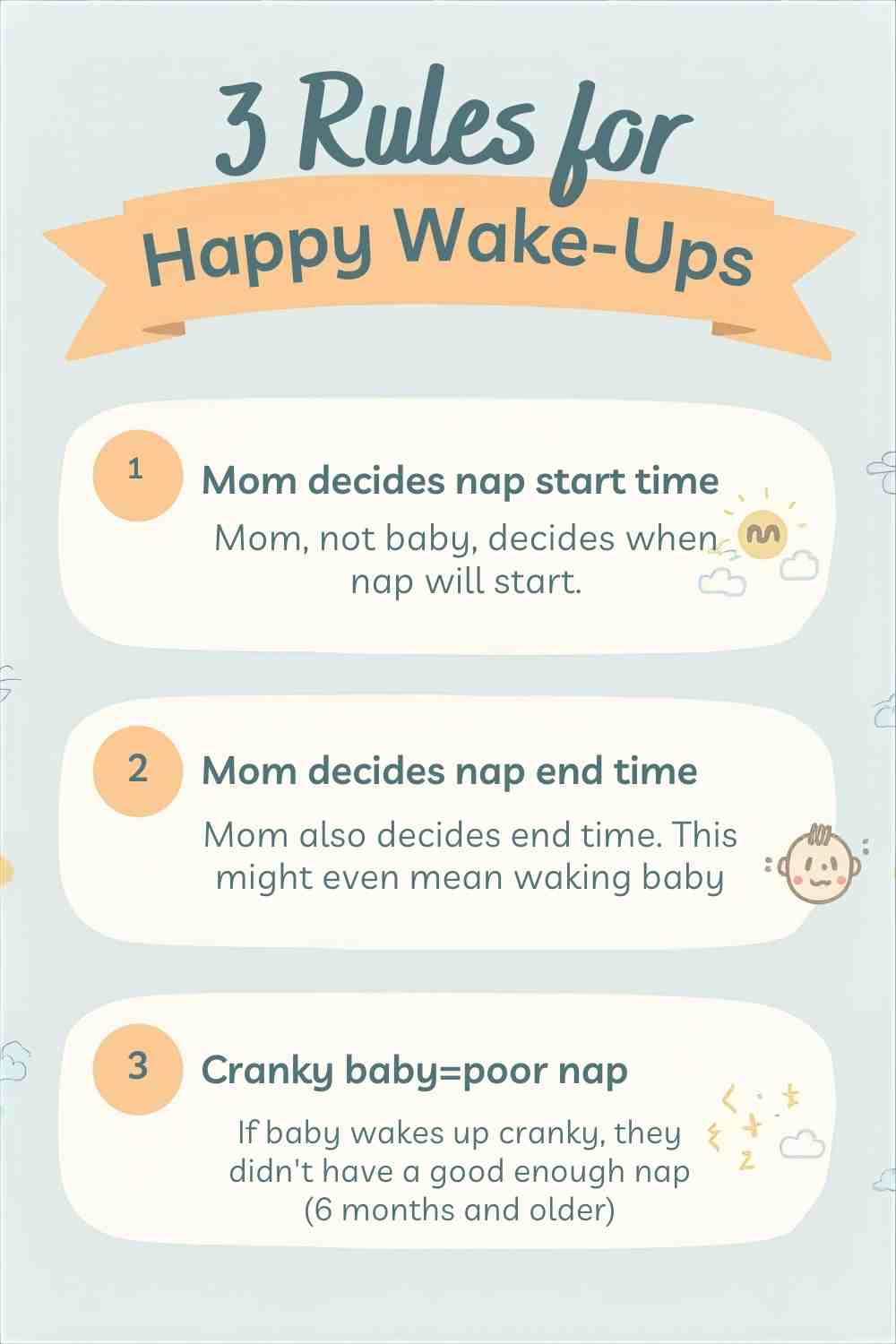
- Mom, not baby, decides when nap will start
- Mom, not baby, decides when nap will end
- If baby wakes up cranky, they didn’t have a good enough nap
Mom, Not Baby, Decides
Before you read any further, be sure you understand the concept of “Mom, not baby, decides…”. Read more about that concept here.
Once you understand the concept of “Mom, not baby, decides…” it should be more clear as to why that is so vital for your baby’s wake up disposition.
This doesn’t mean you say, “I know you aren’t tired right now, but you are going to bed because I decided.” It means that you analyze the factors to ensure your child is getting enough sleep. You say, “Hmm…you aren’t tired right now even though you usually are. Maybe you are ready to extend waketime length?”
In order to “decide” as accurately as possible, you need some tools and abilities. You need to know your child. I have written a post with tips to get to know your child’s personality.
Keeping track of things is a super effective way to quickly get to know your child’s personality and needs. I have a fantastic Book of Logs PDF you can purchase to help you track all of the details you need.

Babywise Mom Book of Logs
Babywise Mom book of tracking sheets to keep track of everything you need to know to get your baby on a fabulous schedule and sleeping well.
This is my Book of Logs PDF. This is invaluable to troubleshooting naps, night, and other problems you encounter with a baby.
When you know your child, you know the sleep cues. You can see a list of common sleep cues in this post so you know what to watch for.
Not all babies show sleep cues. Some show sleep cues while younger and then stop. Paying attention and knowing your baby helps you know that so you can watch the clock.
As the parent, you also know your child’s sleep needs. Does he sleep more than average? Less than average? Adjust expectations and goals according to your child’s sleep needs.
You also know how he feels about sleep. My oldest and youngest both didn’t particularly like to sleep. My two middle girls loved it, though.
With my babies who loved sleep, if they cried after I put them down, I know something is really wrong.
When you know your child, you know how disruptions affect him. You know how extra stimulation affects him. You know whether it is no big deal or if he needs to go down a bit early after being at a big family party.
You also need to know your child’s sleep patterns. Having a consistent schedule makes this job much easier. Read my post on Getting a Consistent Schedule if you need help with consistency and predictability. If you have a hard time hitting things right, keep a log! Write everything down.
You also need to know how long the nap should last. Then, if the nap is shorter than it should be, you can do problem-solving to decide why and what to do about it.
There is variance depending on the baby’s age and which nap of the day it is, but in general, you are aiming for a 1.5-2.5 hour long nap. Later naps in the day are often only 45 minutes long.
And if you want some great help with naps, get my eBook Nap Guide.



Let’s go over each rule with a bit more detail:
RULE #1: Mom, not baby, decides when nap will start
Like I said, this doesn’t mean you put your child down when you feel like it and insist he sleep. This means you consider all factors to know when you should put him down.
- Sleep cues are a wonderful way to know when the nap needs to start. Find sleep cues here and also here.
- Optimal waketime length will help you partner with the clock to guide the length of time until the next nap. This is knowing the perfect length of waketime for your child so she will take the right length of nap and not get overtired. Read all about when and how to extend waketime length here. A log will also help you determine how long this should be.
- Actual waketime length is another good indicator. Knowing when your child woke up from the nap helps you monitor the waketime. If your child wakes up and is pretty quiet, a baby monitor helps to hear those first babbles. I definitely needed one for Kaitlyn.
- Waketime activities are important to some children. If you were at a noisy place, your child might be overstimulated and need to go down earlier. This is another area where keeping a log helps. Read more in How to Calm Your Overstimulated Baby.
- Desired naptime length coupled with the next one,
- Cycle length will help you gauge the waketime length. If you are on a 3 hour schedule and want a 1.5-2 hour nap, then you need 1-1.5 hours of waketime.
These things will all help you decide when the nap should start. When you get this right, baby will [usually] fall asleep quickly and then sleep the correct length of time. Keep in mind that 1.5 hours of sleep is good enough for many babies.
You decide when it starts. If your child protests (which many do; they want to play not sleep), you still decide. You don’t say, “Oh, well I know you really should go down right now, but since you don’t want to, you can stay up an extra 15 minutes and see if you change your mind by then.” At that point, your child will likely be too tired and take a short nap–and therefore wake up early.
At those stages when baby is working on skills or talking and playing instead of going to sleep, you need to address that. Be sure your child is getting enough practice on the skills for waketime. Know if you should interfere or not. Maybe you need to go in and tell him it is time to lay down and go to sleep. Read more about this in How To Stop New Skills from Disrupting Naps and Sleep
RULE #2: Mom, not baby, decides when nap will end
Again, you don’t just say, “I have decided you will sleep for 2.5 hours even though you usually nap for 1.5 hours, so do so.”
No.
You need to consider factors to determine how long your child should be sleeping. Many of them are similar to the previous section.
- Desired naptime length for your cycle length and child’s age will help you gauge the naptime length. If you are on a 3 hour schedule then you want a 1.5-2 hour nap. Again, keep in mind that 1.5 hours is okay. If your child sleeps that long and is happy, don’t fight him to go back to sleep.
- Child’s sleep disposition will tell you which end of the range your child is at. I have had one who was at the shorter end of averages. I have had a couple who were always at the longer end of averages. I have had one pretty average. Know where your child is and what to expect.
- Know when your baby actually wakes up from the nap. A monitor will tell you this. This way you will know for sure if your child woke up happy initially and then started to cry after being awake in his crib for 15 minutes, or if he woke from a sound sleep in a cry. I have to use a monitor to know this.
- If your child wakes earlier than he should, analyze the external factors and troubleshoot the situation. Is your child teething or sick? Was the dog barking? Is your child in a growth spurt? Was he up too long? Is he cold? Really try to find the reason for the early waking so you can know both what to do about it and how to avoid it in the future. See The Complete Guide to Troubleshooting Short Baby Naps and The First 5 Things to Check When Your Baby is Taking Short Naps.
- Be aware of transition time. 30-45 minutes into a nap is the transition time, and your child can be woken up more easily at this time. If the dog was barking during the transition and your child woke up, that is likely the reason. With Brayden, we were always quiet at his transition time. He was so curious that if he heard one sound, he woke fully. Kaitlyn liked to sleep and didn’t seem to care what was going on while she is sleeping (interestingly, we have her in the noisiest bedroom in the house even today because she will sleep through anything). This is another reason I like monitors. You then know the time your child actually fell asleep–or at least have a better idea.
- Wake baby up if necessary. If your child is a sleeper and still asleep when the nap should be over, wake him up. This is part of your decision. Of course, there are times you will decide it is better for him to sleep a little longer. Maybe his previous nap was too short. Maybe he is sick and needs some extra sleep. It is correct to wake up a sleeping baby if needed!
A huge part of nap success day after day is starting each morning off consistently. This is also a time you need to decide to wake your baby up. If your baby is waking early in the morning, read this post.
Struggling to figure out the right wake windows? Get help here.


RULE #3: If baby wakes up cranky, he didn’t have a good enough nap
When your baby wakes up fussy, crying, or irritable from a nap, this is your biggest clue that something went wrong with the sleep cycle. A well-rested baby naturally wakes up happy, calm, and ready to engage.
Why Babies Wake Up Cranky: Common Causes
Sleep Cycle Interruption: Babies go through 45-minute sleep cycles. If your baby consistently wakes at exactly 30-45 minutes crying, they’ve likely woken during the transition between sleep cycles but couldn’t resettle themselves.
Insufficient Total Sleep: Even if your baby slept for 45 minutes without waking, this might not be enough total sleep for their age and developmental needs. Most babies need 1.5-2.5 hours per nap in the first year.
Waketime Was Too Long: An overtired baby has elevated cortisol levels that make quality sleep harder to achieve. They may fall asleep from exhaustion but wake up still tired and cranky. Watch for the optimal wake window for your baby’s age.
Waketime Was Too Short: Surprisingly, a baby who wasn’t tired enough won’t achieve deep, restorative sleep. They may doze lightly and wake up unrested.
External Disruptions: Noise during the sleep transition (30-45 minutes in), temperature changes, teething pain, hunger, or wet diapers can all cut naps short.
What To Do When Baby Wakes Up Cranky
First, determine if this is a pattern or a one-time event. Use your log to track naps for 3-5 days.
For One-Time Cranky Wake-Ups: Comfort your baby, check for immediate needs (diaper, hunger, temperature), and continue with your schedule. Everyone has an off day.
For Consistent Cranky Wake-Ups: Troubleshoot systematically:
- Check wake windows: Is your baby awake too long or not long enough before naps? Adjust by 10-15 minute increments. You might even need to adjust by just 5-minute increments.
- Evaluate sleep environment: Is the room dark enough? Is white noise consistent? Is temperature comfortable (68-72°F is ideal)?
- Review the pre-nap routine: Do you have a consistent wind-down that signals sleep time? Even a simple 5-minute routine helps.
- Consider developmental factors: Is your baby working on a new skill (rolling, sitting, crawling)? Give extra practice time during wake periods.
- Look for physical causes: Teething, illness, growth spurts, or discomfort can all affect nap quality.
The 30-45 Minute Intruder Solution
If your baby consistently wakes crying at 30-45 minutes, try these strategies:
- Give them 5-10 minutes to resettle on their own before intervening
- Ensure the sleep environment stays consistent (don’t let white noise turn off at 30 minutes)
- Practice independent sleep skills during the day when baby is awake
- Consider shortening wake time by 10-15 minutes so baby is sleepier when going down
Age-Specific Cranky Wake-Up Considerations
0-3 months: Cranky wake-ups are more normal during this phase. Focus on meeting needs and establishing routines rather than perfect naps.
4-6 months: This is when happy wake-ups should start to happen. If they’re not happening by 6 months, actively troubleshoot.
7-13 months: Cranky wake-ups at this age often signal schedule changes needed (dropping a nap, adjusting wake windows, earlier bedtime).
Over 14 months: Consider if your toddler is ready to transition from two naps to one.
The key principle: A cranky wake-up is valuable feedback from your baby that something needs adjusting. Don’t accept it as “just how my baby is”—investigate and solve.
If your baby is well-rested, he will wake up and be happy initially (older than 6 months old). He will wake up and babble or sing or whatever. Some will do that for a long time before you go get him. Others are less patient and will soon start to scream for you.
If your child is waking up early, you need to decide what to do about it. See these posts for help in that decision:
- What to Do When Baby Wakes Early From Naps or Won’t Fall Asleep For Naps
- Easy Nap Fix
- Everything You Need to Know About Dropping Naps
- Waketime When Baby Wakes Early
- Comforting a Sick Toddler/Baby and Maintaining the Schedule
- Dealing With Disruptions To Your Routine
- How To Stop New Skills from Disrupting Naps and Sleep
Common Mistakes Parents Make
Here are some common mistakes parents make that contribute to their baby NOT waking up happy.
Mistake #1: Rushing in at the First Sound
Many parents hear one peep on the monitor and immediately rush to the nursery. This teaches baby that any noise gets instant attention and prevents them from learning to self-soothe back to sleep or entertain themselves upon waking.
Better approach: Wait 2-5 minutes when you hear stirring. Many babies will resettle or wake fully and play contentedly.
Mistake #2: Assuming Crying Means Baby Needs to Get Up Immediately
If your baby cries 20 minutes into a 90-minute nap, getting them up reinforces short naps.
Better approach: Give them 10 minutes to resettle. If still crying, check for needs, then use your judgment based on the situation.
Mistake #3: Inconsistent Nap Start Times
Starting naps at 10:00 one day, 10:45 the next, and 9:30 the day after confuses baby’s biological clock.
Better approach: Aim for consistent nap start times with a 15-30 minute window. Use wake windows as a guide but watch the clock too.
Mistake #4: Skipping the Pre-Nap Routine
Going from high-energy play straight to the crib doesn’t give baby time to wind down.
Better approach: A simple 5-10 minute routine (diaper change, sleep sack, song, cuddle, lay down) signals that sleep is coming.
Mistake #5: Accepting ‘Cat Naps’ as Normal After 4 Months
Many parents think 30-40 minute naps are just their baby’s pattern.
Better approach: If baby is cranky after these short naps, they need more sleep. Actively work on extending naps rather than accepting them.
Tools to Help You Succeed
Here are some essential tools for tracking happy wake-ups:
- Baby Sleep Log: Track nap start time, how long to fall asleep, wake time, disposition upon waking, and any disruptions. Pattern recognition is powerful. Get my logs here!
- Video Baby Monitor: Helps you distinguish between “just waking up” sounds and “needs help” crying. You can also see if baby is playing happily before you go in.
- Wake Window Chart: Print and post by the changing table so you remember optimal awake times.
- Room Darkening Shades: Light exposure affects nap quality. Invest in truly blackout curtains.
- Quality White Noise Machine: Should run continuously, not on a timer. Look for options with consistent sound that don’t have obvious loops.
- Consistent Sleep Sack: Creates a “sleep uniform” that signals nap time to baby’s brain.”
Conclusion
Hopefully through this post and “Mom, not baby, decides…” you can see how so many things for successful sleep are intrinsically connected. So many things are linked and a domino effect quickly happens, for better or worse.
Following these three rules can help you to help your baby wake up from nap or in the morning happily. This is a great sign that your baby is getting the sleep he needs and that everything is optimal.
Frequently Asked Questions
Q: My baby wakes up happy from some naps but not others. What does this mean?
A: This is normal! Different naps have different qualities. The first nap of the day is often the best because baby is most well-rested. Late afternoon naps are typically shorter and may have fussier wake-ups. Look for consistency within each individual nap (i.e., first nap should consistently be happy).
Q: Should I get my baby as soon as they wake up happy?
A: Not necessarily! If your baby is content, it’s perfectly fine to let them have 10-15 minutes of quiet time in the crib. This teaches independent contentment and gives you time to finish what you’re doing. Just don’t let them progress to crying.
Q: My baby plays for 20 minutes after waking, then starts crying. Did they wake up happy?
A: Yes! They woke up happy. The crying 20 minutes later means they’re ready to get up. That’s your cue to end the nap. Try to get your baby before the crying starts so you can reinforce that waking up happy is a good thing and that crying is not required to get out of bed.
Q: Can sleep training help with cranky wake-ups?
A: Yes, if your baby doesn’t know how to fall asleep independently. Babies who need assistance to fall asleep often can’t transition between sleep cycles or resettle when they wake up. Independent sleep skills support better quality naps.
Q: Will my baby always wake up happy once this is established?
A: Mostly, yes! But expect some flexibility. Teething, illness, travel, developmental leaps, and schedule transitions can temporarily disrupt happy wake-ups. Once you’ve established good sleep habits, you’ll bounce back quickly after disruptions.
Q: Is waking up happy related to night sleep?
A: Absolutely! Babies who get quality daytime sleep almost always sleep better at night. Remember: sleep begets sleep. A well-rested baby from good naps will have better nighttime sleep, and good nighttime sleep supports better naps.”
Reader Questions
Wendy asked: Hi, this is Wendy from Dallas. I’ve been reading this blog for over a month now and has been really a blessing. Now my son is 3.5 months old. Sometimes he wakes up happy. But almost often, he is not. And I still need to wake him up ALL the time. Bottle feeding – 6oz each/6 feedings. We’re still feeding every 3 hours. An hour of wake time and 2 hours of sleep. But he doesn’t like it when I wake him up for another feeding. He has 3 nap times. But he’s cranky on the should be 4th around 5-6pm so I just use that time to give him a bath and more reading/playing time. His bed time is 7:30 where I put him to his crib and sleeps until 7AM. Thank you so much.
Babywise Mom said: Wendy, for most babies, waking happy really doesn’t happen until 5ish months, so I wouldn’t worry about it.It is possible he is ready to move to a 4 hour schedule, or perhaps a 3/3.5 or 3/4 (and everything in between).
Wendy said: Hi! Yes you are right! He is so ready to move to a 4 hour schedule. We’ve been doing it for almost two weeks now and it’s great for both of us. Blessings for you and your family!
This post first appeared on this blog in 2008